A stone wall of rounded stones, with a wall of crisp, perfectly squared corners right next to it. Stone walls from different eras really do look this different… I spent my whole visit to Okayama Castle comparing them. With the rain coming, going, then coming back again, I even got to meet stone walls that had been sleeping underground. As always, today was the best.
🗺️ See the route I walked in photos → Castle Hopping: Okayama Castle Route Map (October 2026)
What Kind of Castle Is Okayama Castle?
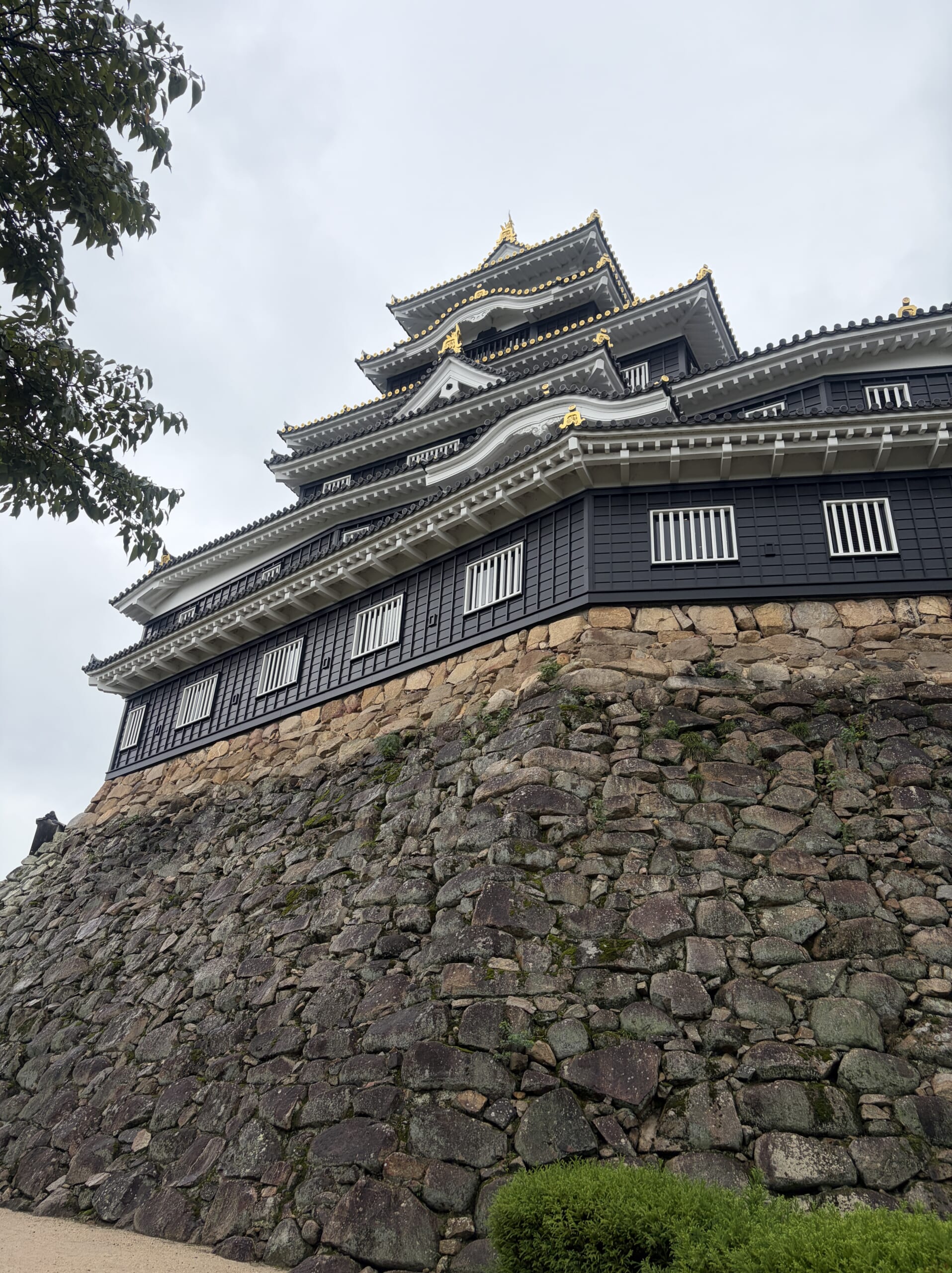
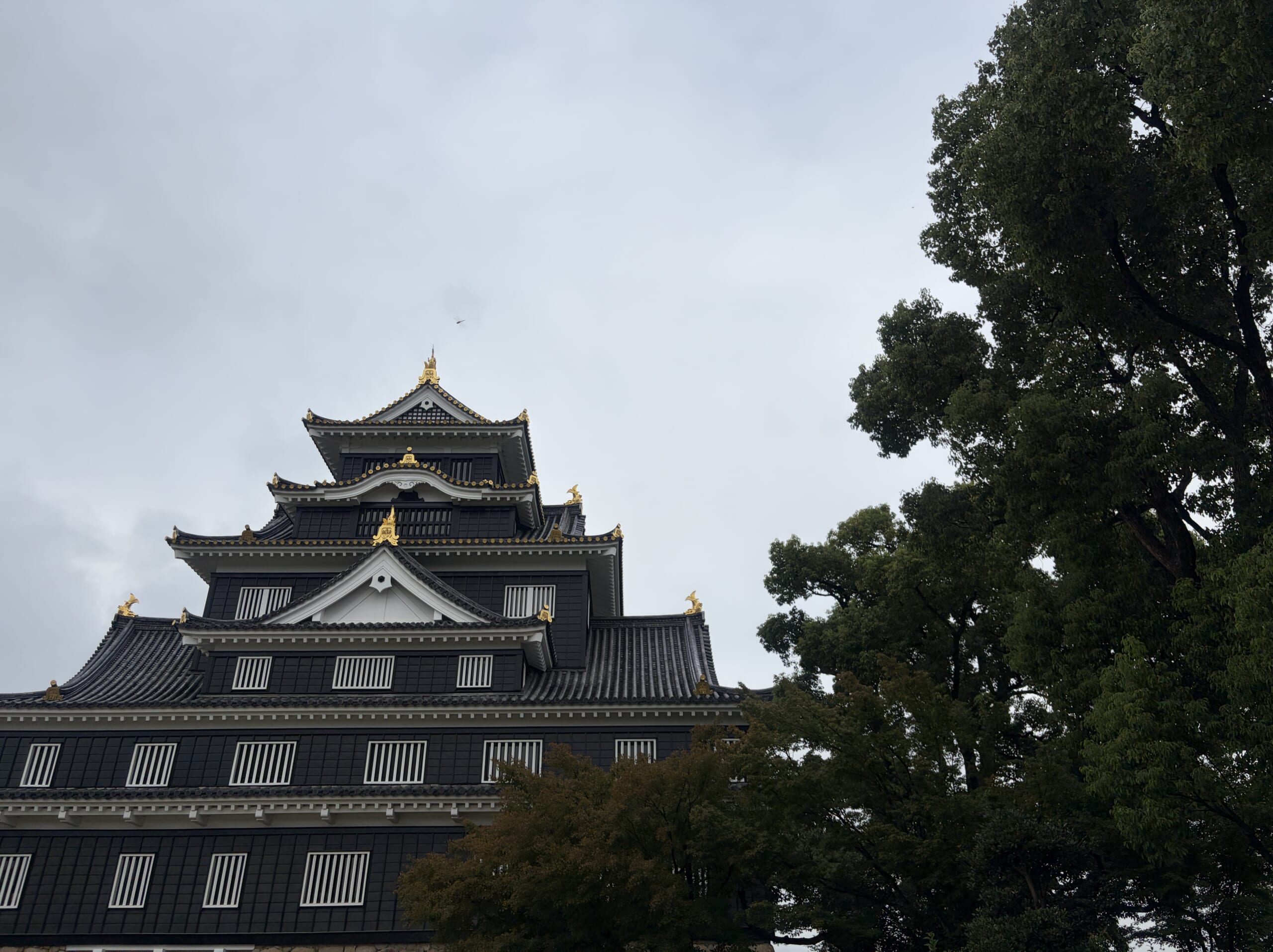
Okayama Castle was built around 1597 by Ukita Hideie, one of the Five Elders of the Toyotomi government. Thanks to its black wooden-board exterior, it’s also known as Ujō, the “Crow Castle”. The original keep burnt down in the war; the keep you see today is a 1966 reconstruction.
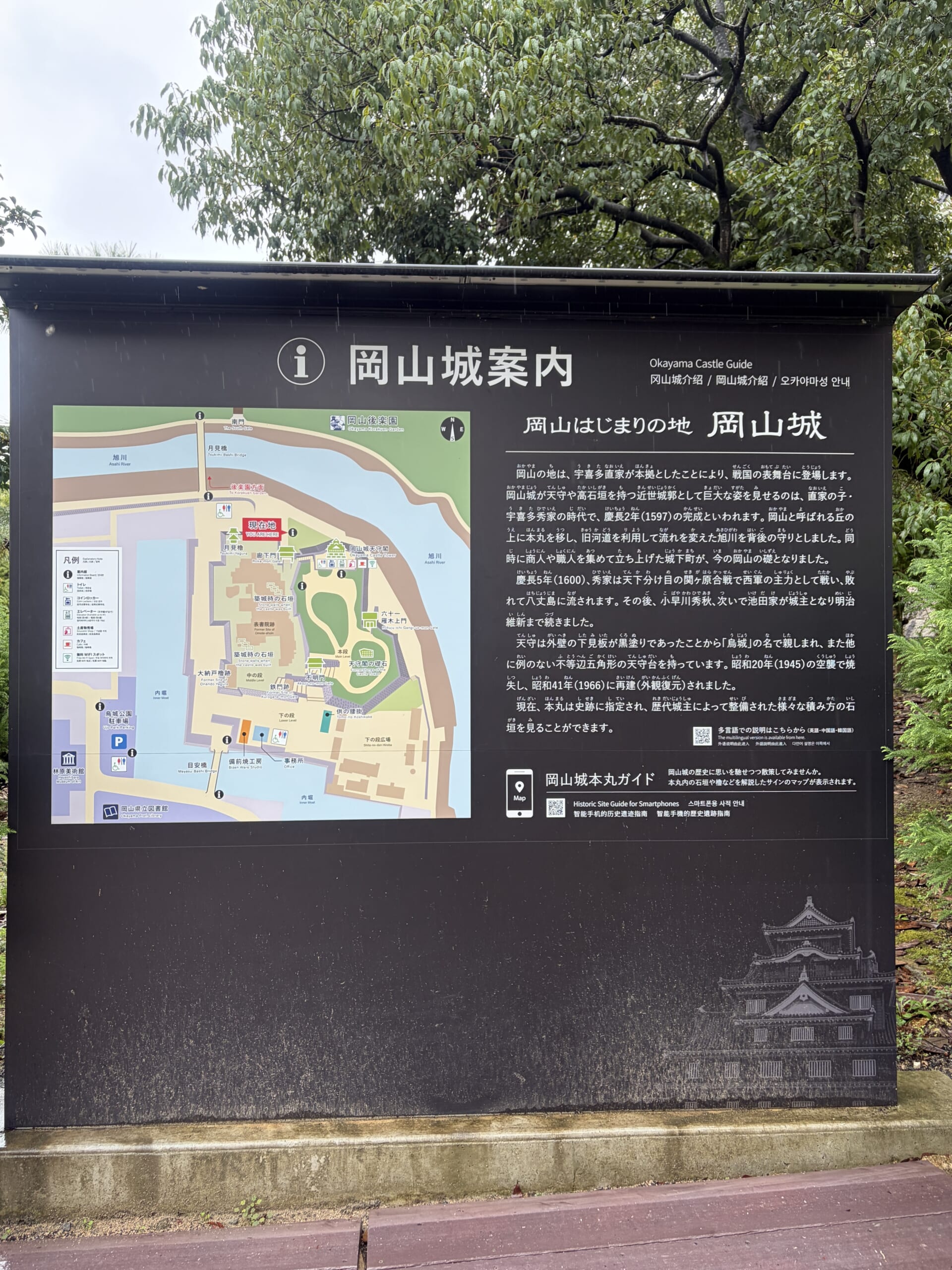
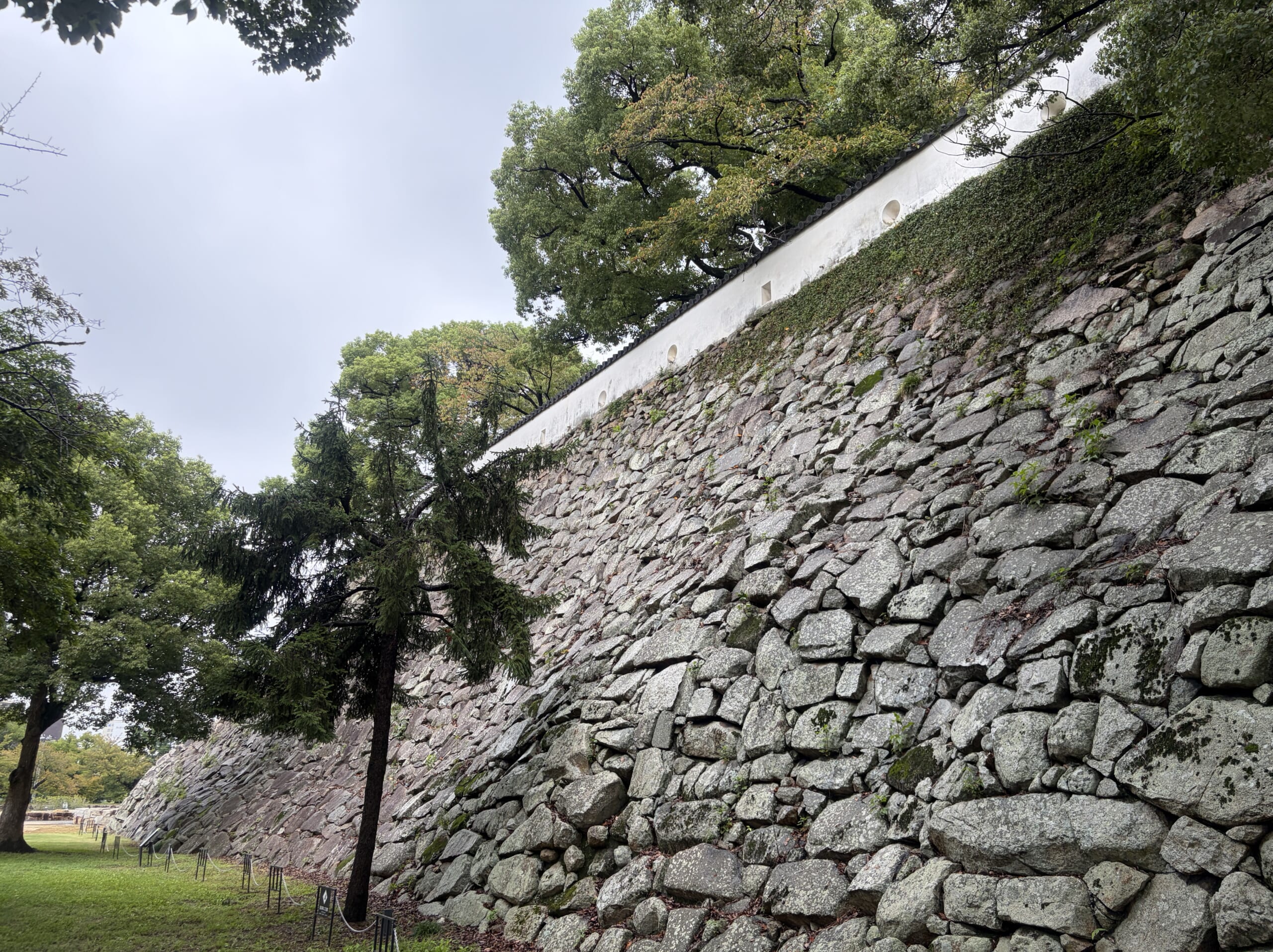
The Honmaru (main enclosure) is divided into three levels: the Hondan (Main Level), where the keep stands; the Naka-no-dan (Middle Level), home to the Tsukimi Yagura (Moon-Viewing Turret); plus the Shimo-no-dan (Lower Level) surrounding it. Every time a new lord took over, the castle was expanded here, reinforced there, so the way the stones are stacked differs from place to place. A sign on site even said Okayama Castle is called a “museum of stone walls”.
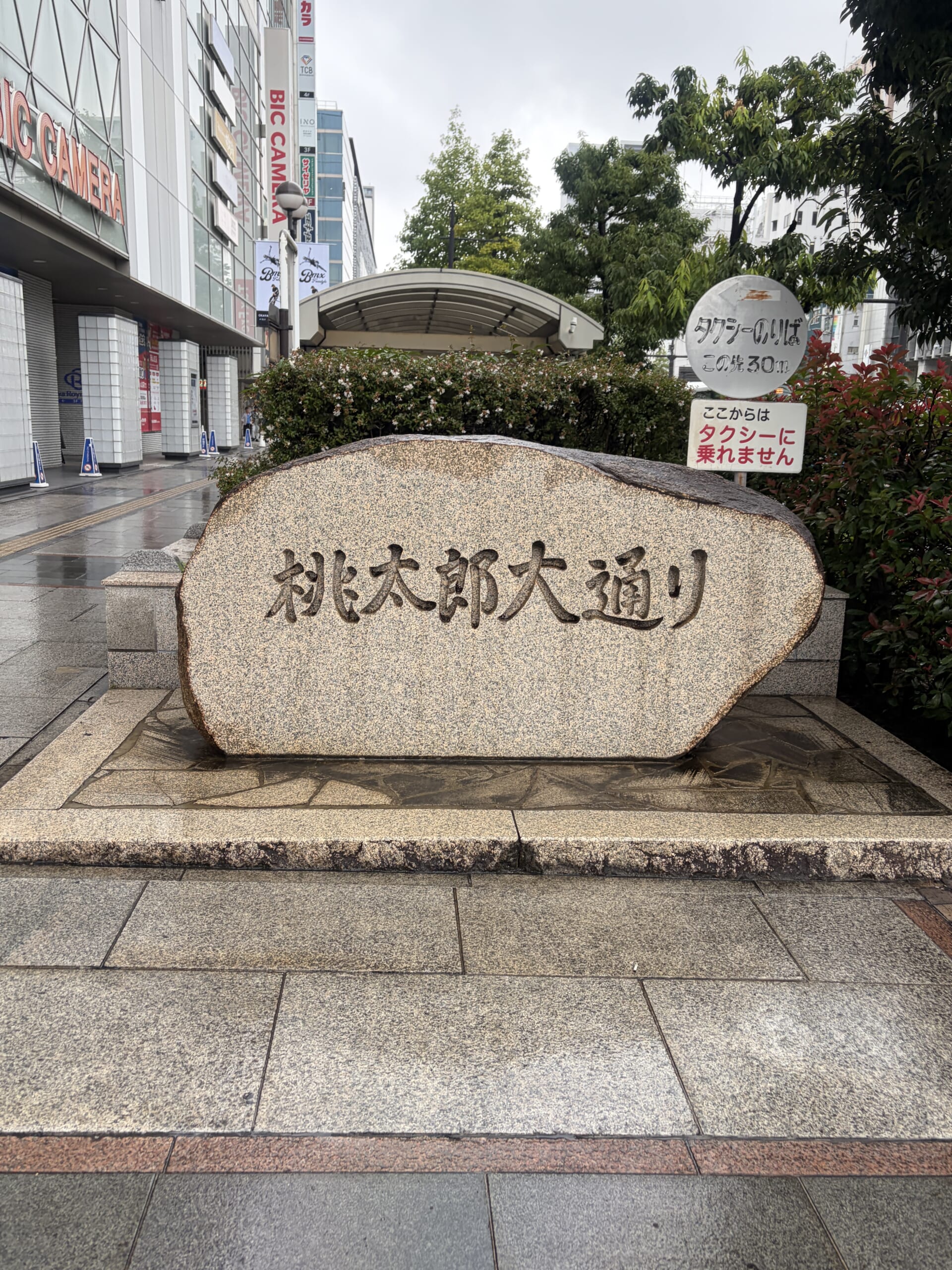
Taking the Tram to Okayama Castle
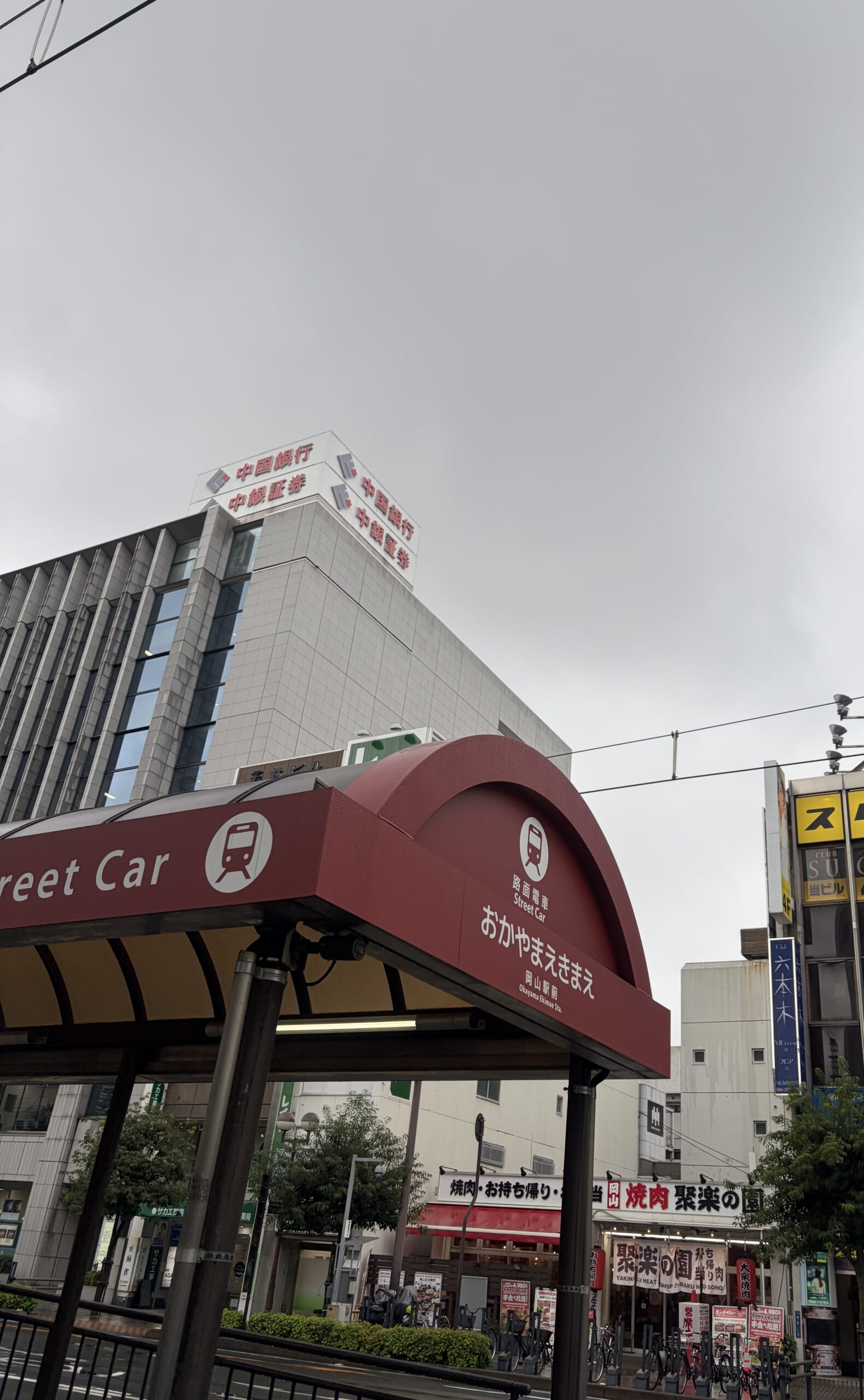
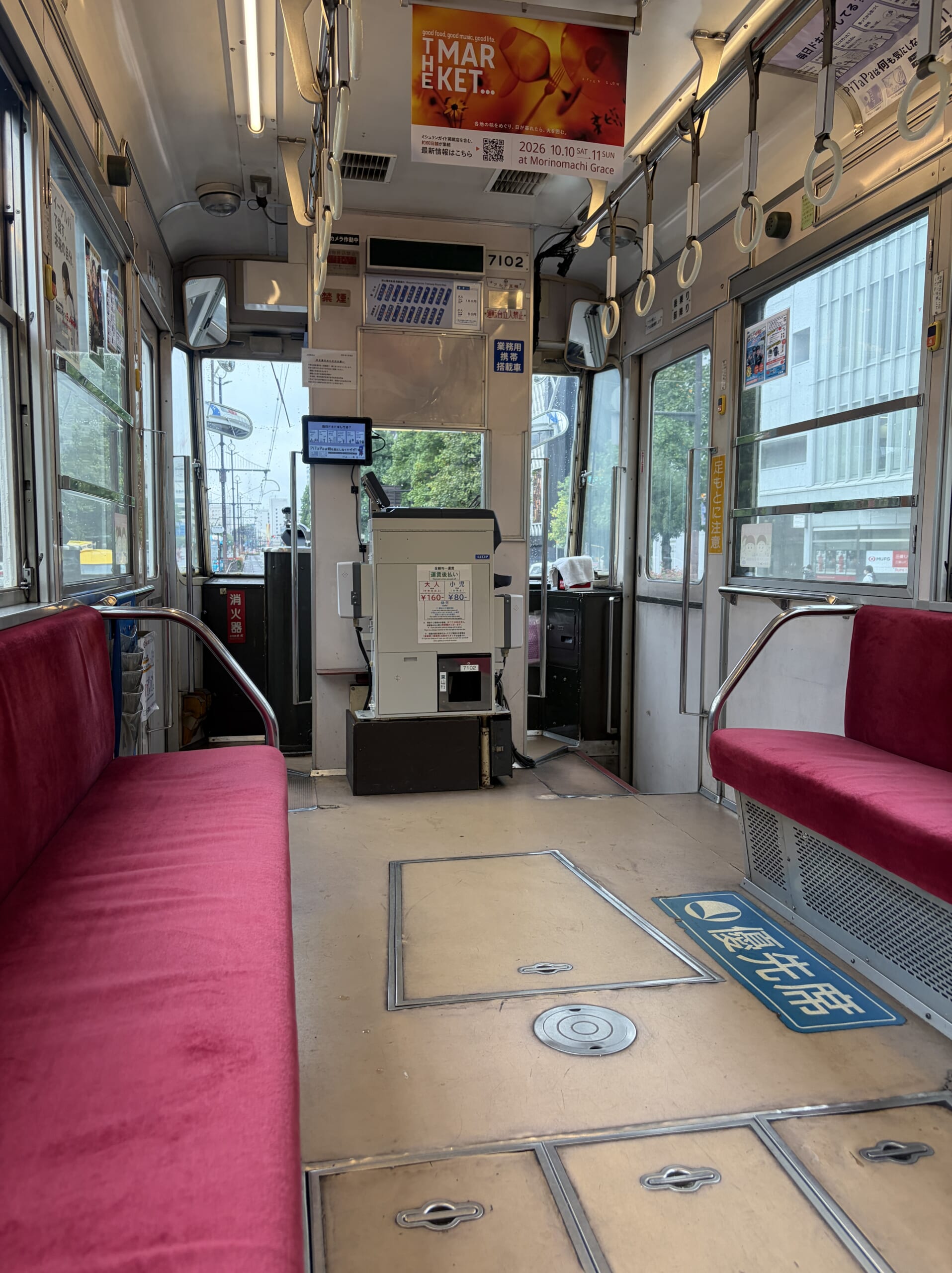
I headed off by tram from Okayama Ekimae. Since Okayama Ekimae is the first stop on the line, you could get on at the front door as well as the back. At the other stops, you get on at the back, then get off at the front. With an IC card, you tap it when you get on, then tap it again when you get off. That’s all there is to it.
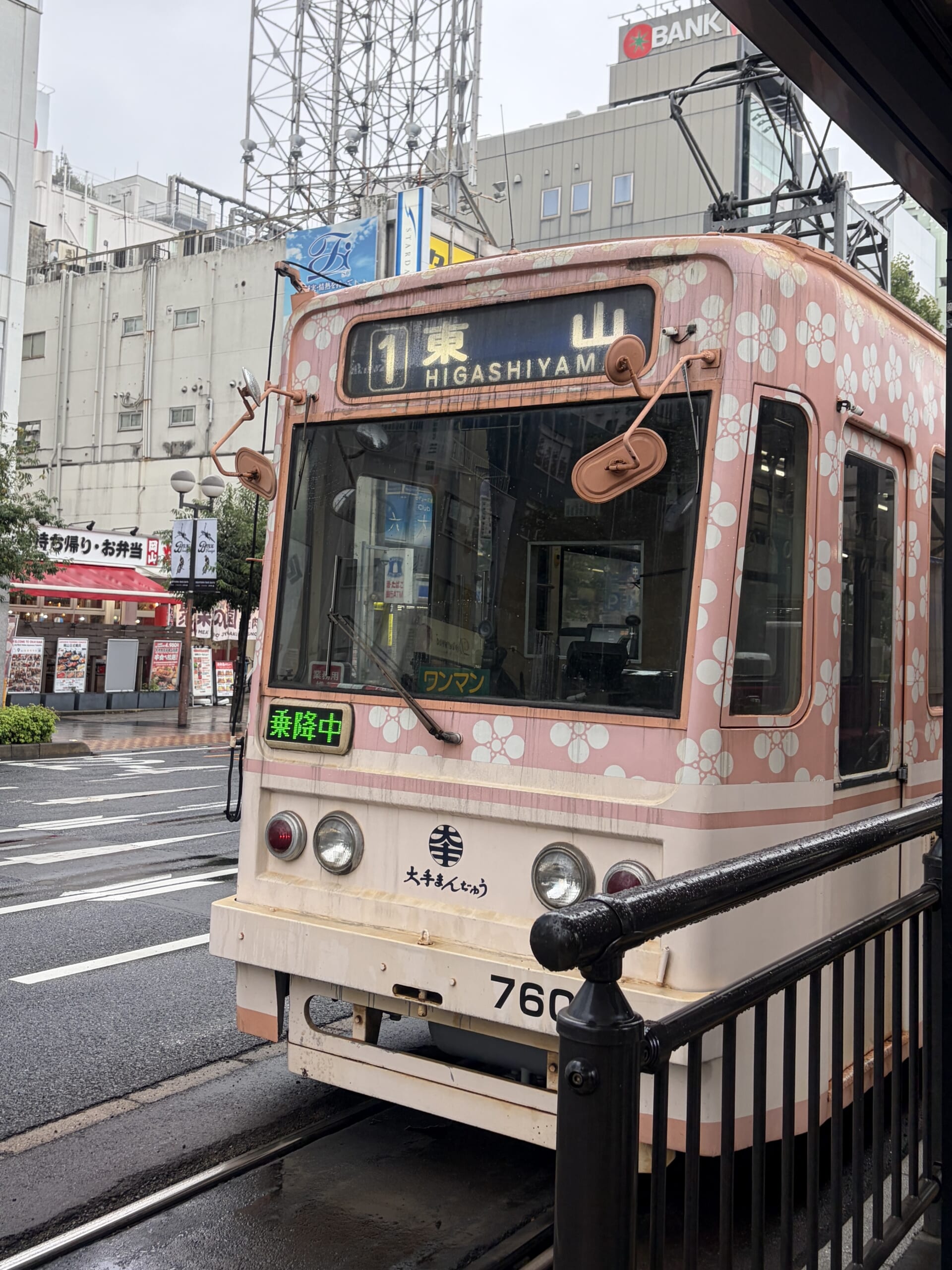
The tram that pulled in was pink with a floral pattern. So cute 🌸
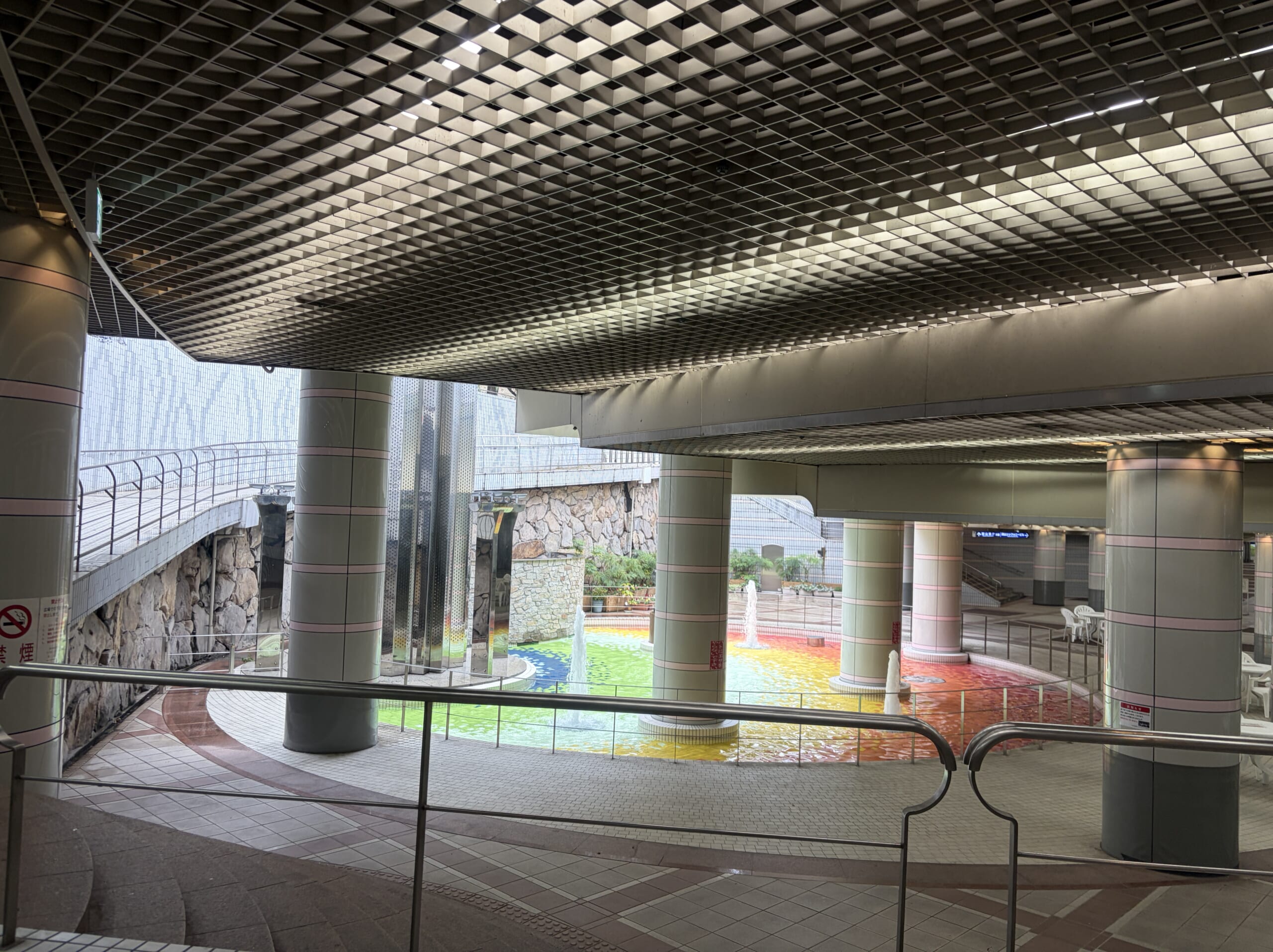
I got off at Shiroshita, walked through the underground passage known as “Shirochika”, then headed towards the castle. It was cloudy, with rain on top — it kept starting, then stopping. I walked on, opening my umbrella, closing it, opening it again.
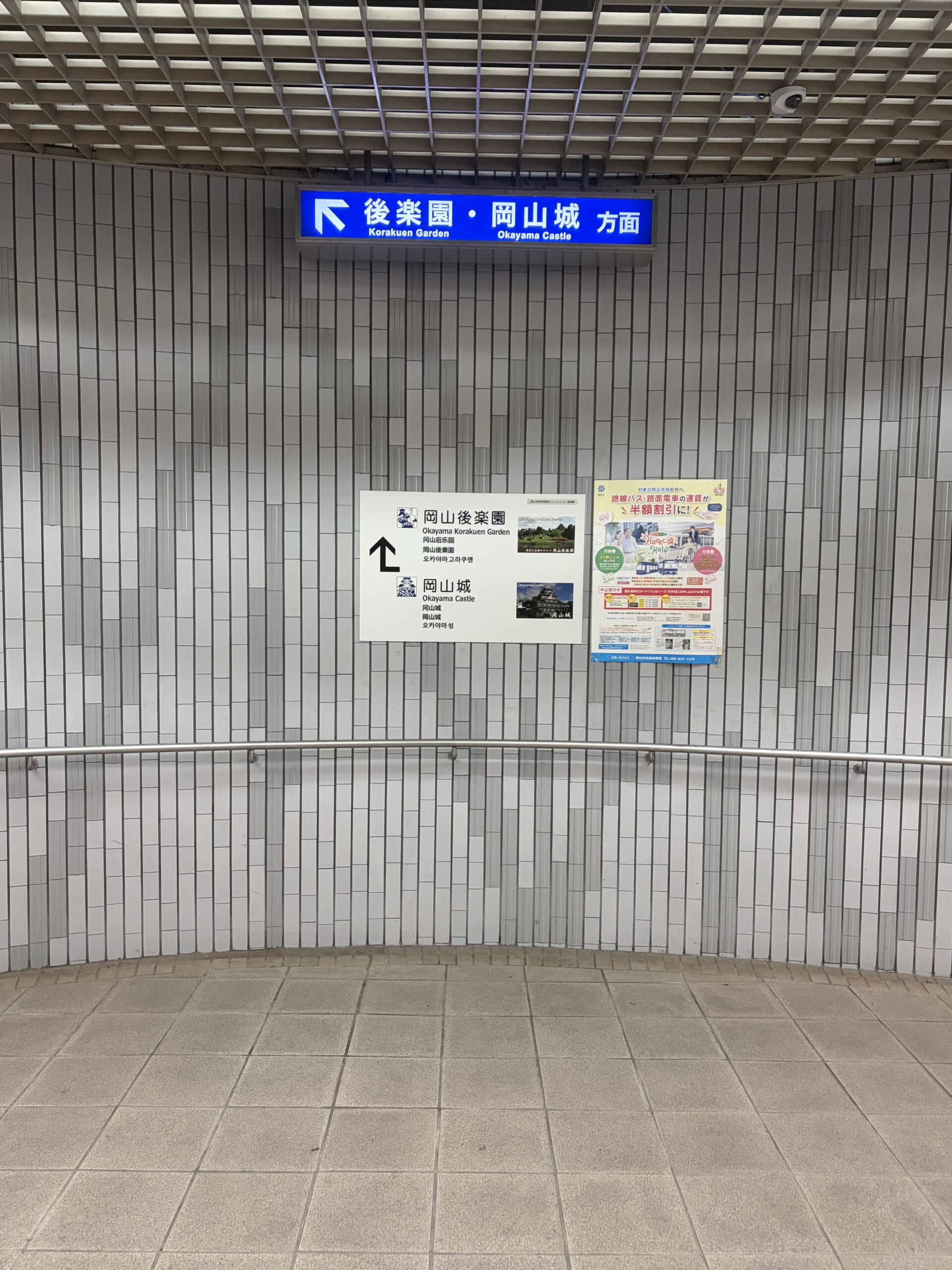
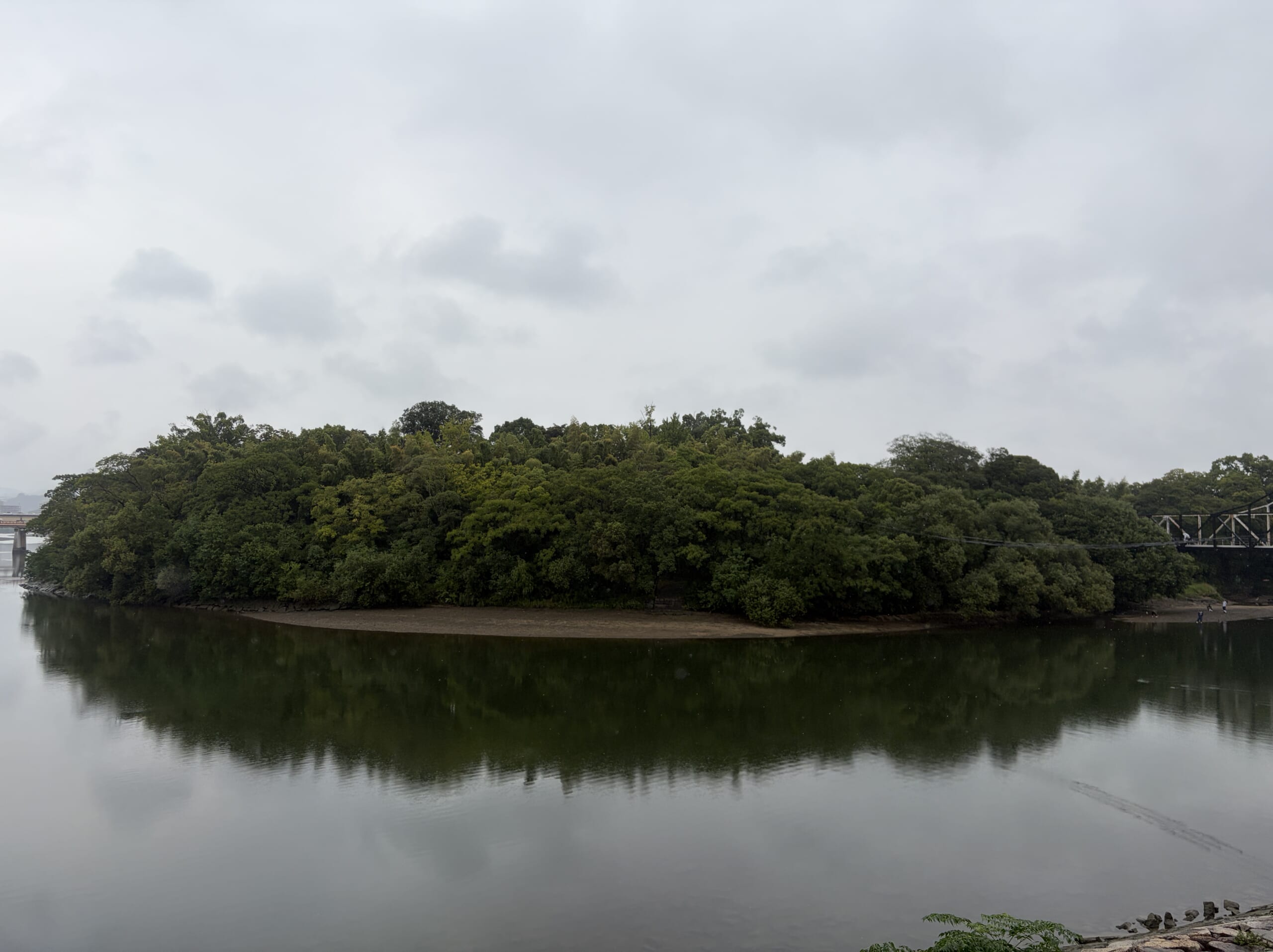
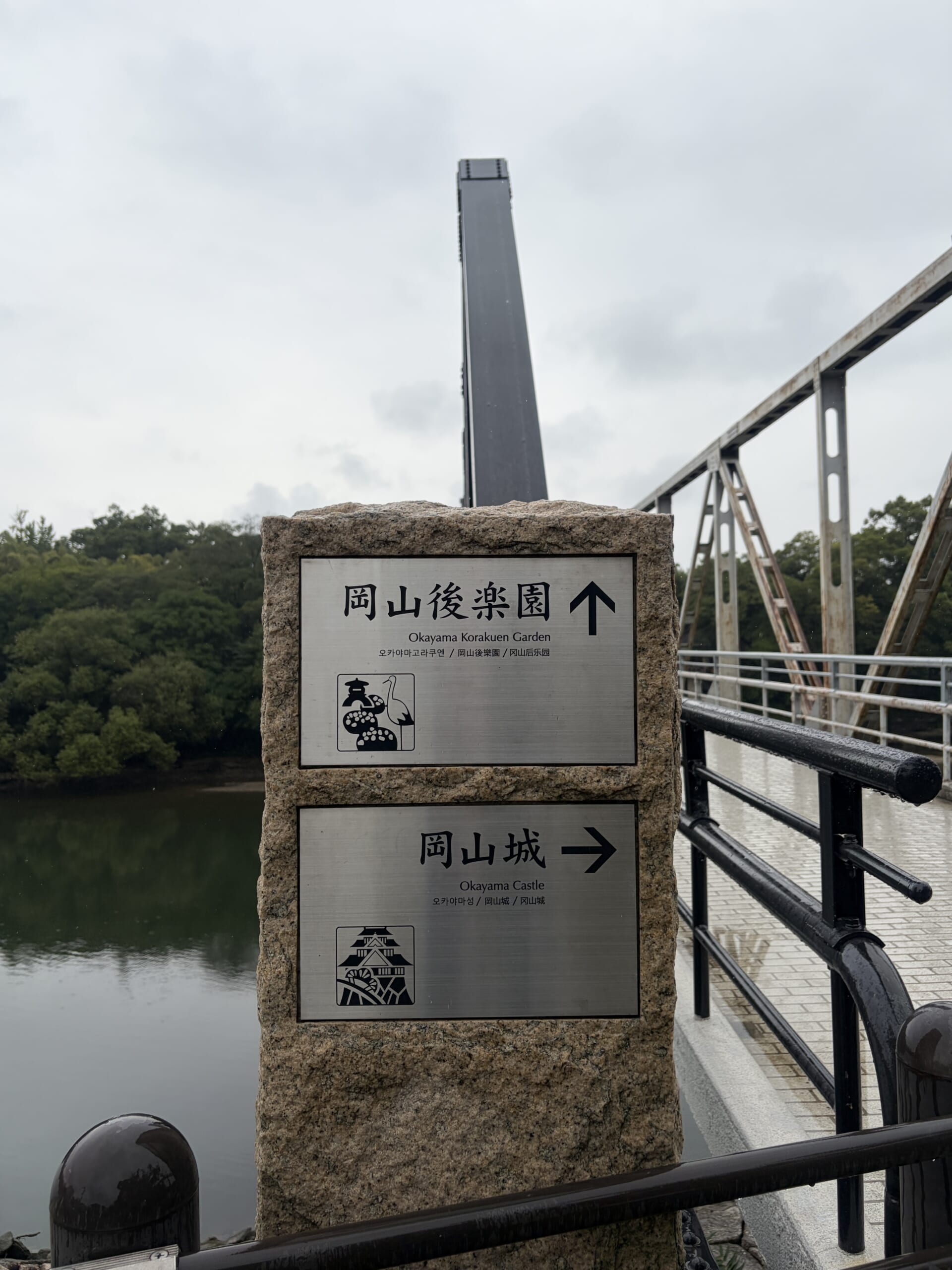
When I came out by the river, Korakuen Garden was right across the water. The reflections on the river were beautiful. At the fork where the way to Korakuen Garden splits off, I turned right for Okayama Castle today.
I Could Look at Stone Walls Forever
Stones from Inujima, Plus Stonemasons’ Marks I Couldn’t Find
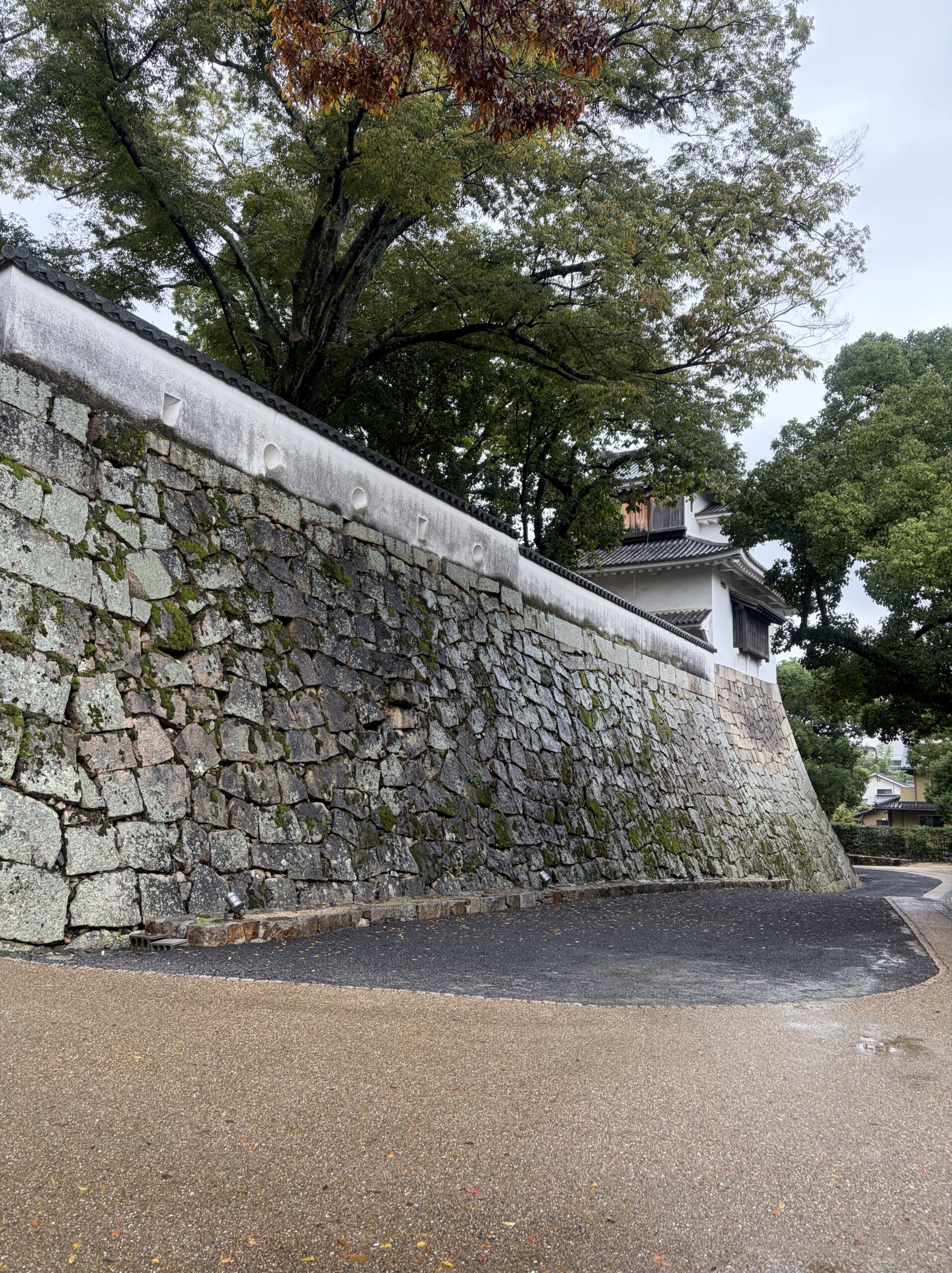
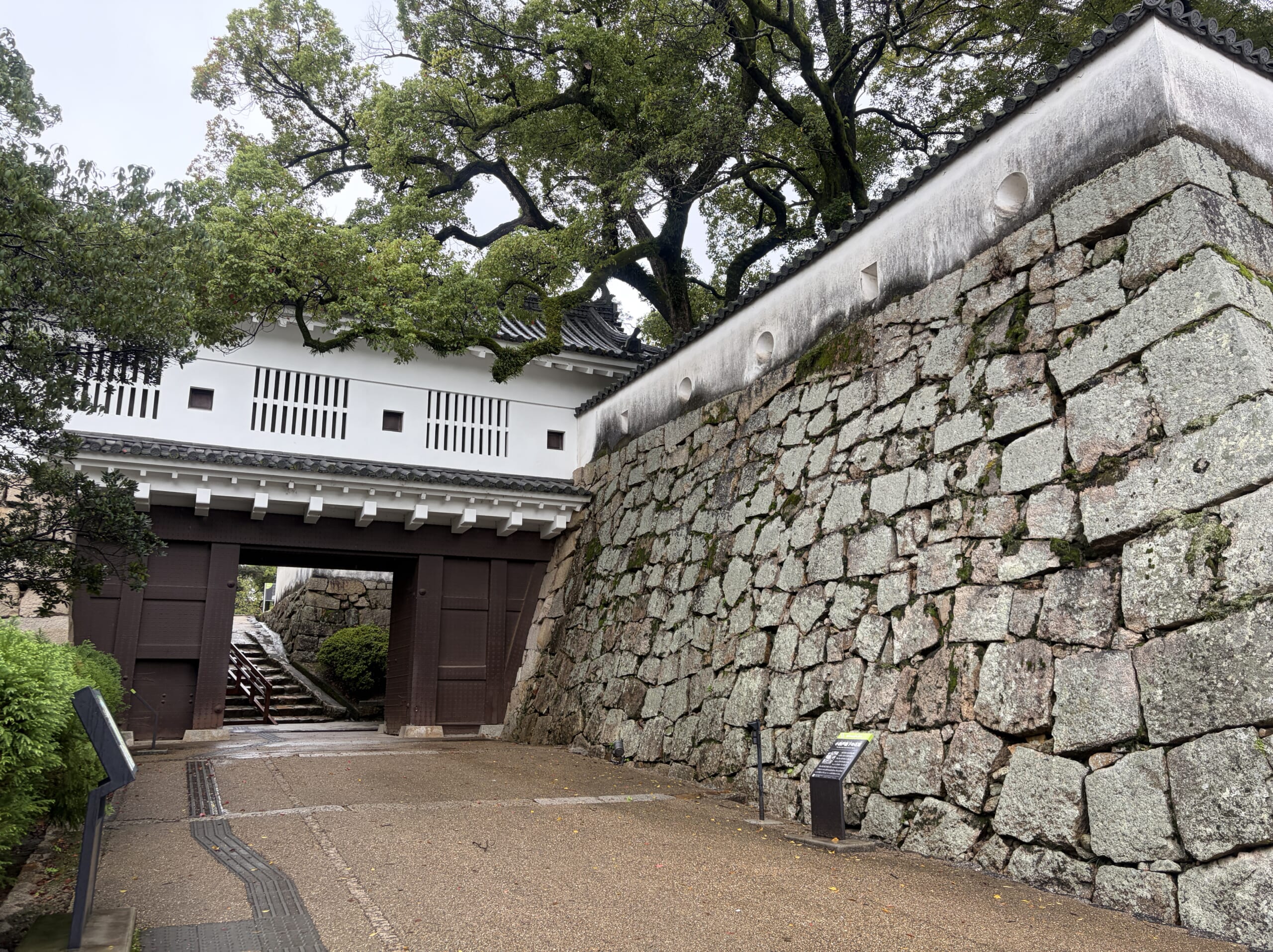
Running from the Rōka Gate (Corridor Gate) to the Tsukimi Yagura is the stone wall below the Konando Yagura. According to the sign, it was built with stones thought to have been quarried on Inujima, an island in the Seto Inland Sea, with kokuin (stonemasons’ marks) to be found too.
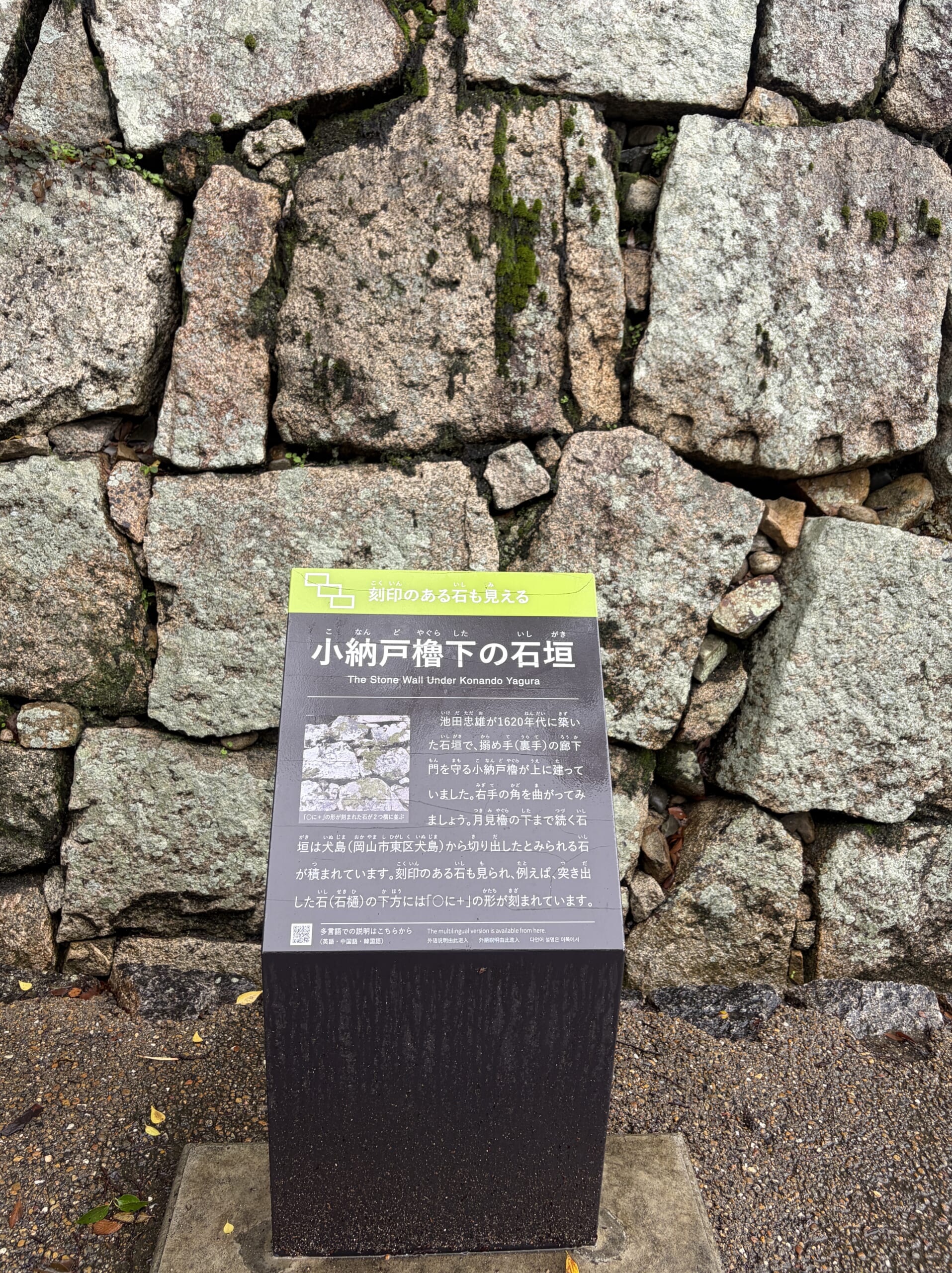
They’re from Inujima!!!!! I got all excited on my own, then went looking for the marks… but couldn’t find a single one.
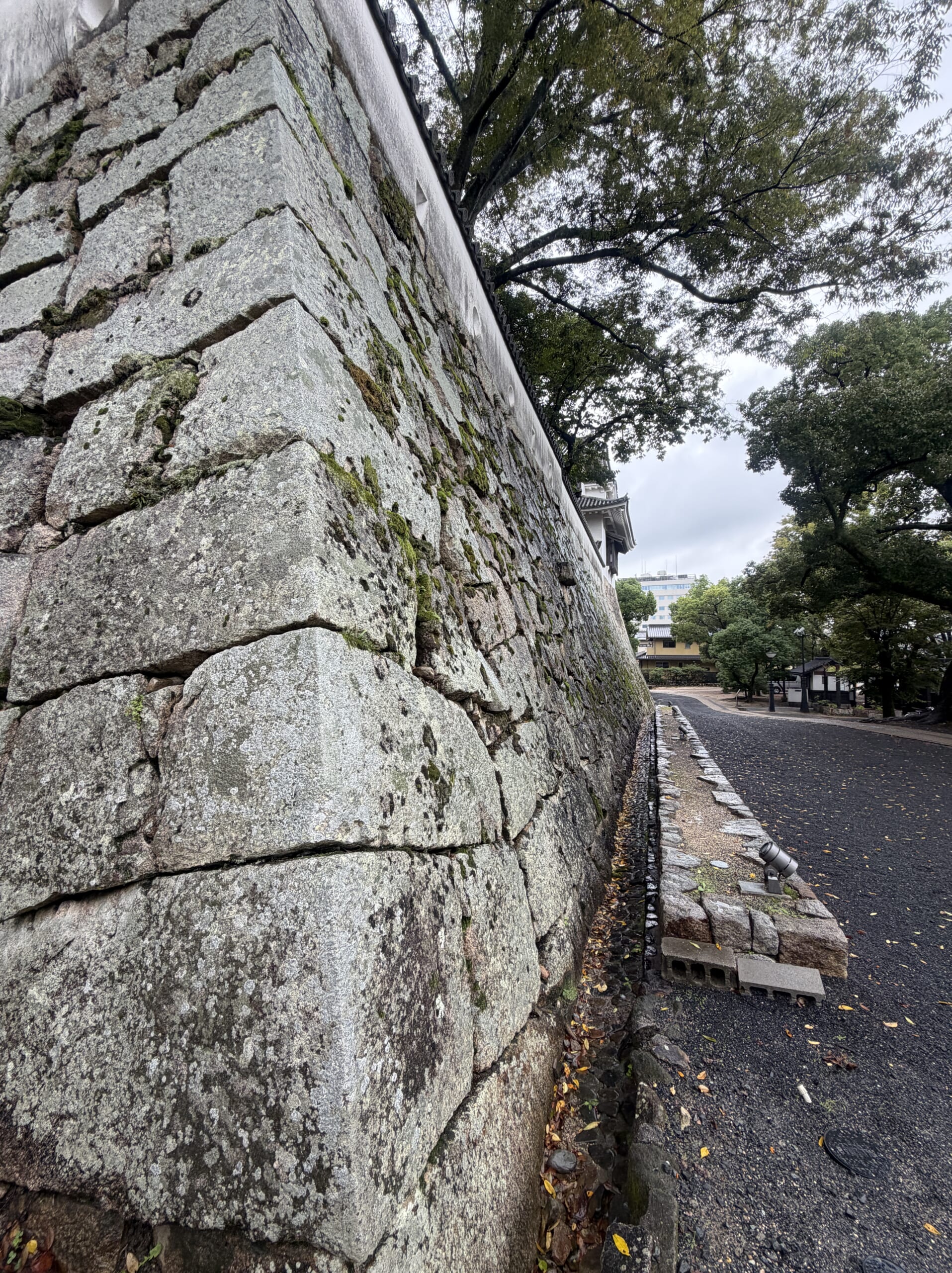
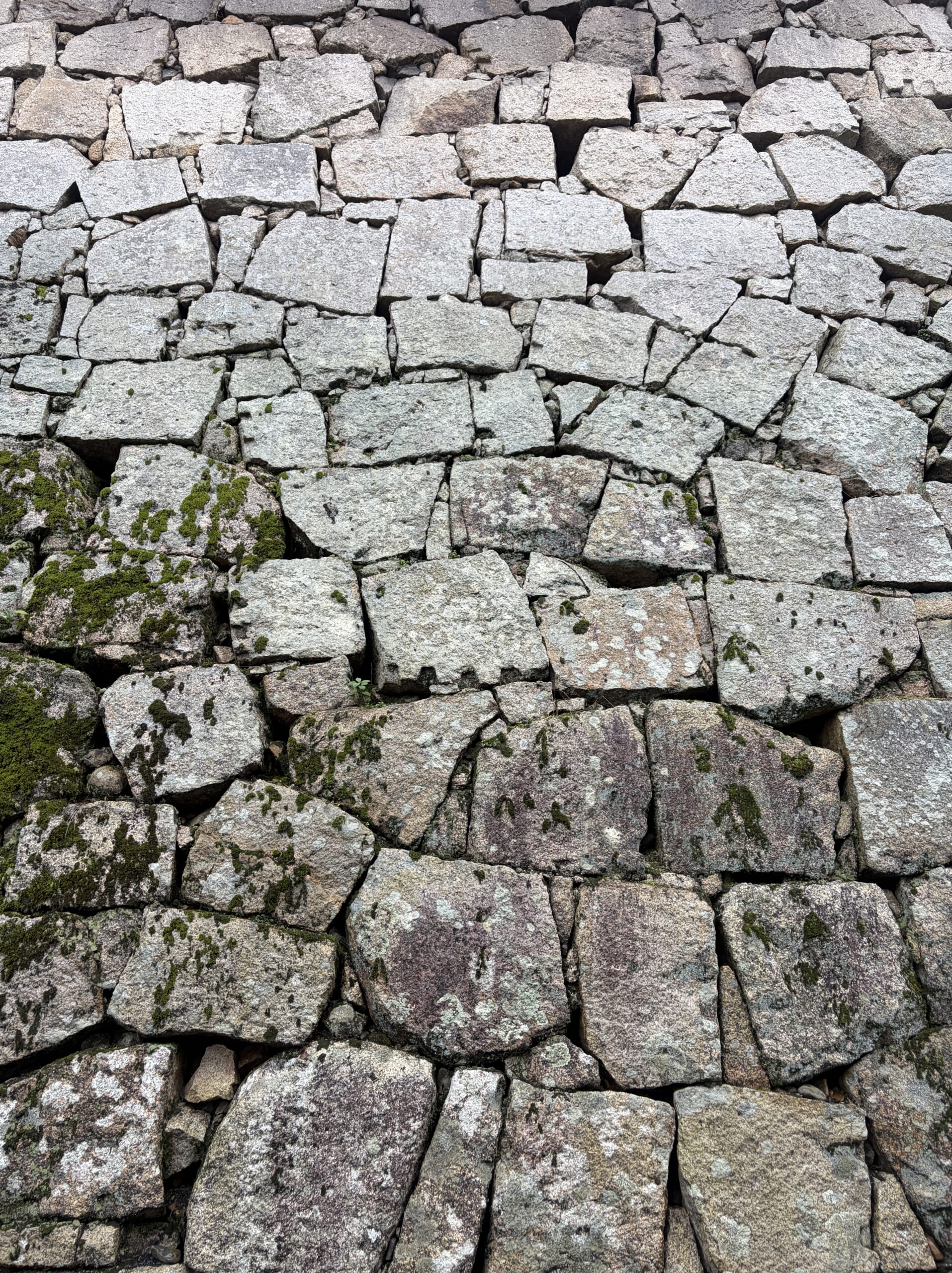
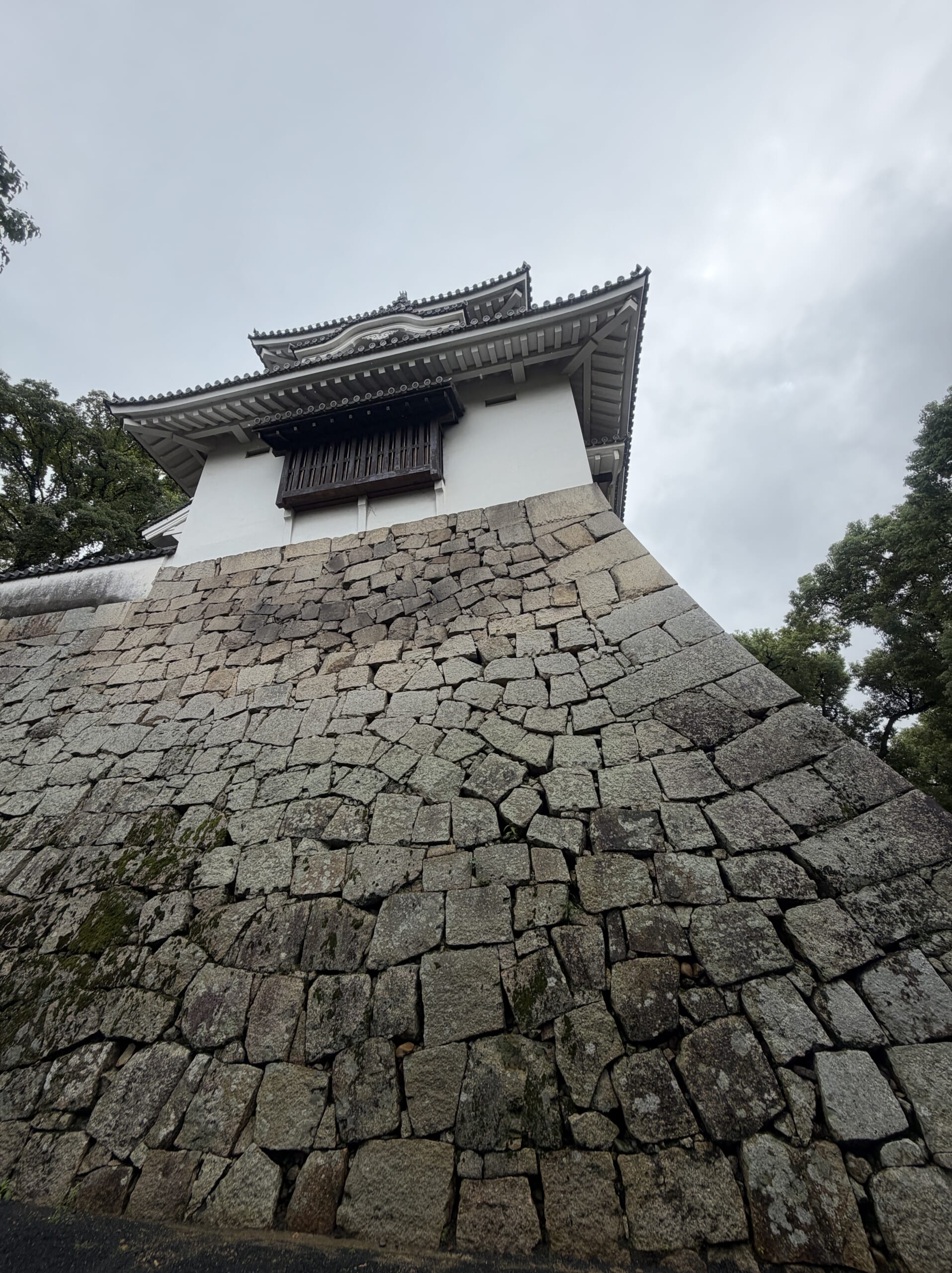
Even so, I never get bored staring at the shapes of the stones, the way they fit together. I could look at stone walls forever. Up on top of the high stone wall stands the Tsukimi Yagura. It’s a genuine turret built in the 1620s, designated as an Important Cultural Property of Japan.
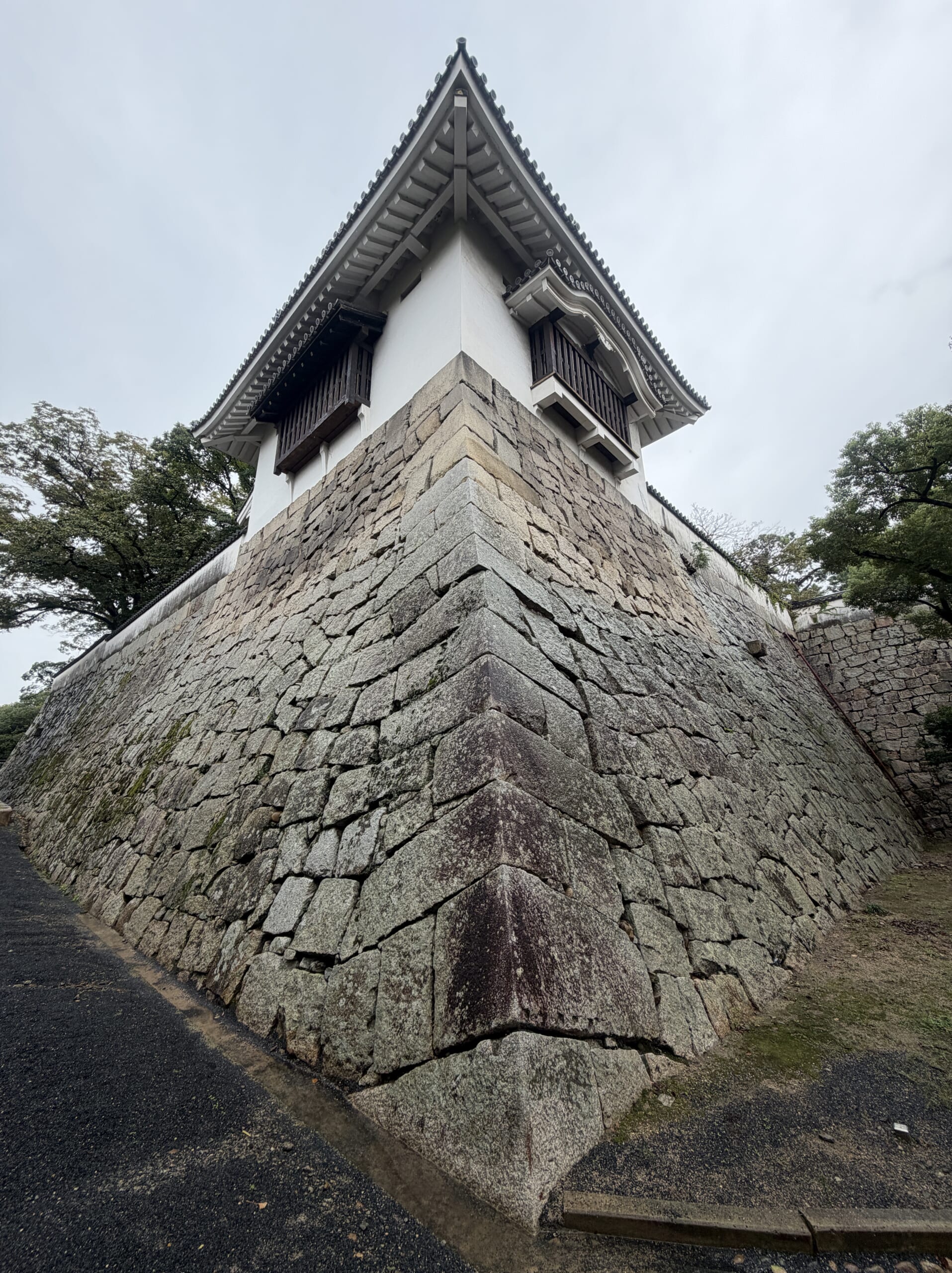
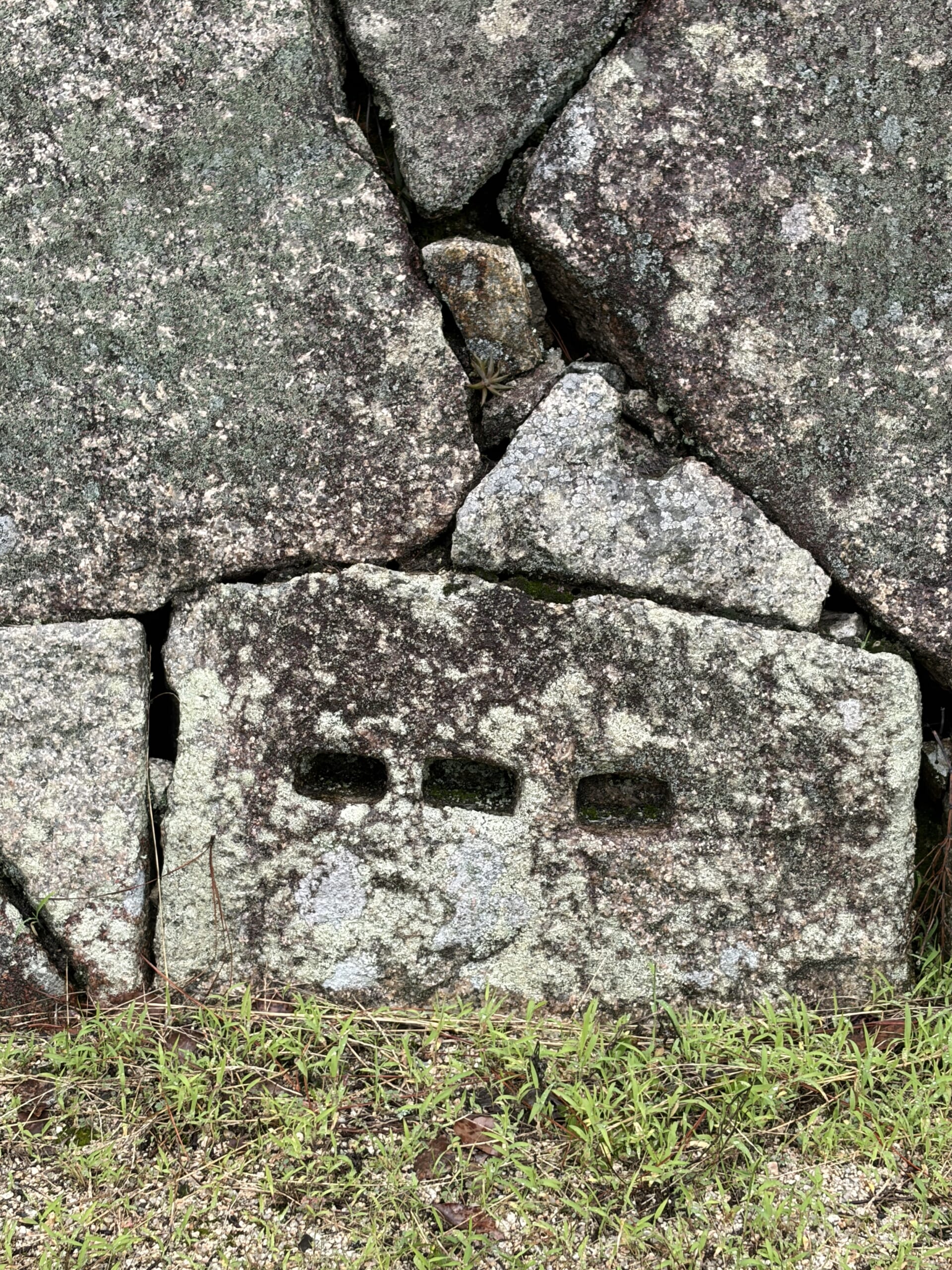
I also spotted three square dents lined up on the surface of a stone. I really love these holes. What were they called again… ah yes, they were yaana (wedge holes), cut when splitting the stone out of the quarry.
Rounded Walls, Right-Angled Walls
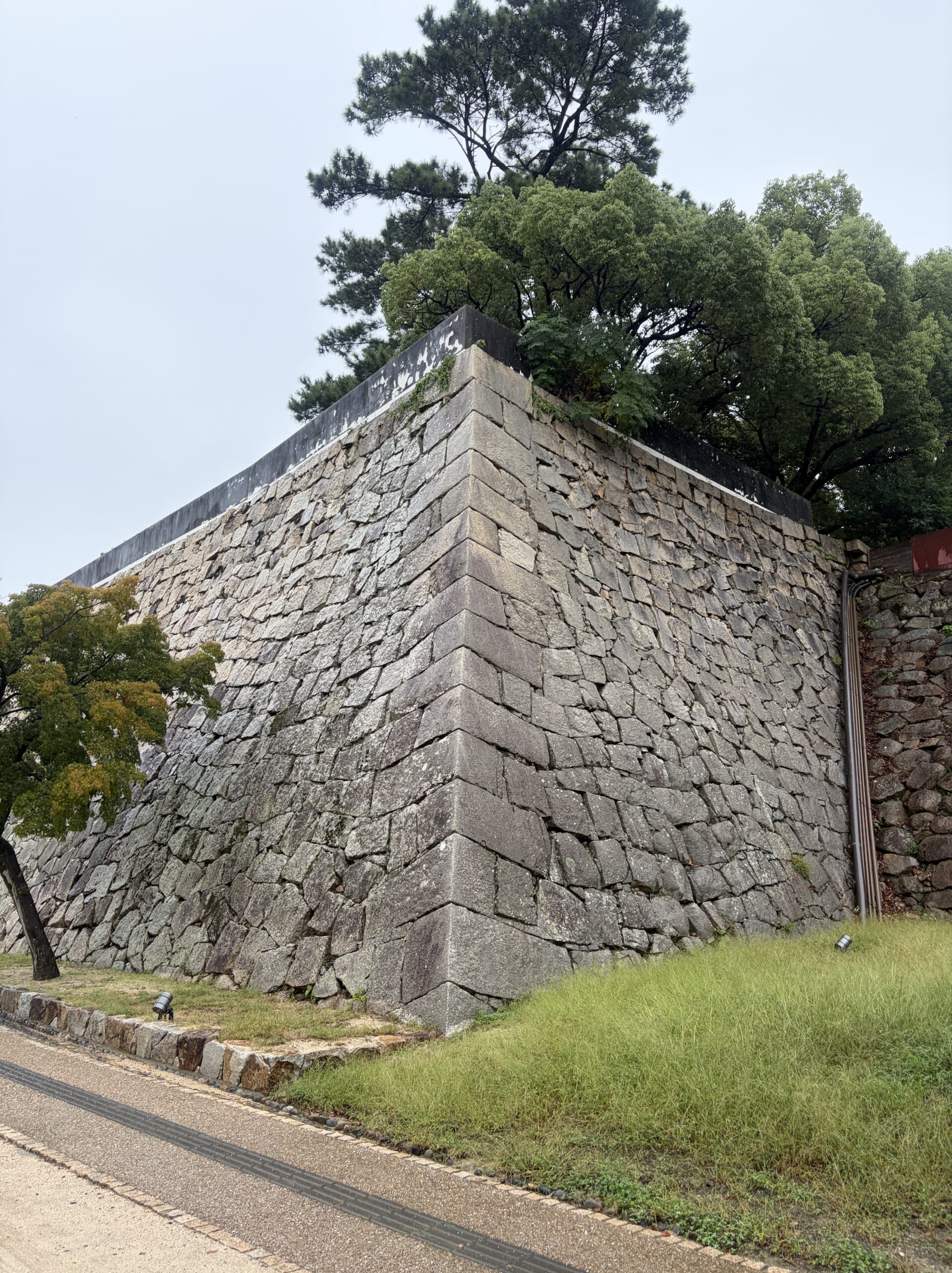
In the southwest of the Naka-no-dan, stone walls from different eras sit side by side. The wall of barely worked, roundish stones stacked at a gentle slope was built by Kobayakawa Hideaki, then repaired in the time of the next lord, Ikeda Tadatsugu. The wall next to it, neatly stacked with squared-off stones, was built by Ikeda Tadakatsu in the 1620s.
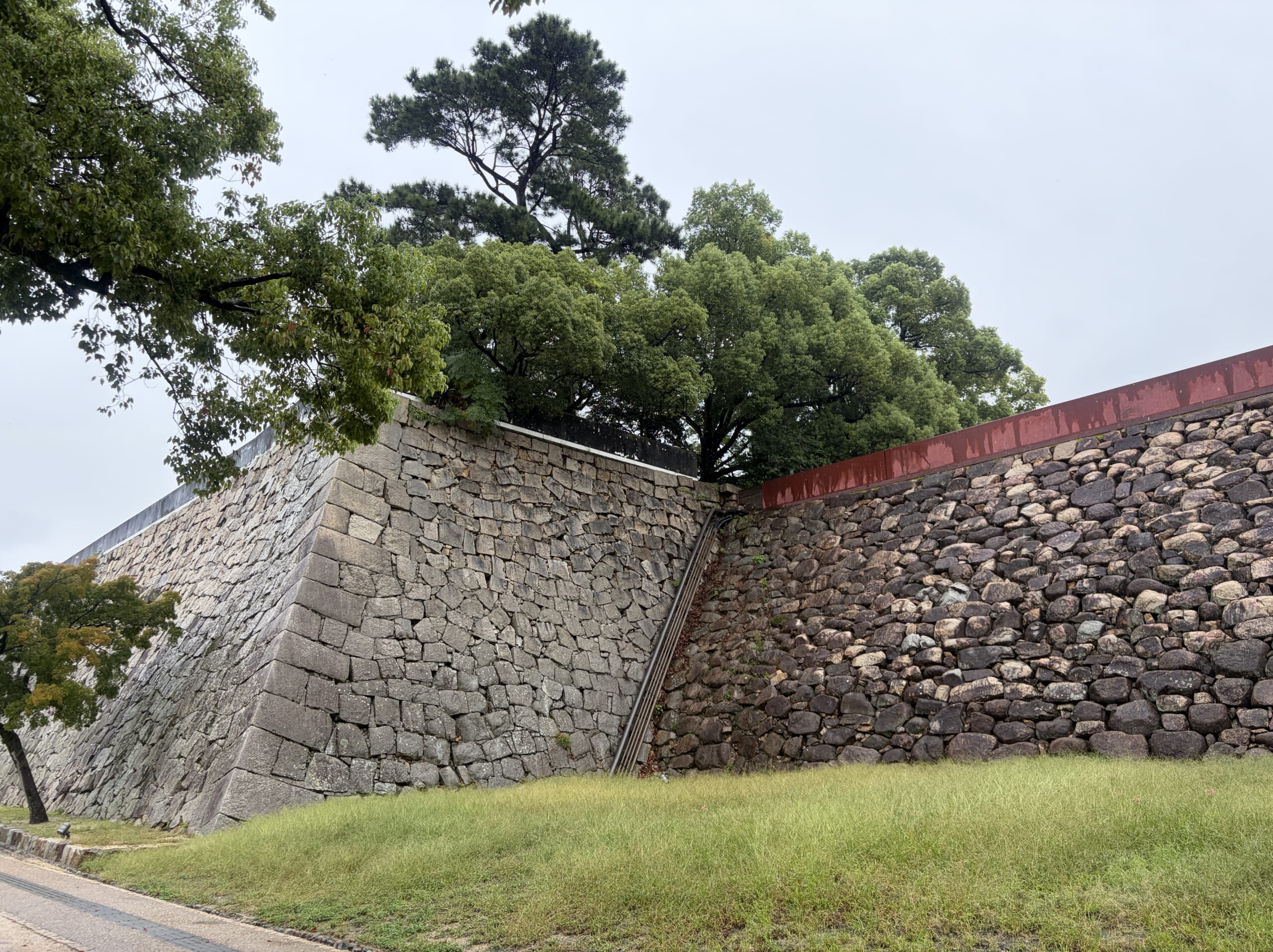
Rounded stone walls, right-angled stone walls. They’re from different eras! This one, that one, the one over there — I took photo after photo, comparing them.
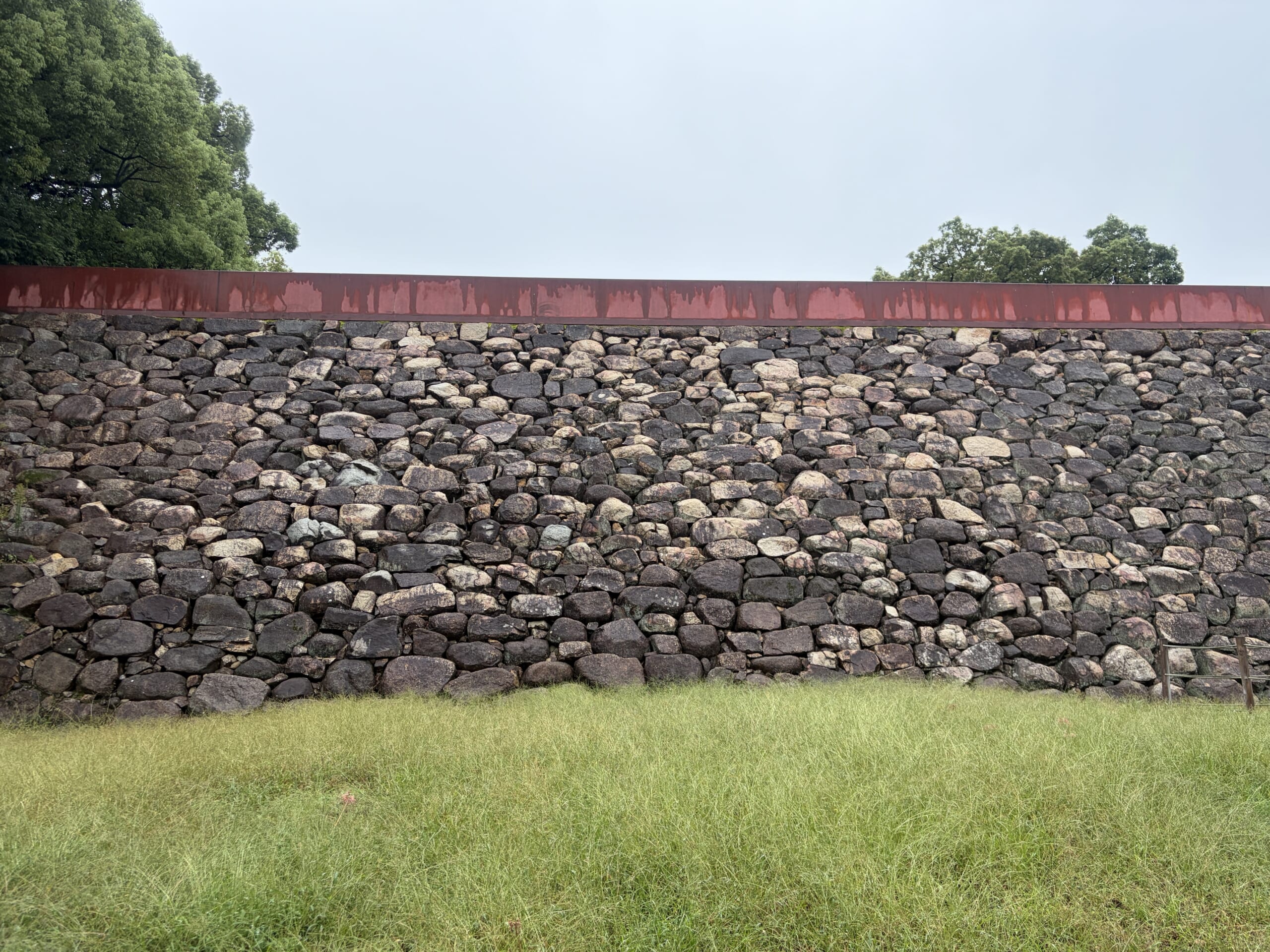
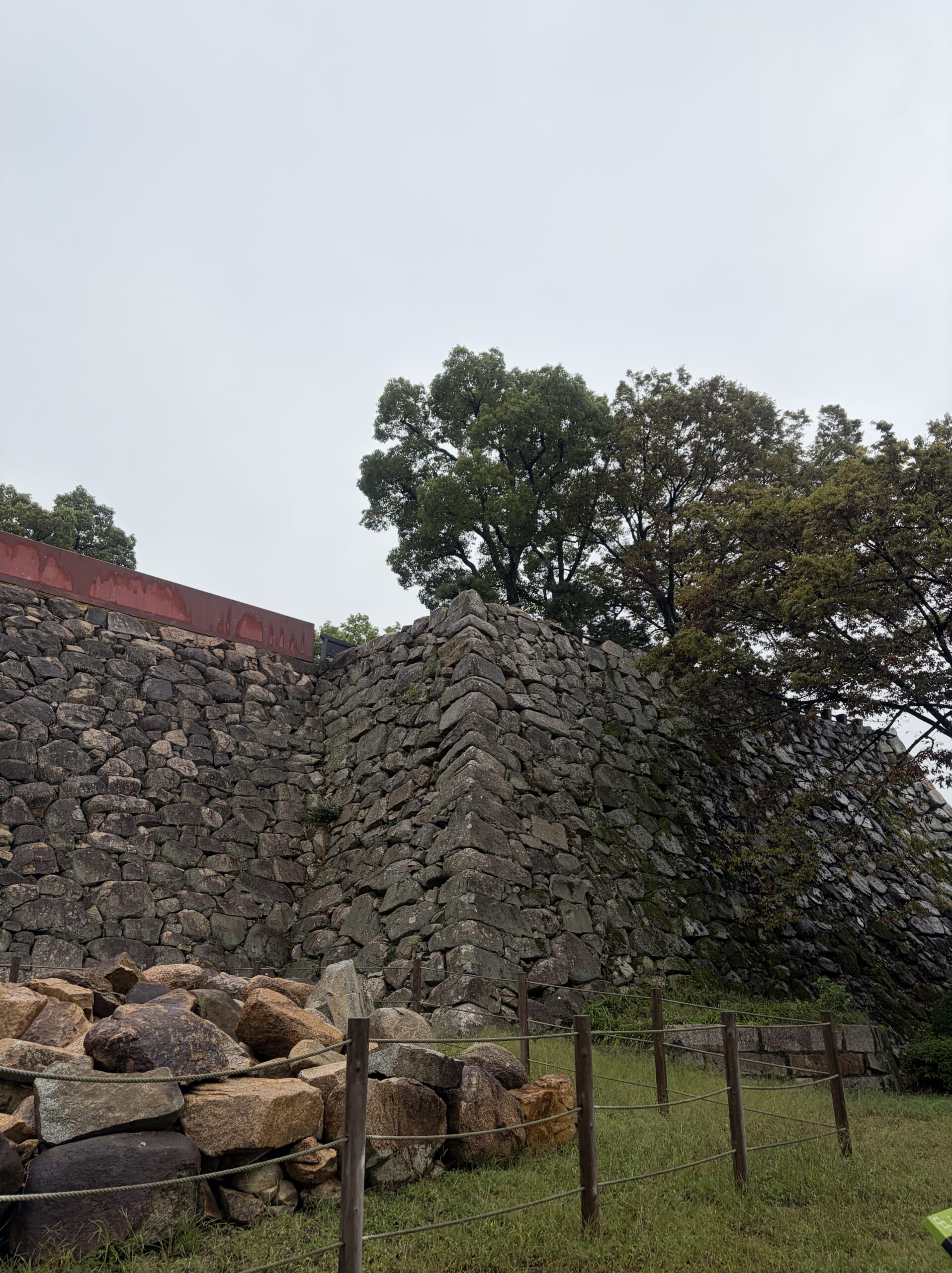
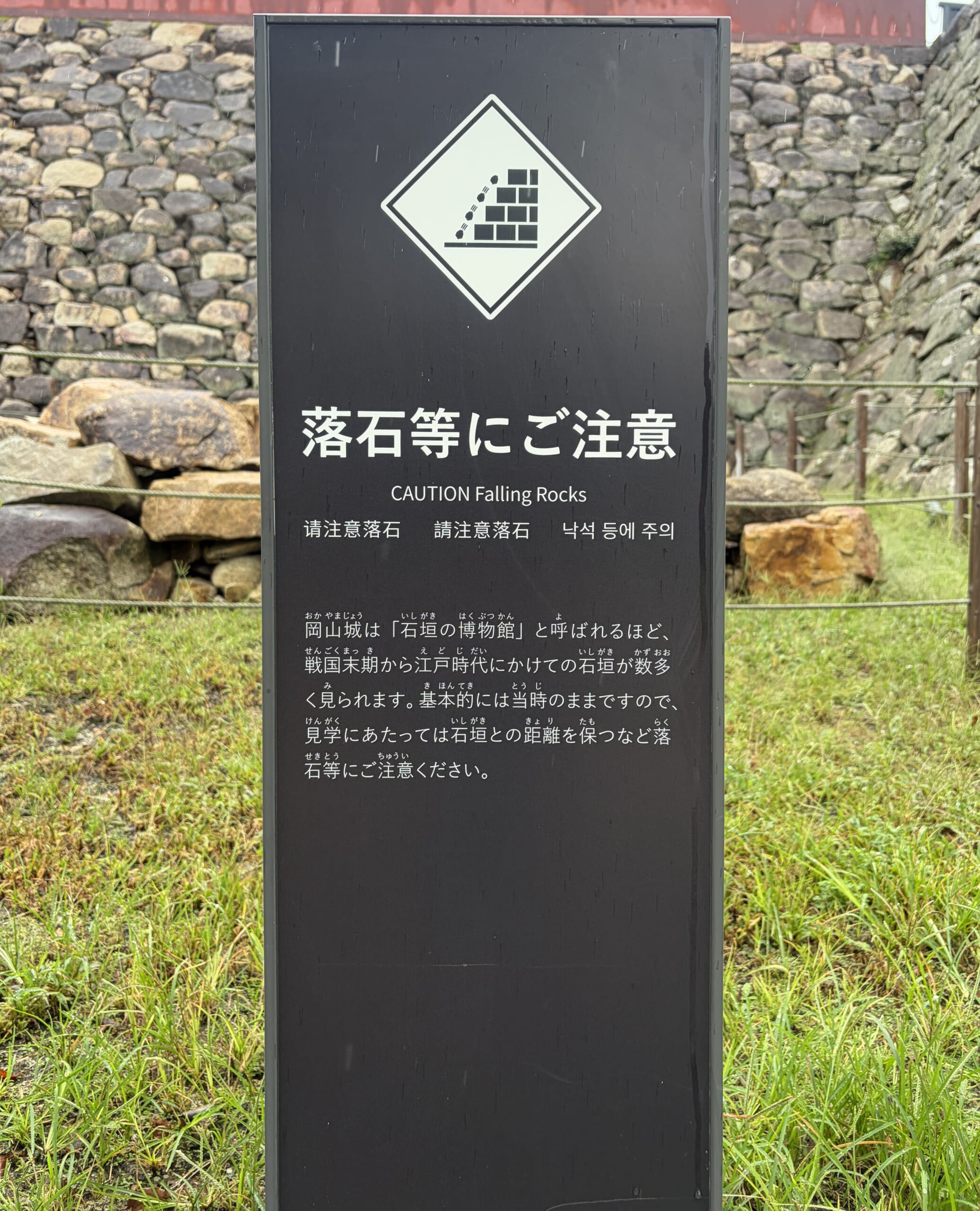
Right nearby was a sign saying “Beware of Falling Rocks”. Fair enough. Wait — do you actually need a helmet to look at stone walls…? (haha) These are old walls, so I kept a little distance while looking. Safety first.
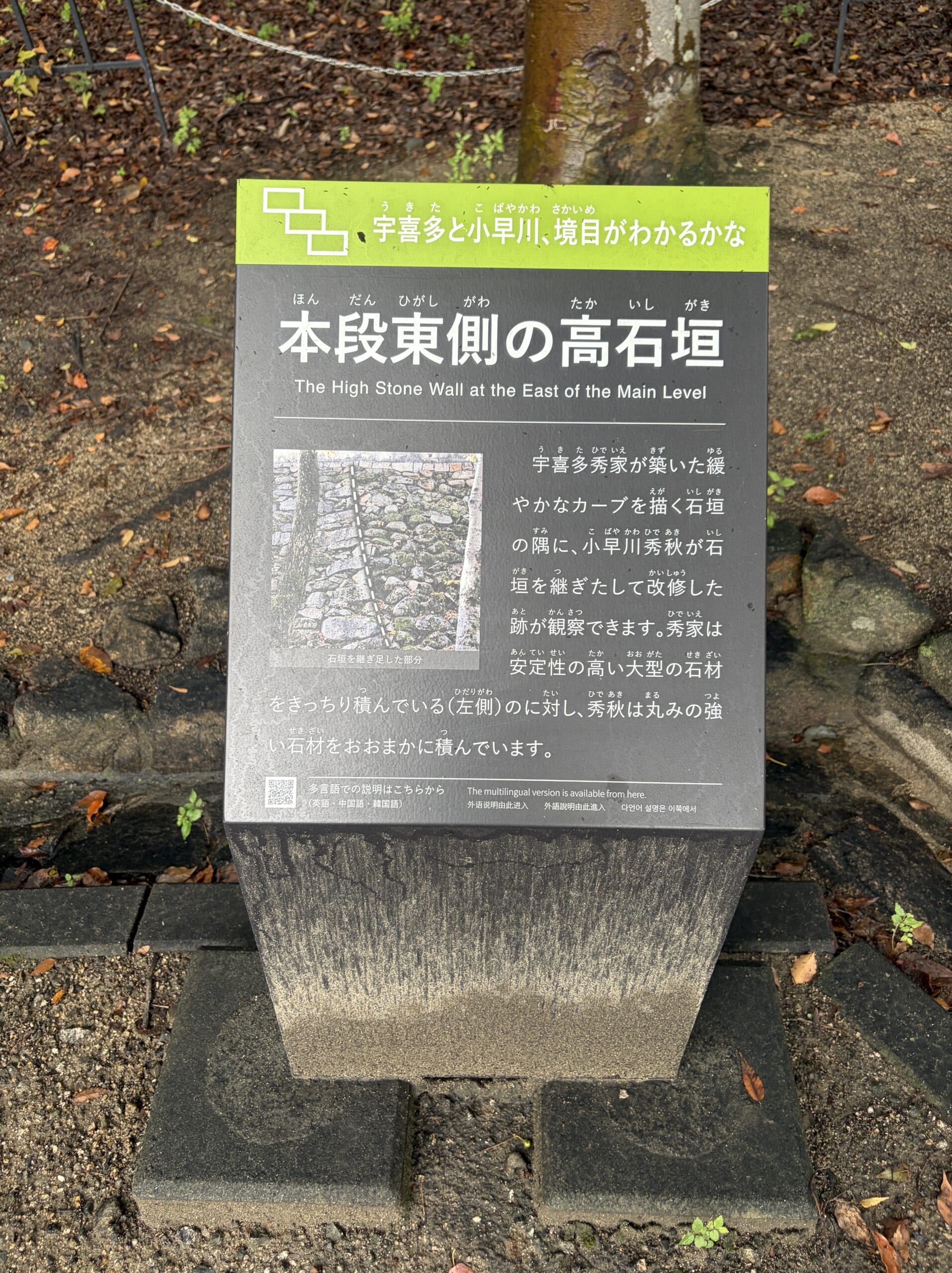
On the east side of the Hondan, you can see where Kobayakawa Hideaki extended the corner of a stone wall built by Ukita Hideie. The heading on the sign reads: “Ukita meets Kobayakawa — can you spot the join?”
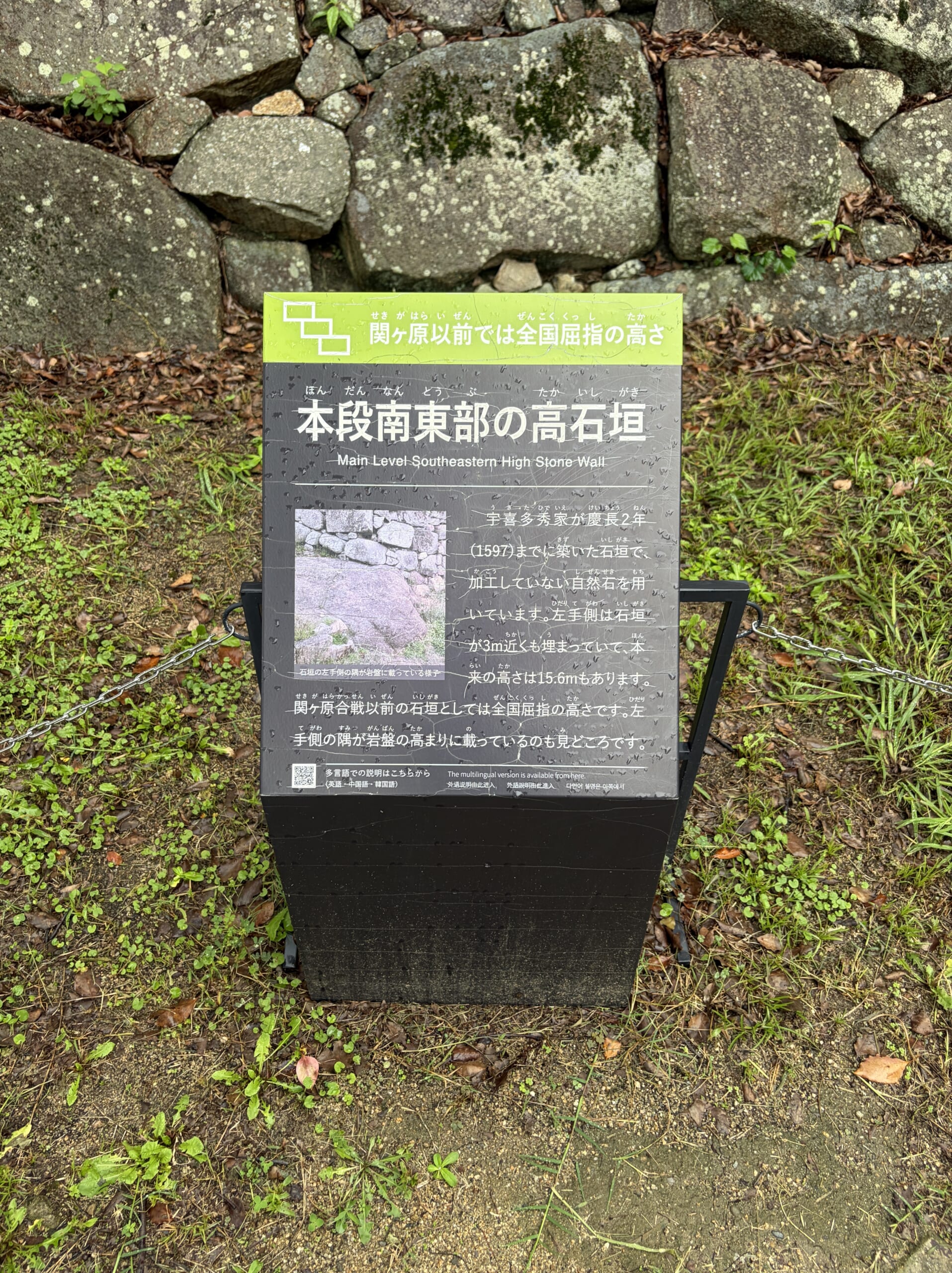
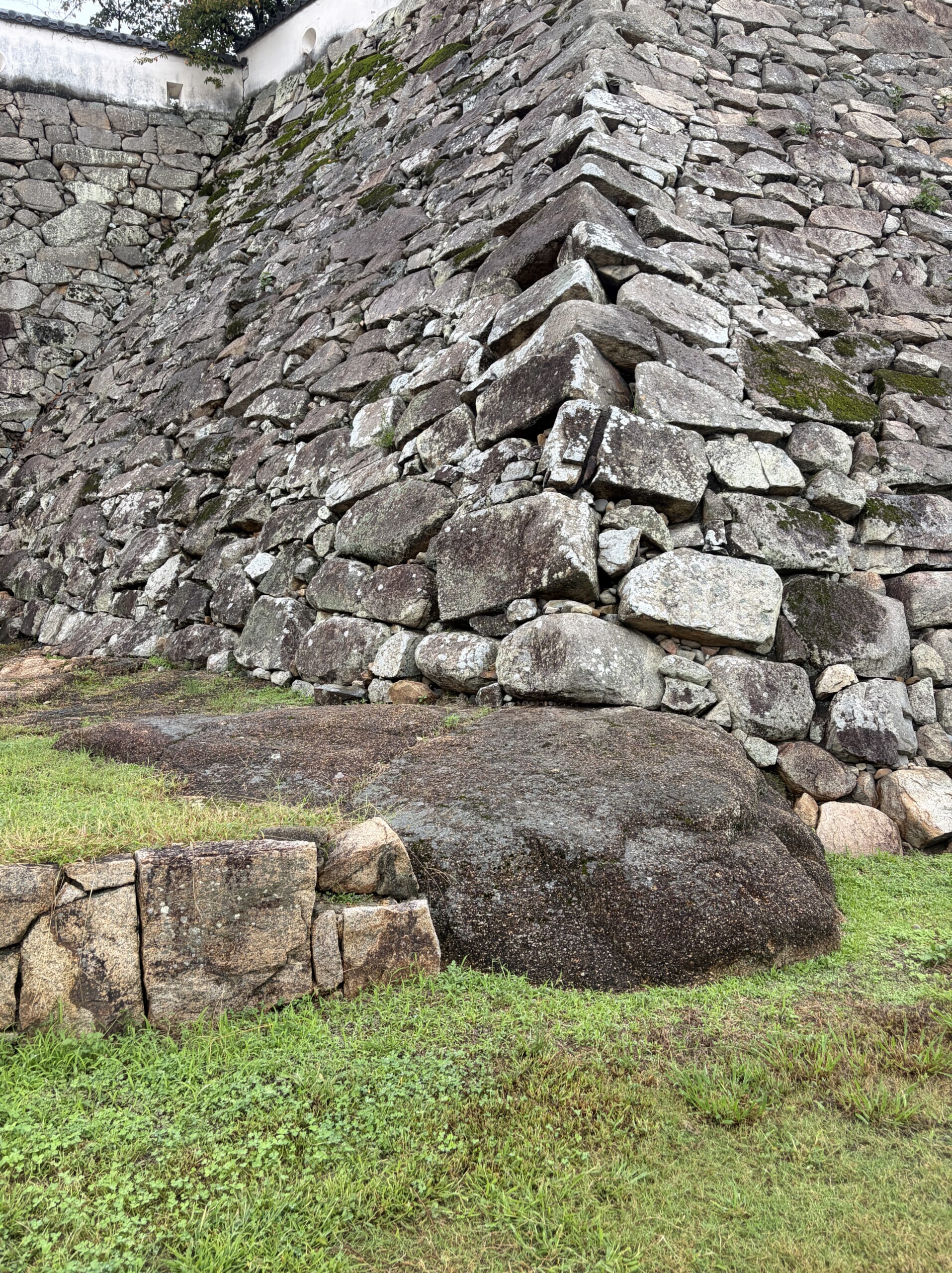
In the southeast, there’s also a high stone wall built by Ukita Hideie by 1597. Part of it is buried, so its original height is apparently a whole 15.6 metres. The sign says its corner sits on bedrock, so I looked at the big rock at its base: “Probably this one.”
A Floor Plan on the Ground, Plus the Black Keep
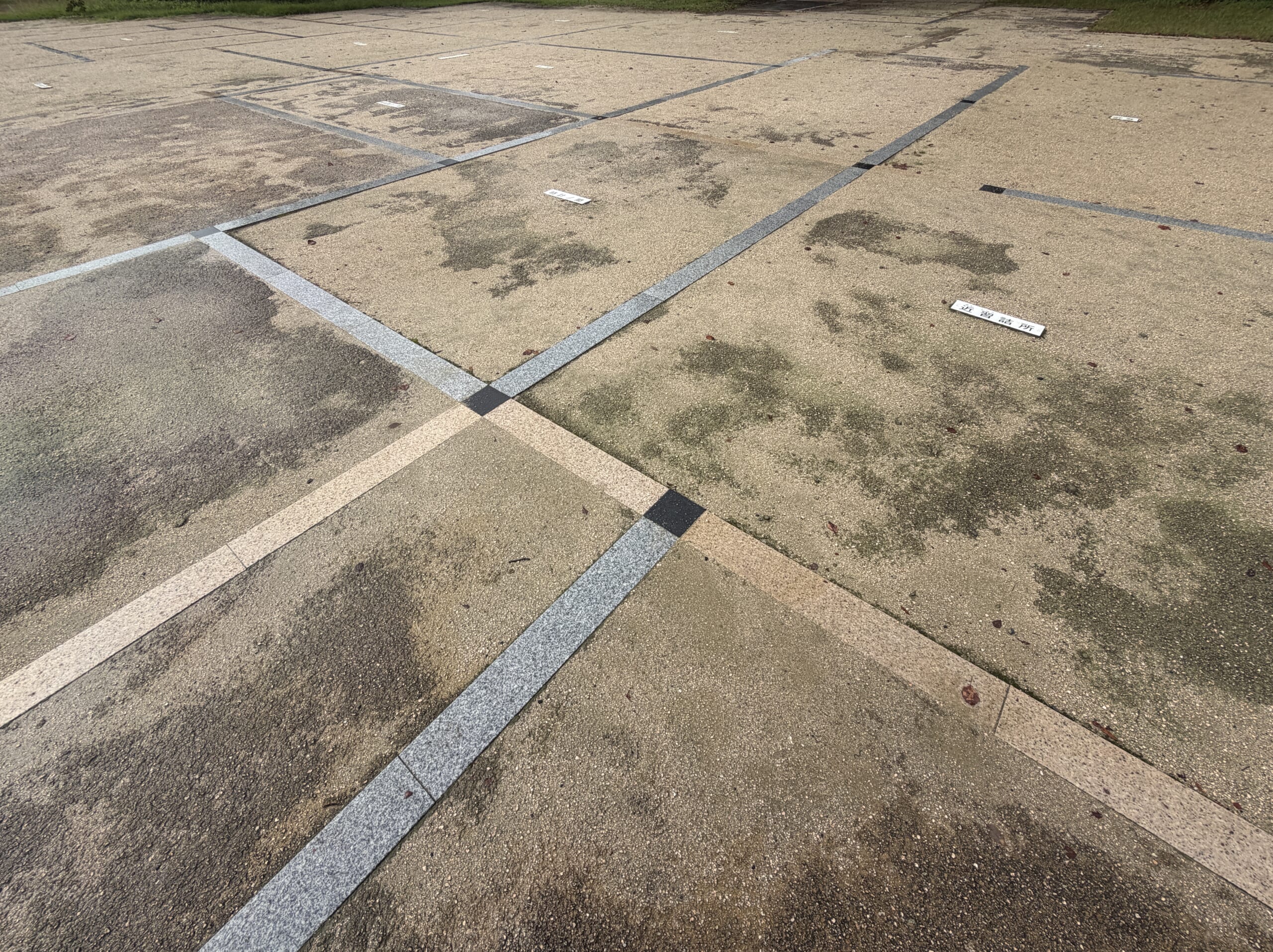
The site of the Omote Shoin on the Naka-no-dan is where the domain’s government was run. The buildings are gone, but the floor plan is drawn on the ground in lines, with room names such as “Kinju Tsumesho” (the attendants’ waiting room), “Daidokoro” (the kitchen), too.
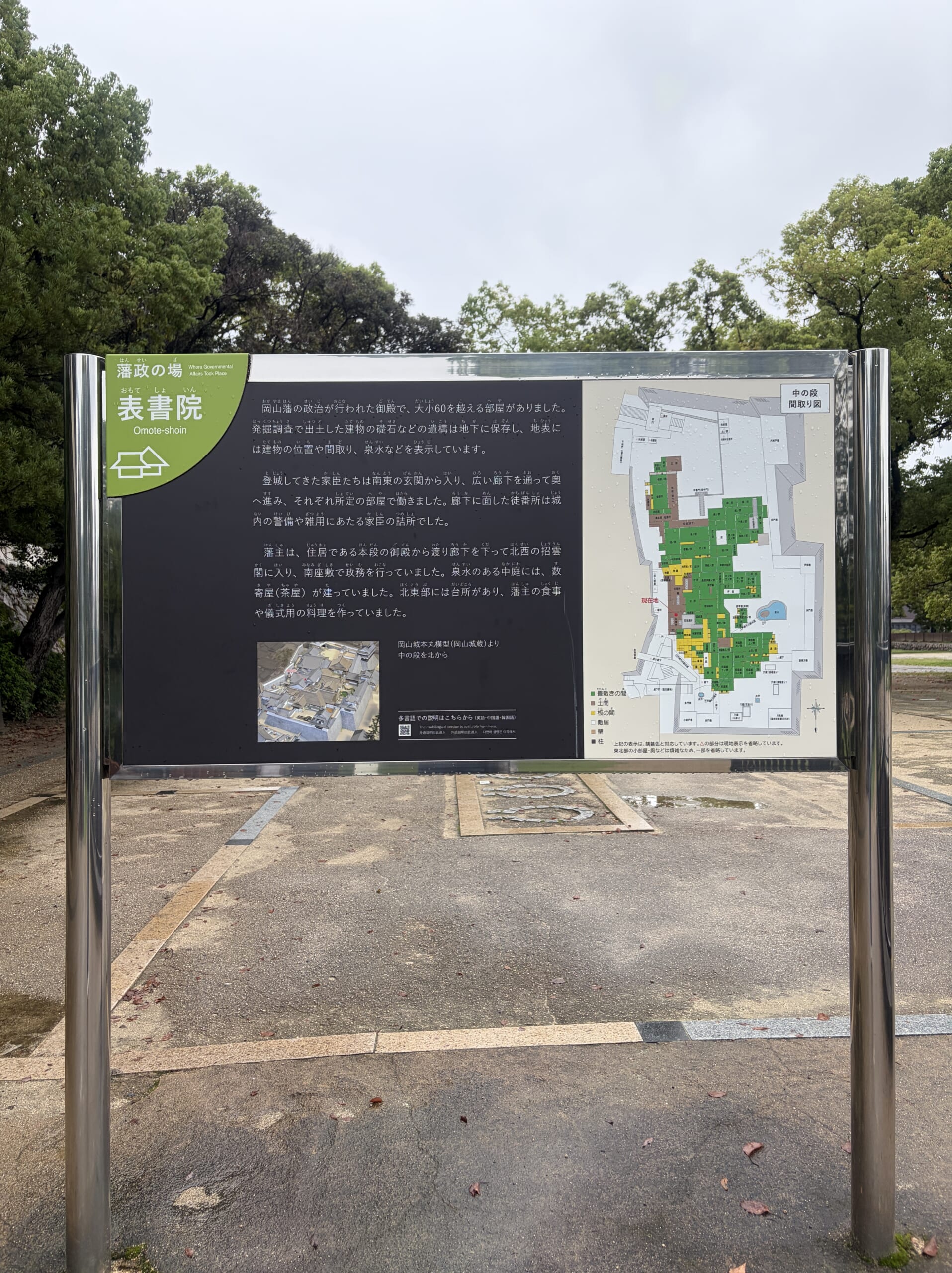
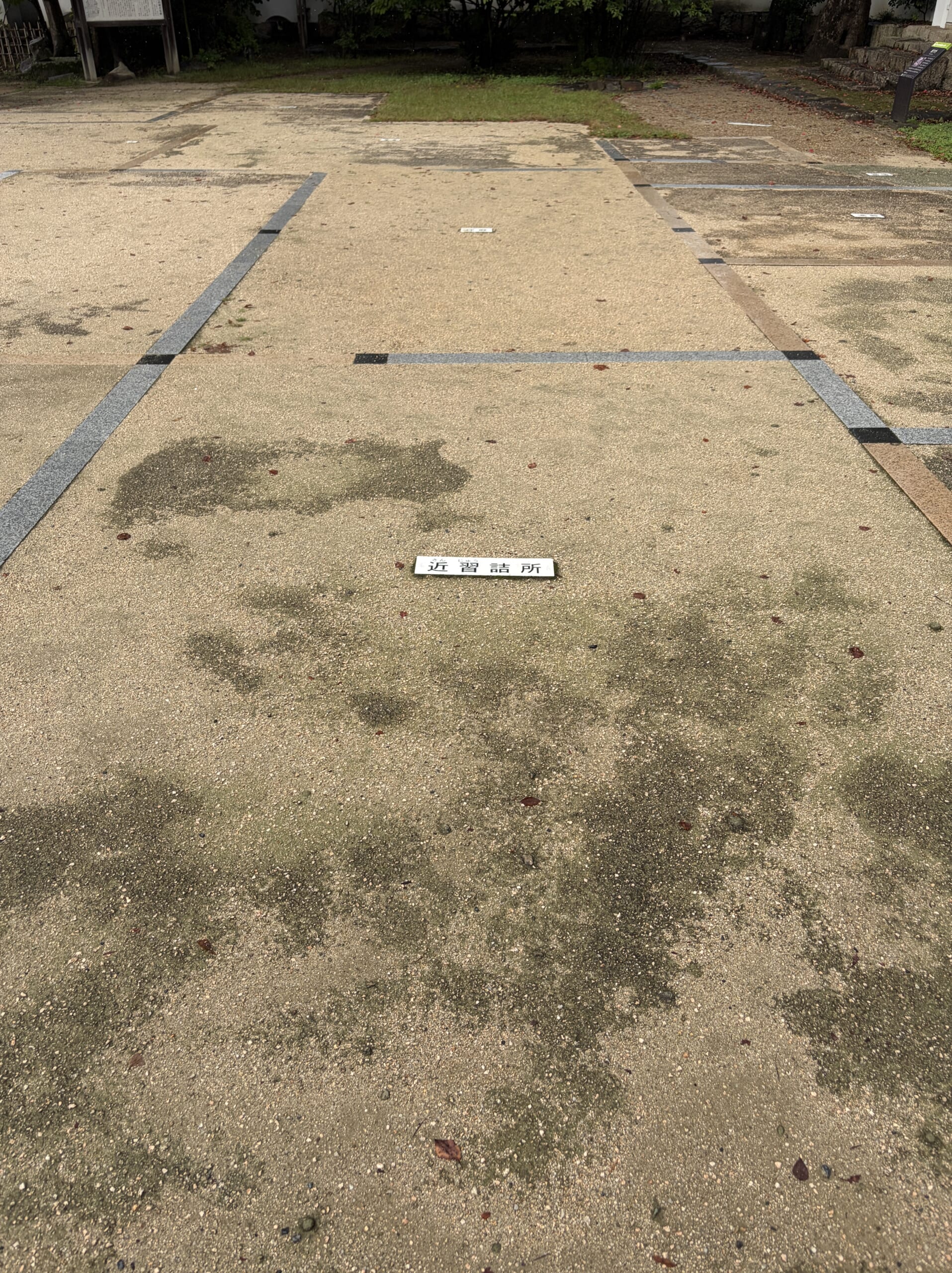
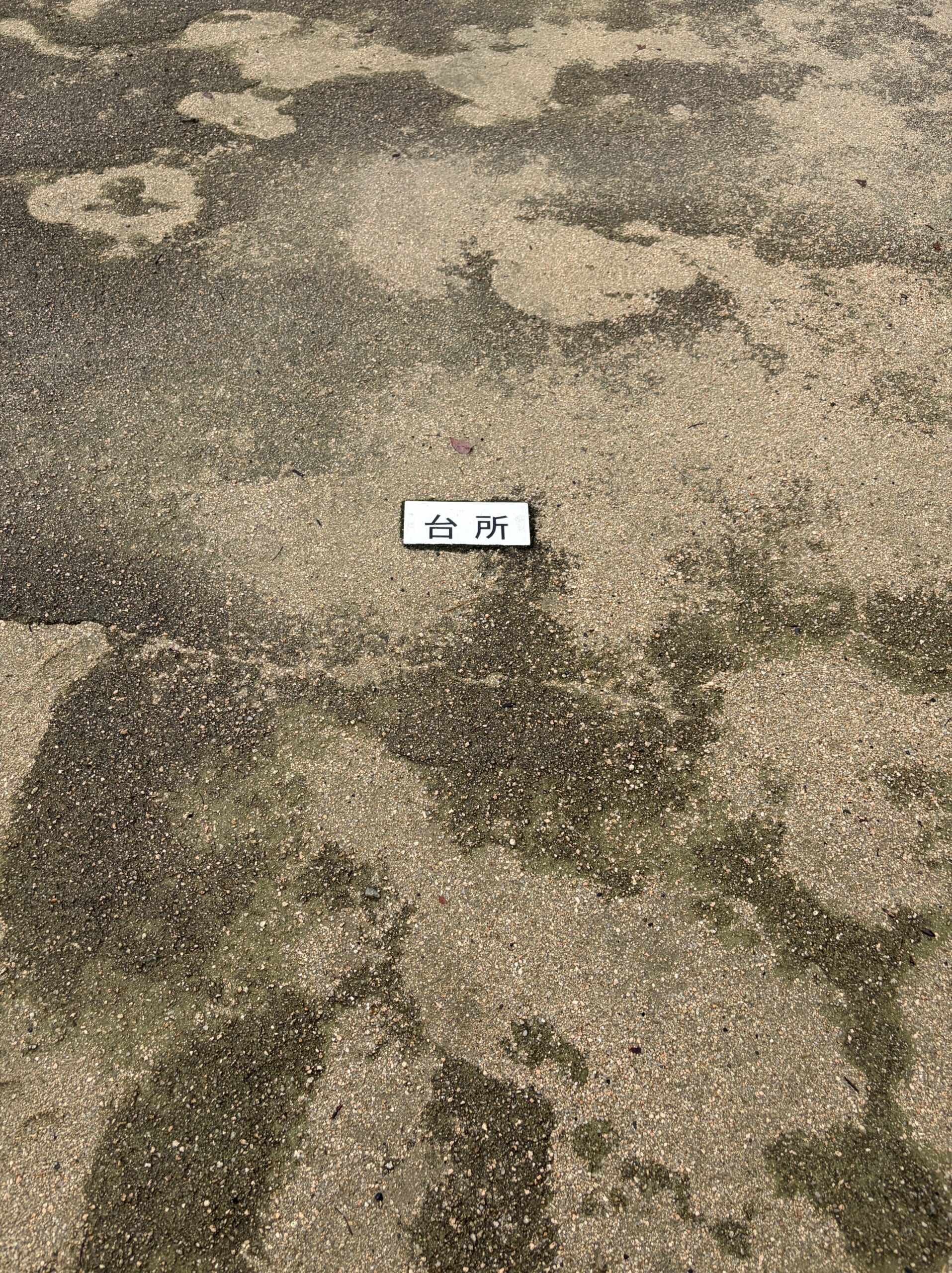
So grateful they’ve marked it all out like this! It’s like playing house for real — kind of fun!!!!
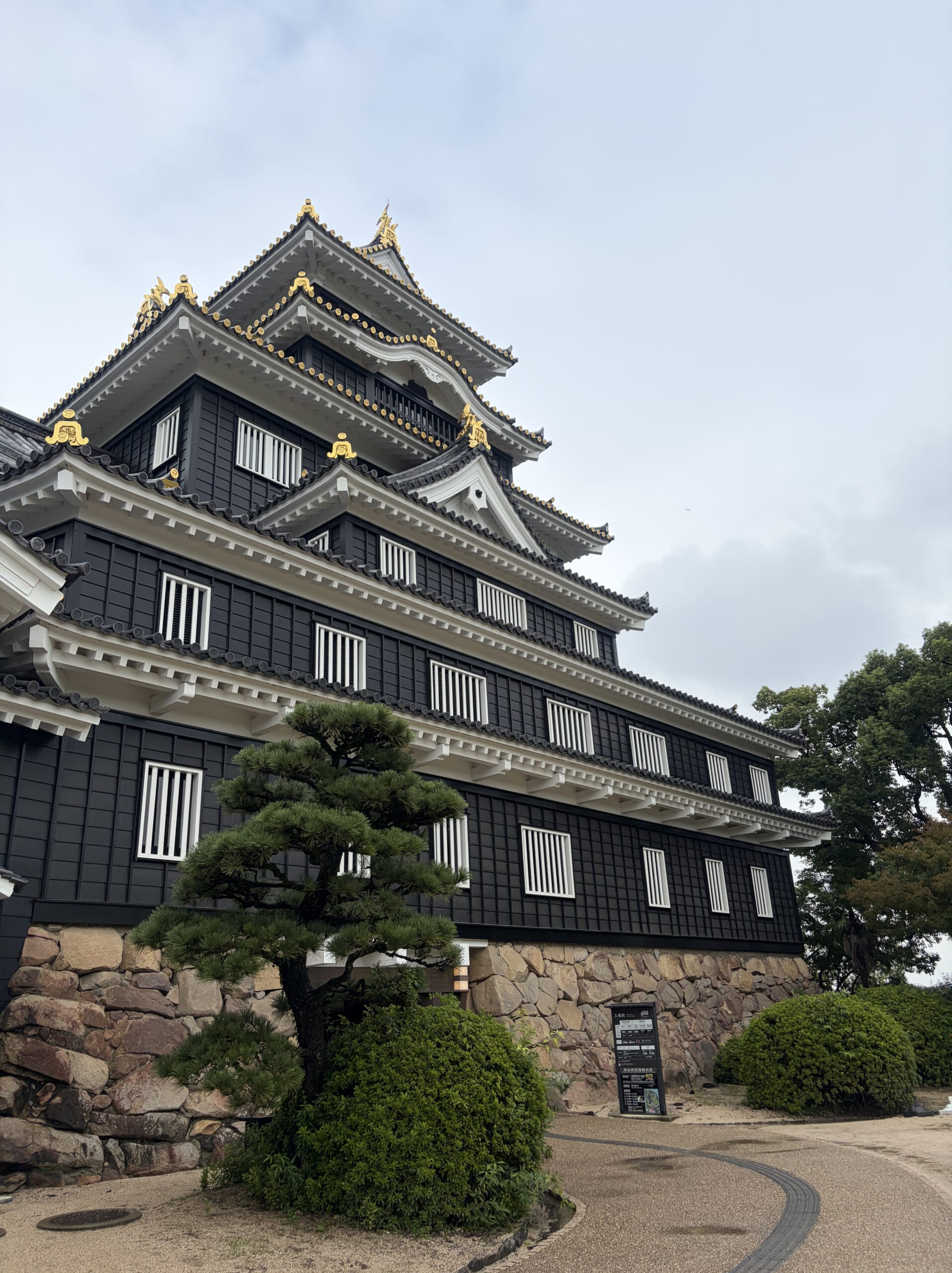
Then on to the keep. Black walls with gold ornaments. So cool~! Looking up at it from close by, it felt pretty big. The stone base it sits on was also built by Ukita Hideie; seen from above, it’s apparently an irregular pentagon.
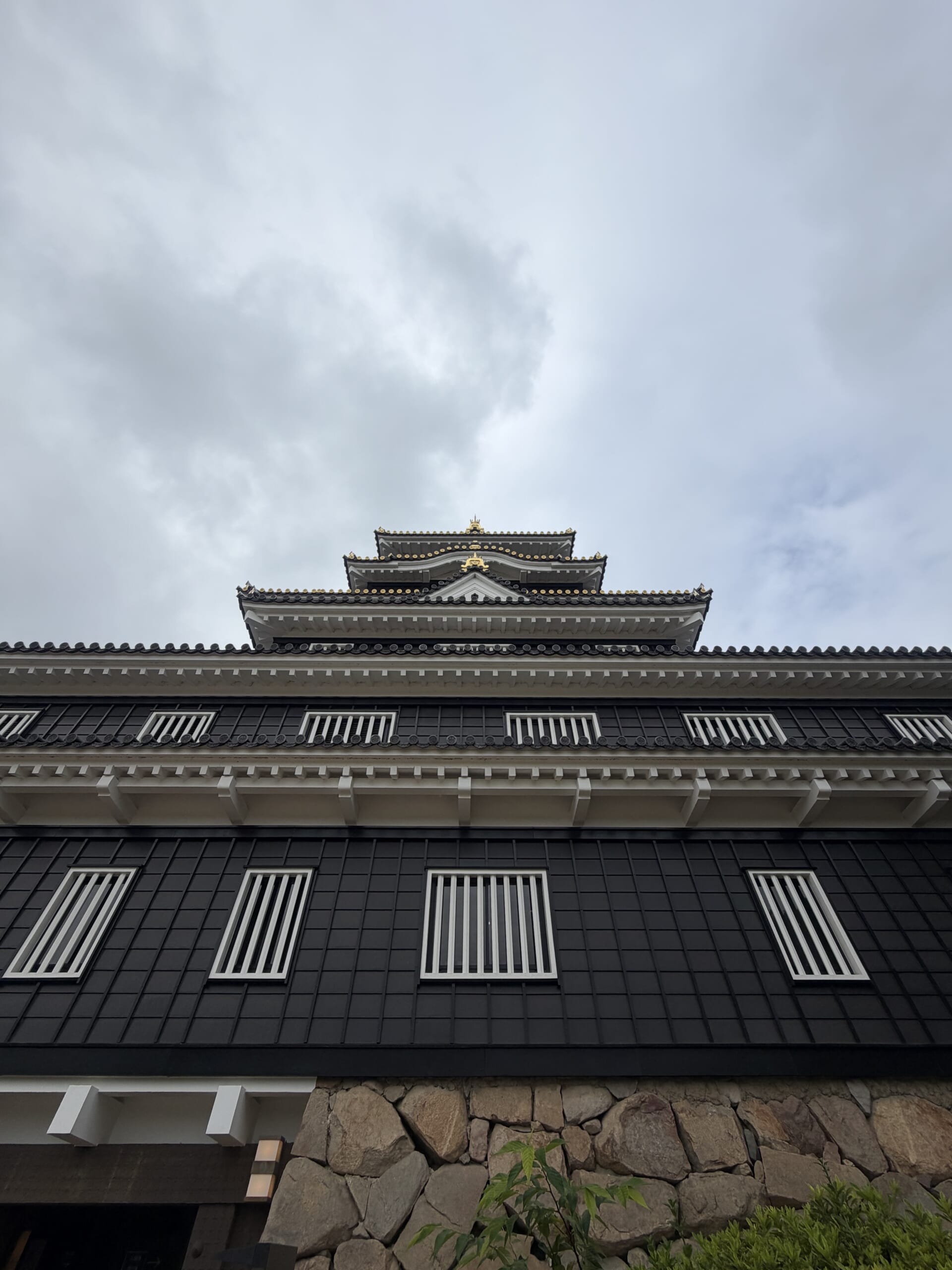
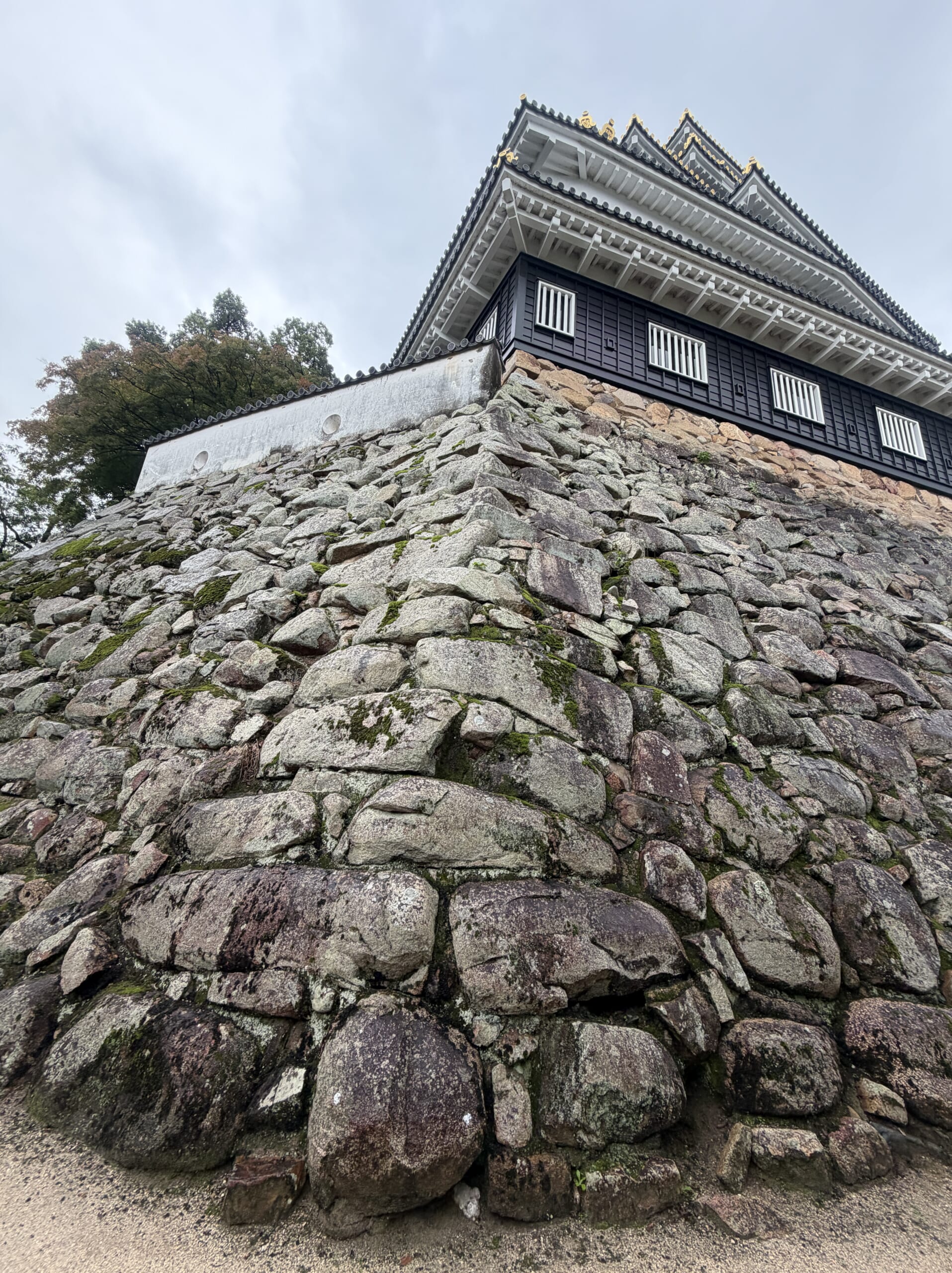
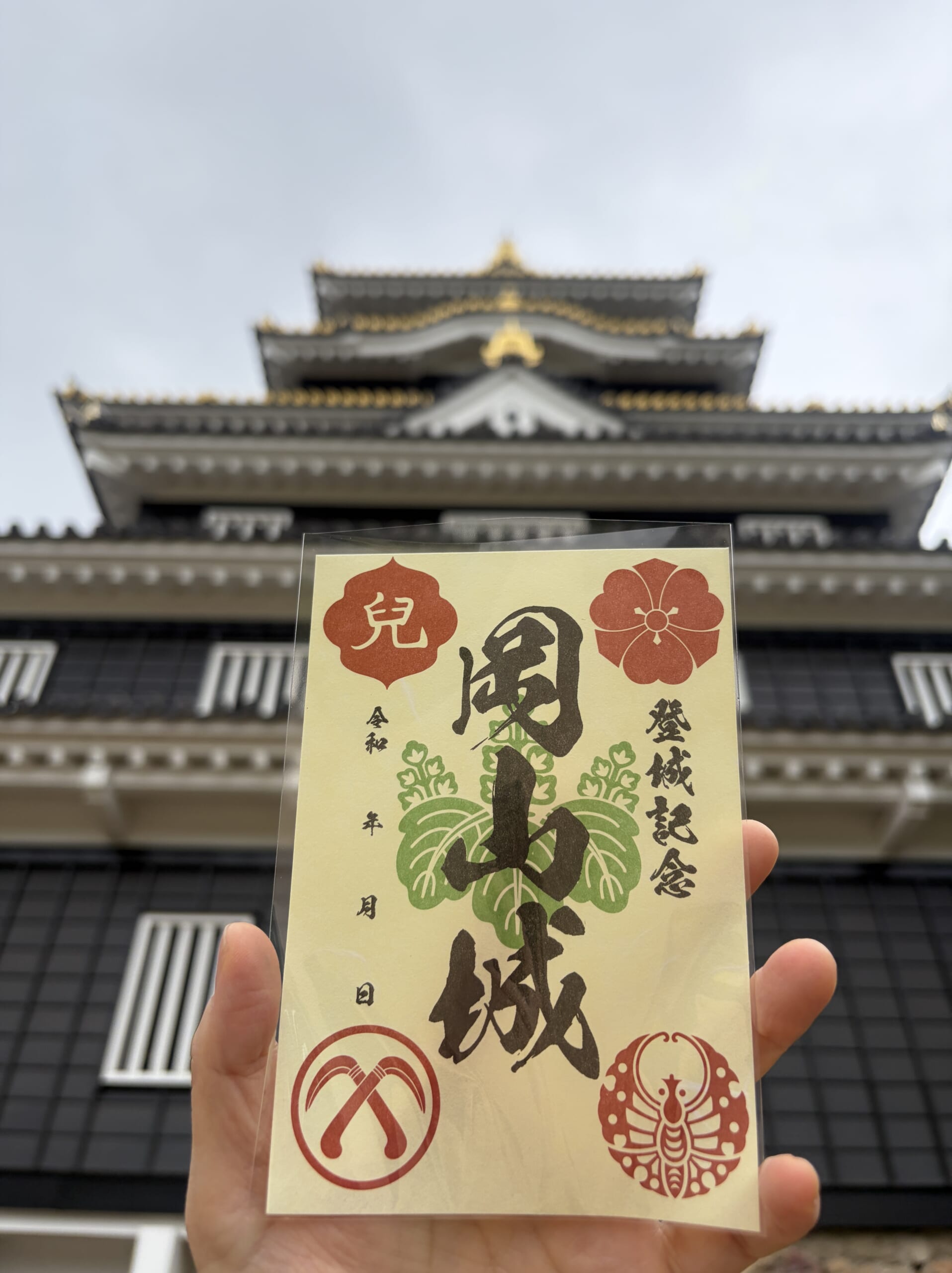
Inside the keep there’s a museum plus a shop. When I asked a staff member, they said it was fine to use just the shop, so this time I bought a goshuin (castle seal) as well as a Meijō card (famous castle card) there. I held the goshuin up in front of the keep to snap a souvenir photo.
Stone Walls Sleeping Underground
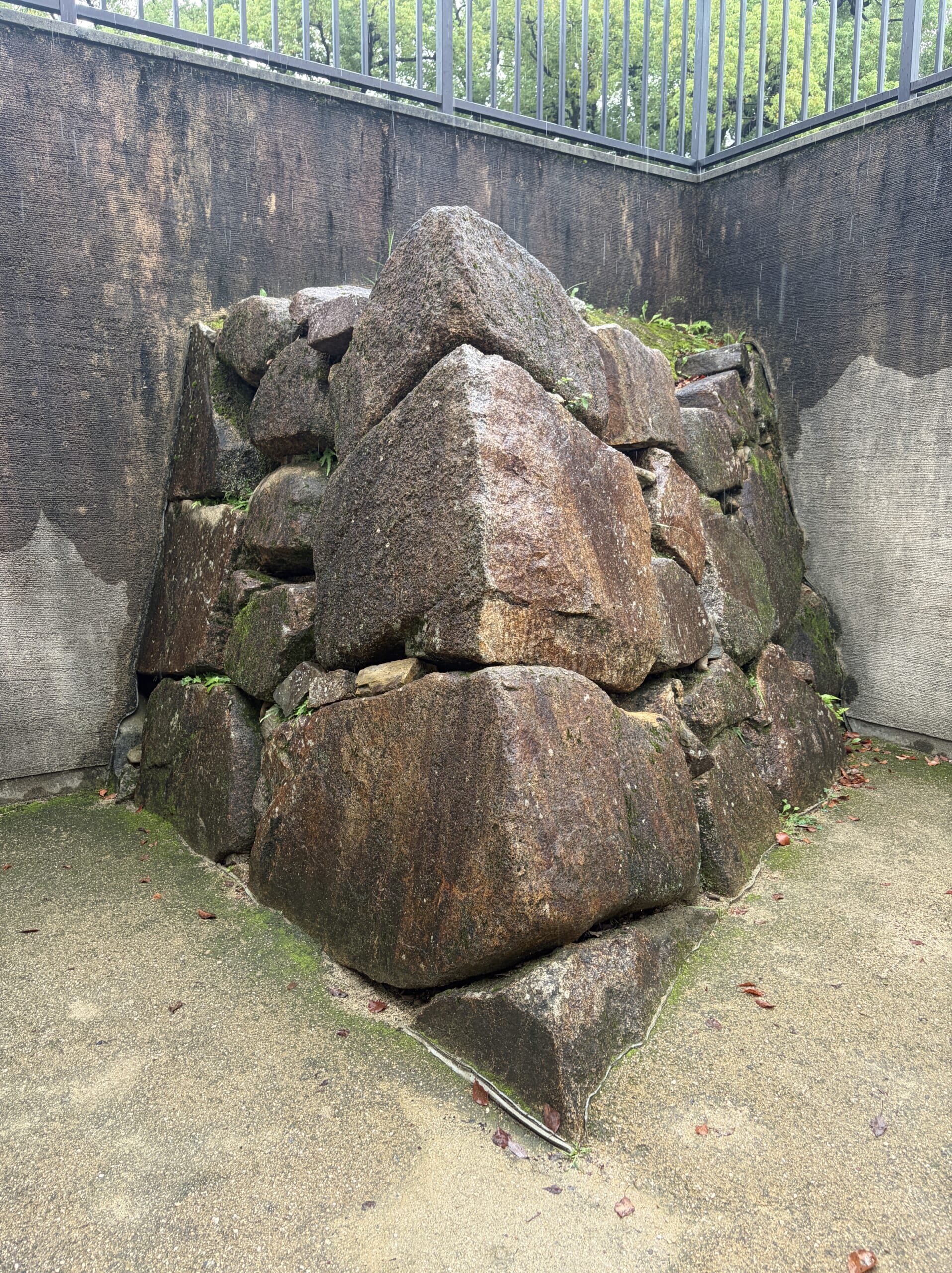
At Okayama Castle, you can also see stone walls that had been buried underground.
The first was the sharp-cornered stone wall I saw on the Naka-no-dan. Apparently it was buried when the Naka-no-dan was extended northwards in the early Edo period, then discovered in a survey in fiscal 1993. The corner angle is 70 degrees. This is amazing.
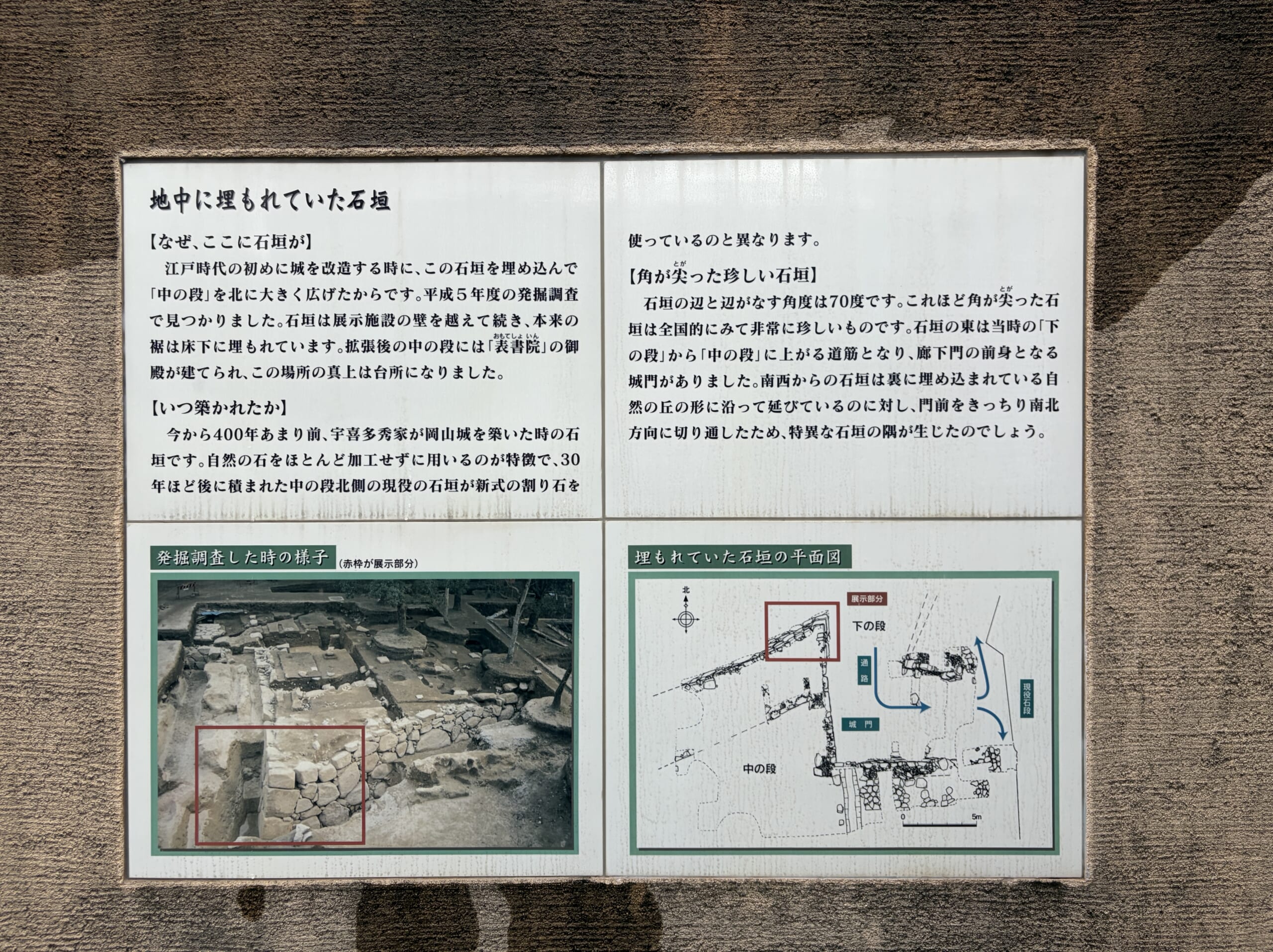
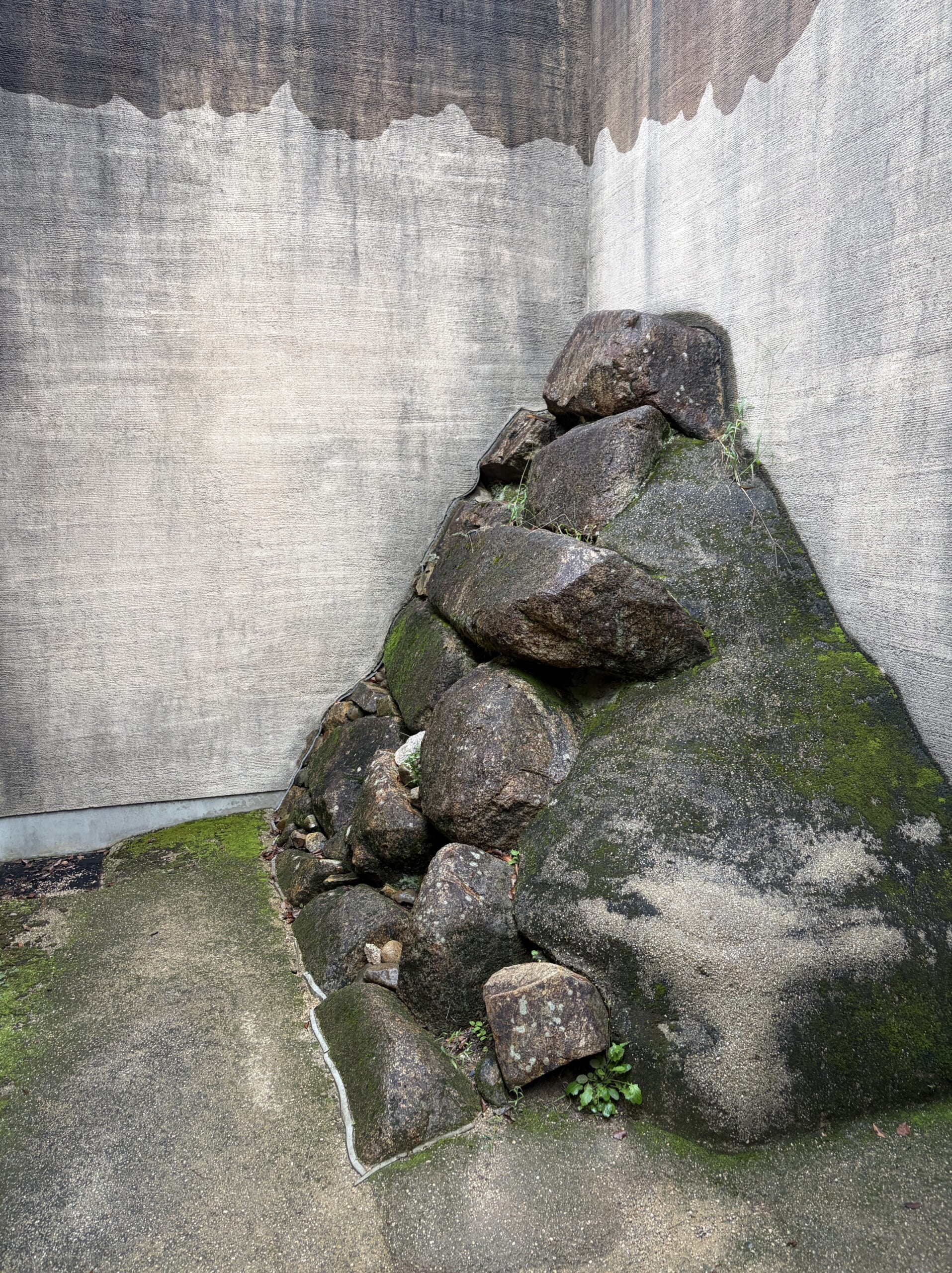
The second is the “Stone Wall from the Time of the Castle’s Construction” exhibit on the west side of the Naka-no-dan. Go down the stairs, then you can see the stone wall built by Ukita Hideie up close.
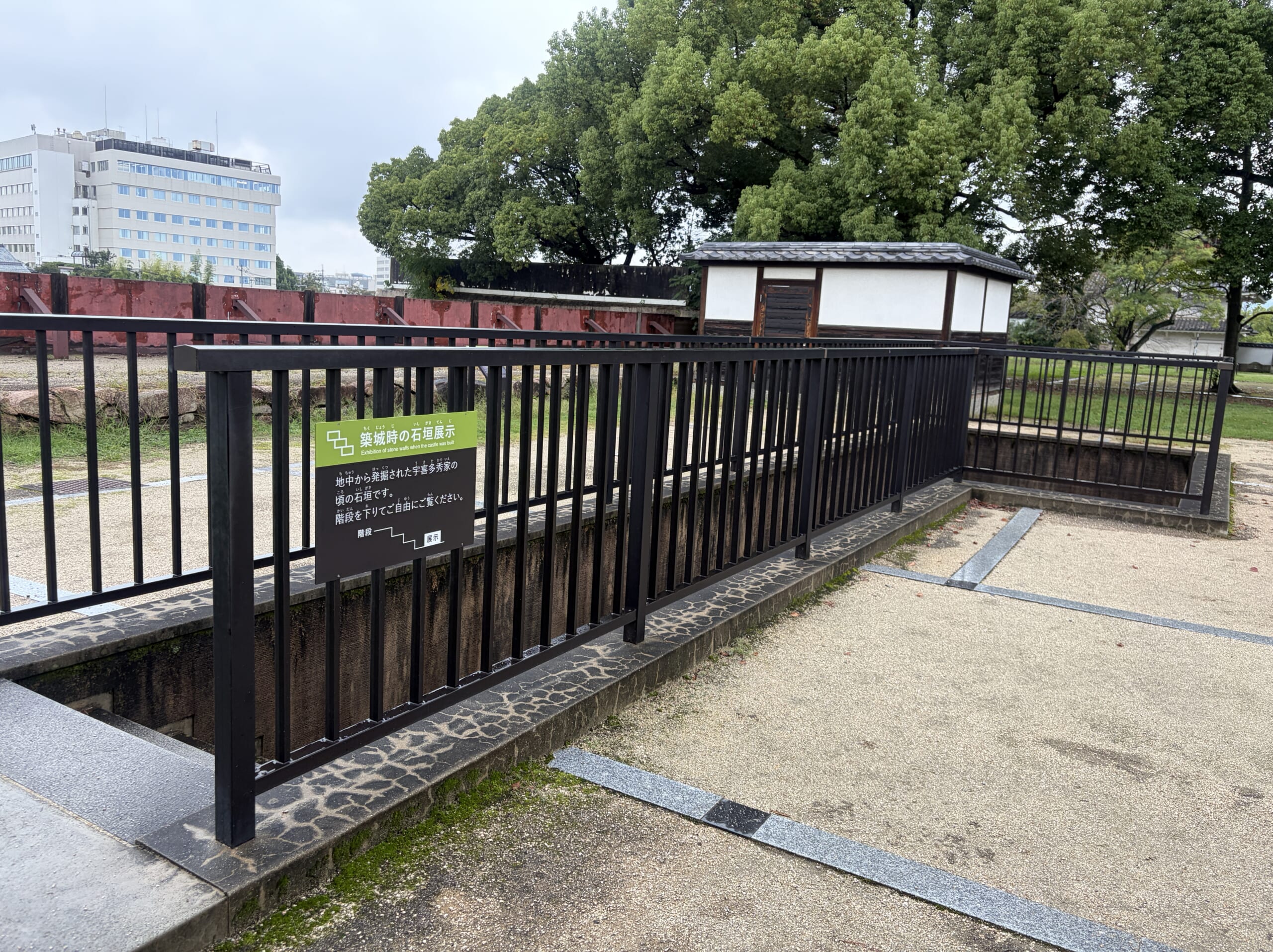
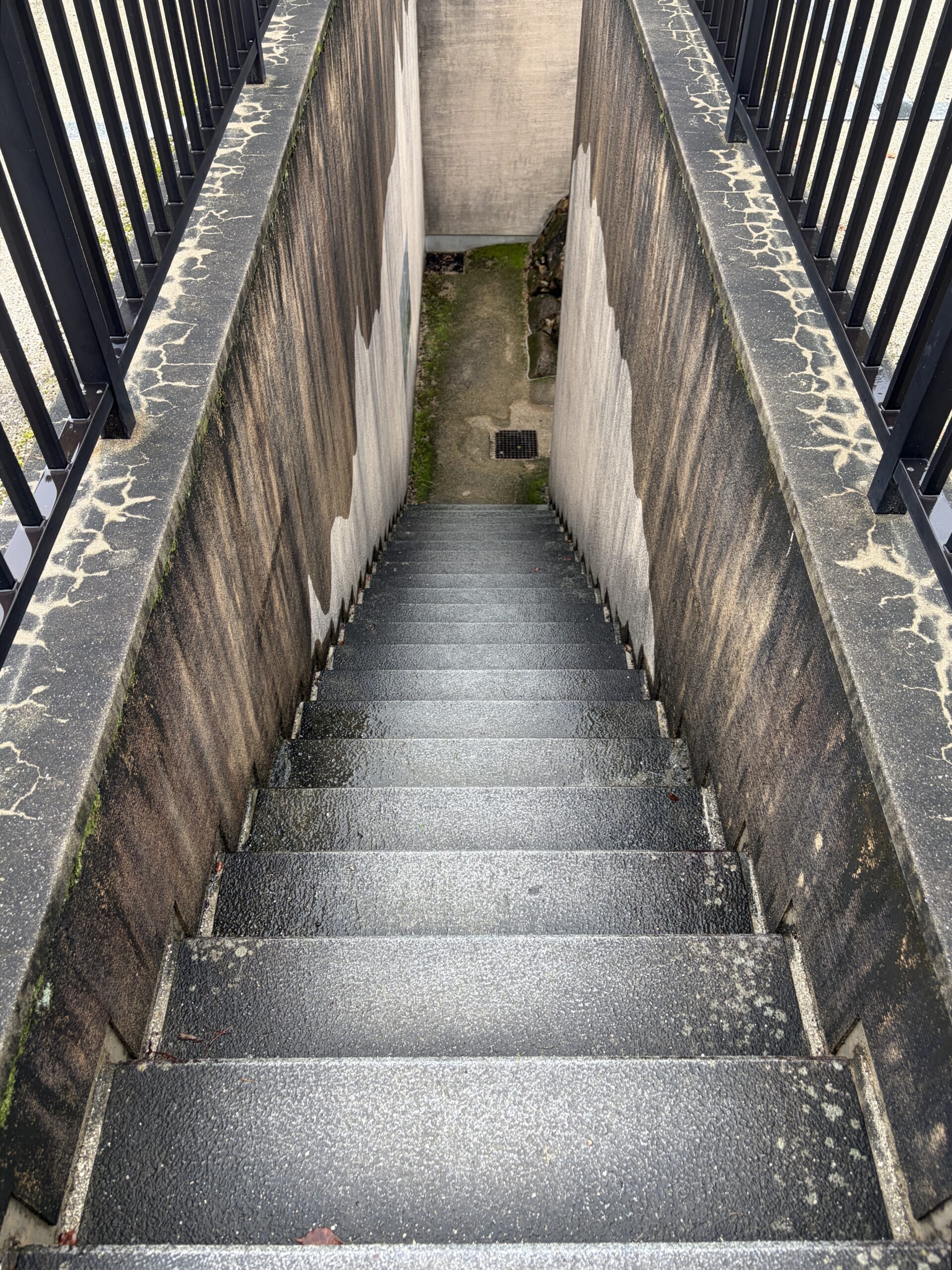
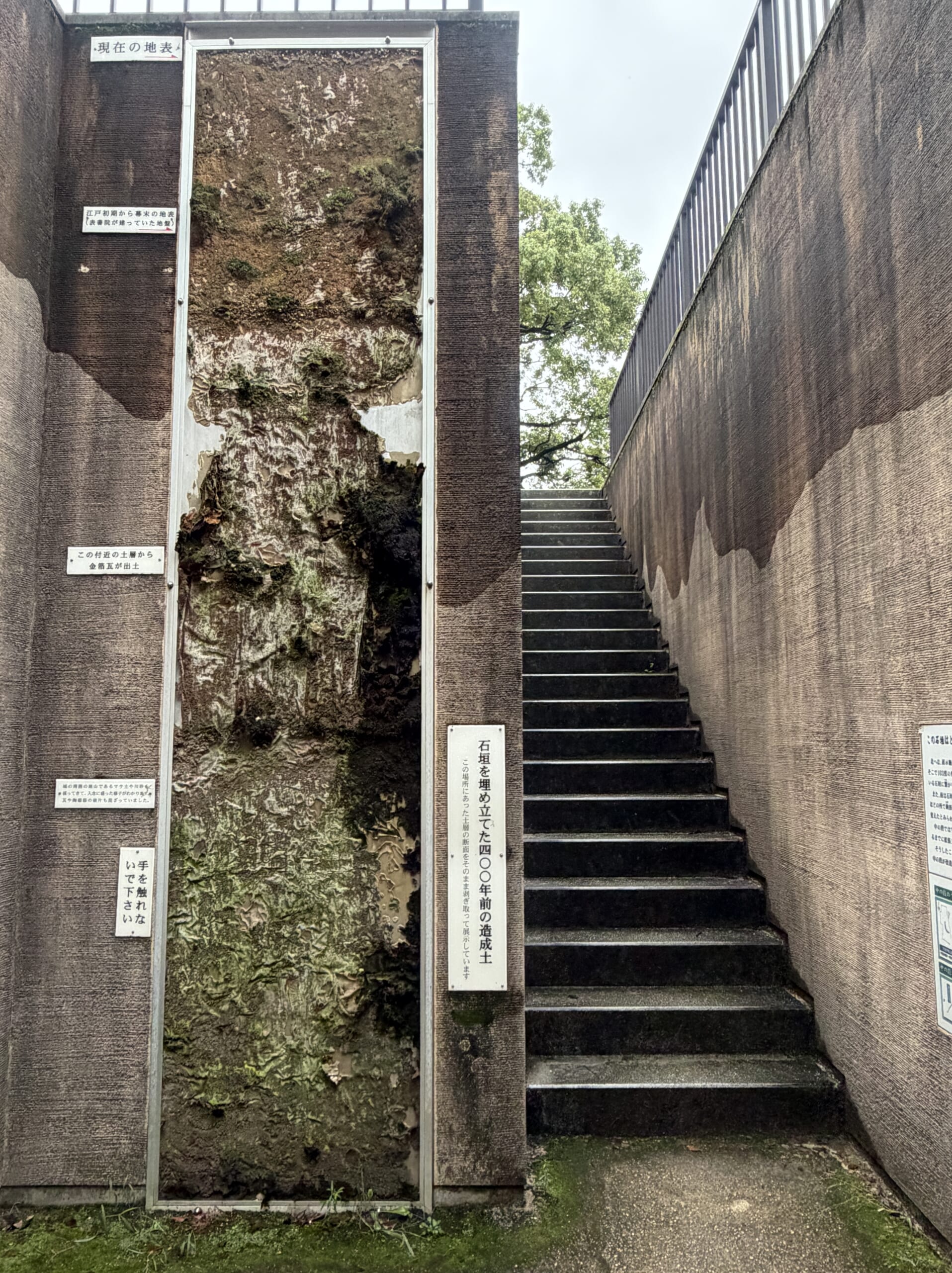
I was about to head home, but when I checked the map one more time, I realised this was the one spot I’d missed. I went straight back. There was nobody around, so even going down felt a little scary. Somehow, the air felt a bit different just there. Beside the stairs, there’s also a cross-section of the soil that was used to bury the stone wall.
Wrapping Up
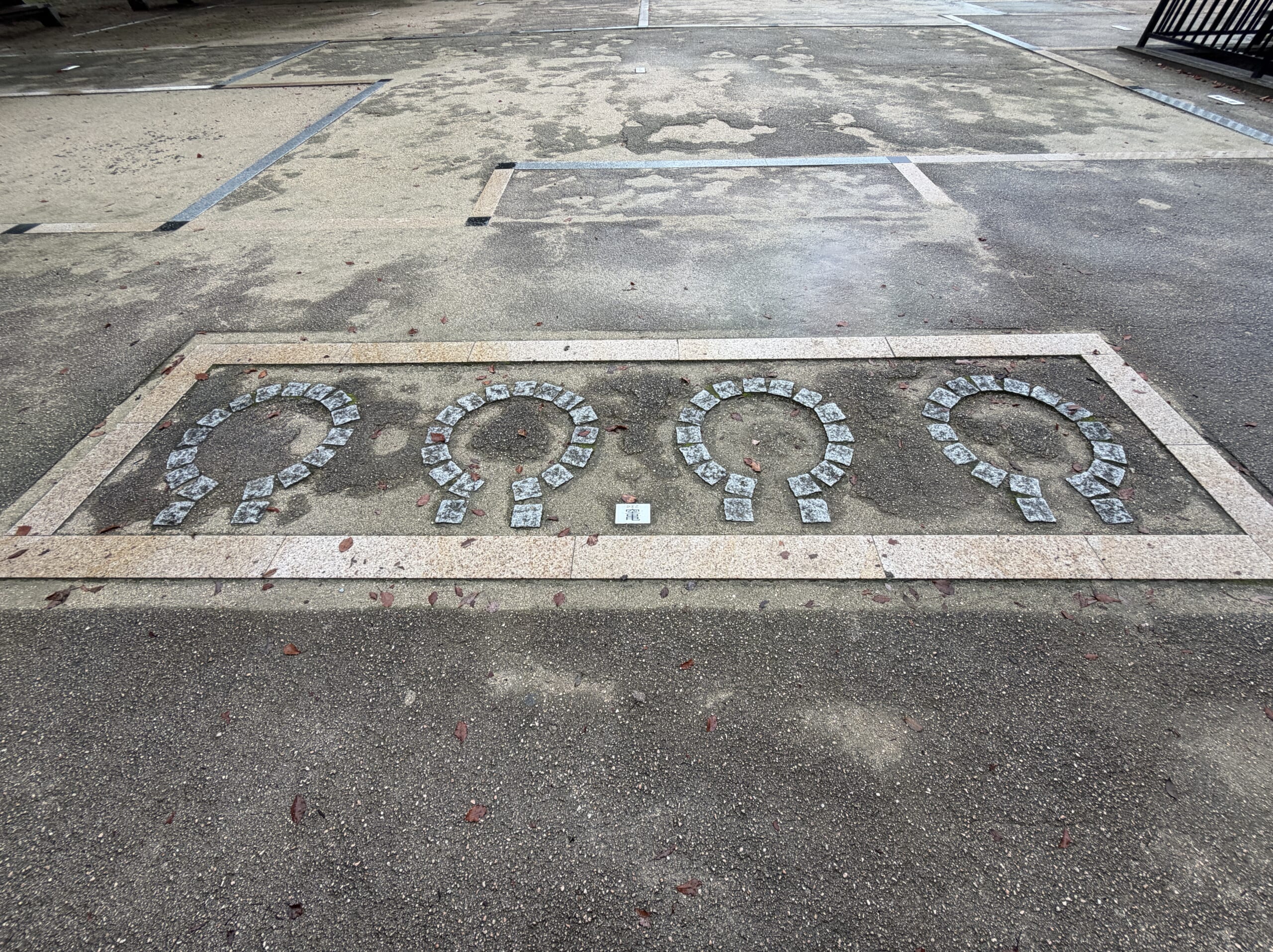
I kept saying “this is the last one, the last one”, then spotted the “Kamado” (cooking stove) markers drawn on the ground, so this is the last one… (haha)
Okayama Castle was bigger than I expected, so going all the way round took quite a while. I took the tram back from Shiroshita, too. It felt like I got off almost as soon as I’d got on — I wish I could have swayed along on the tram a little longer~.
Comparing stone walls from different eras, learning where the stones came from — it all made me want to visit the ishichōba (old stone quarries) left on the islands of the Seto Inland Sea. First, I’ll start by reading up on them. Next time, I’d like to see much more, Korakuen Garden included.
Bonus: The Ekiben from the Night Before
The night before, I had the Okayama ekiben (station bento) “Momotarō no Matsurizushi”. It’s sushi topped with prawns, fish, plus shredded omelette, served in a pink peach-shaped container.