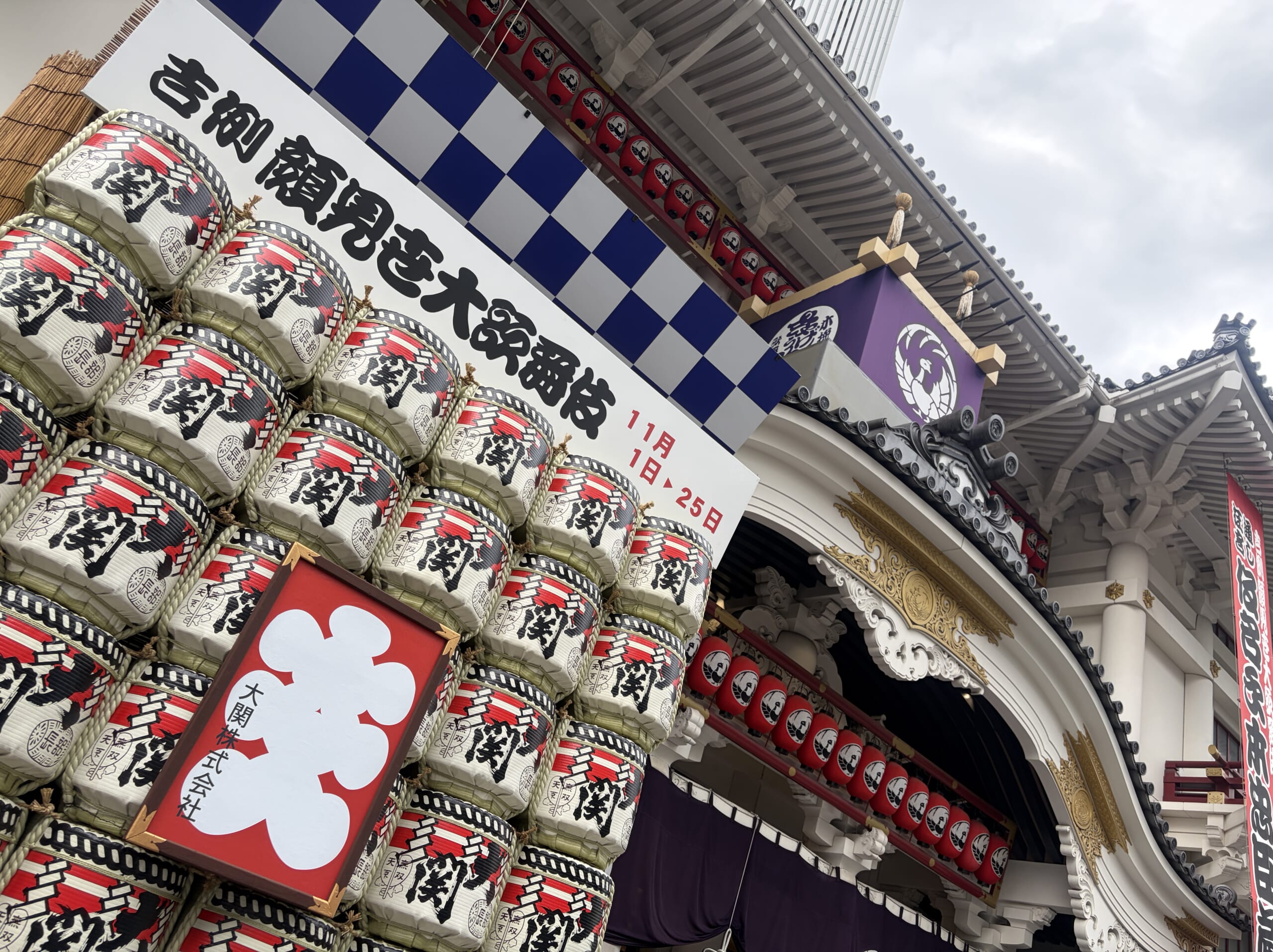
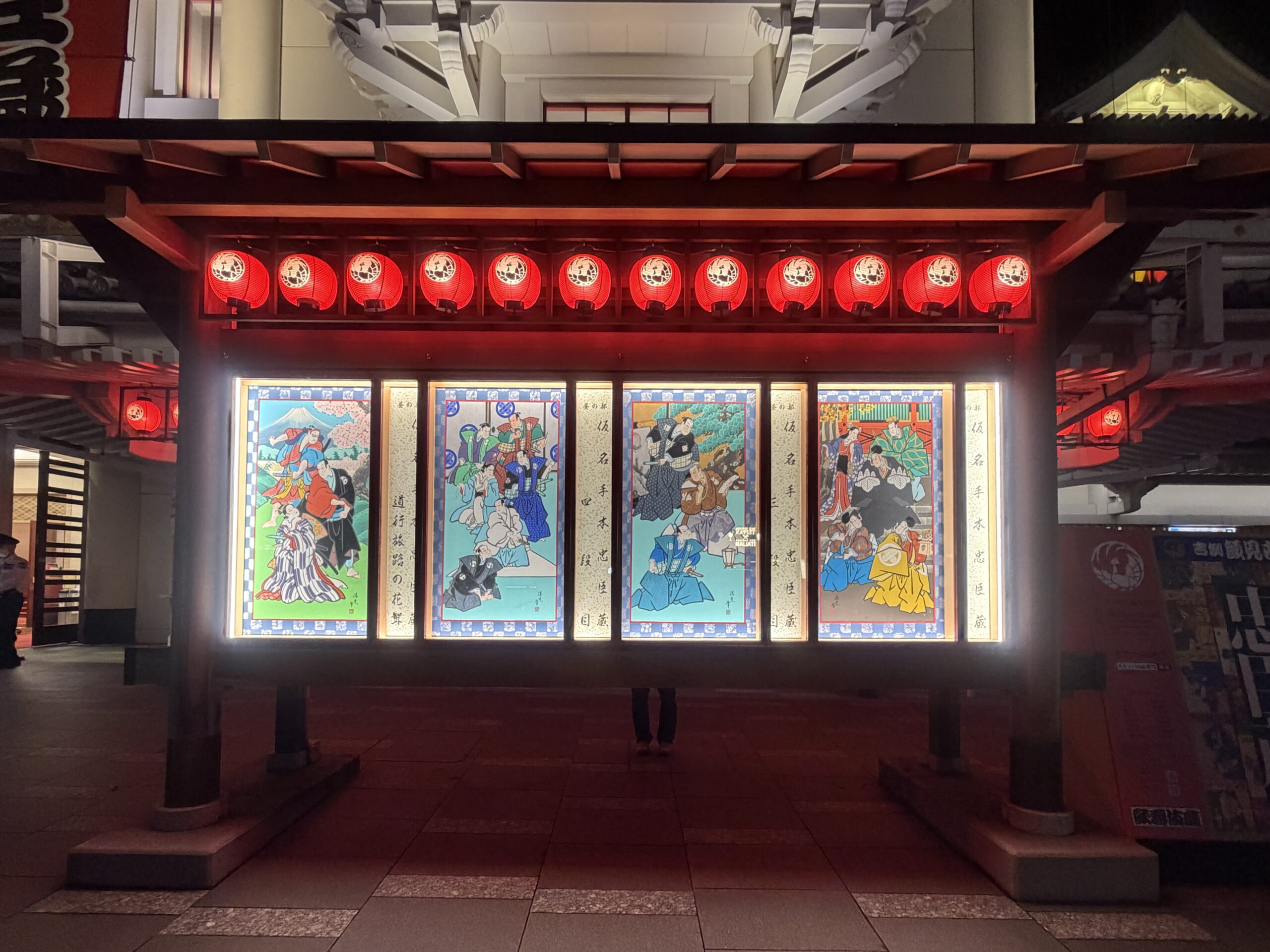
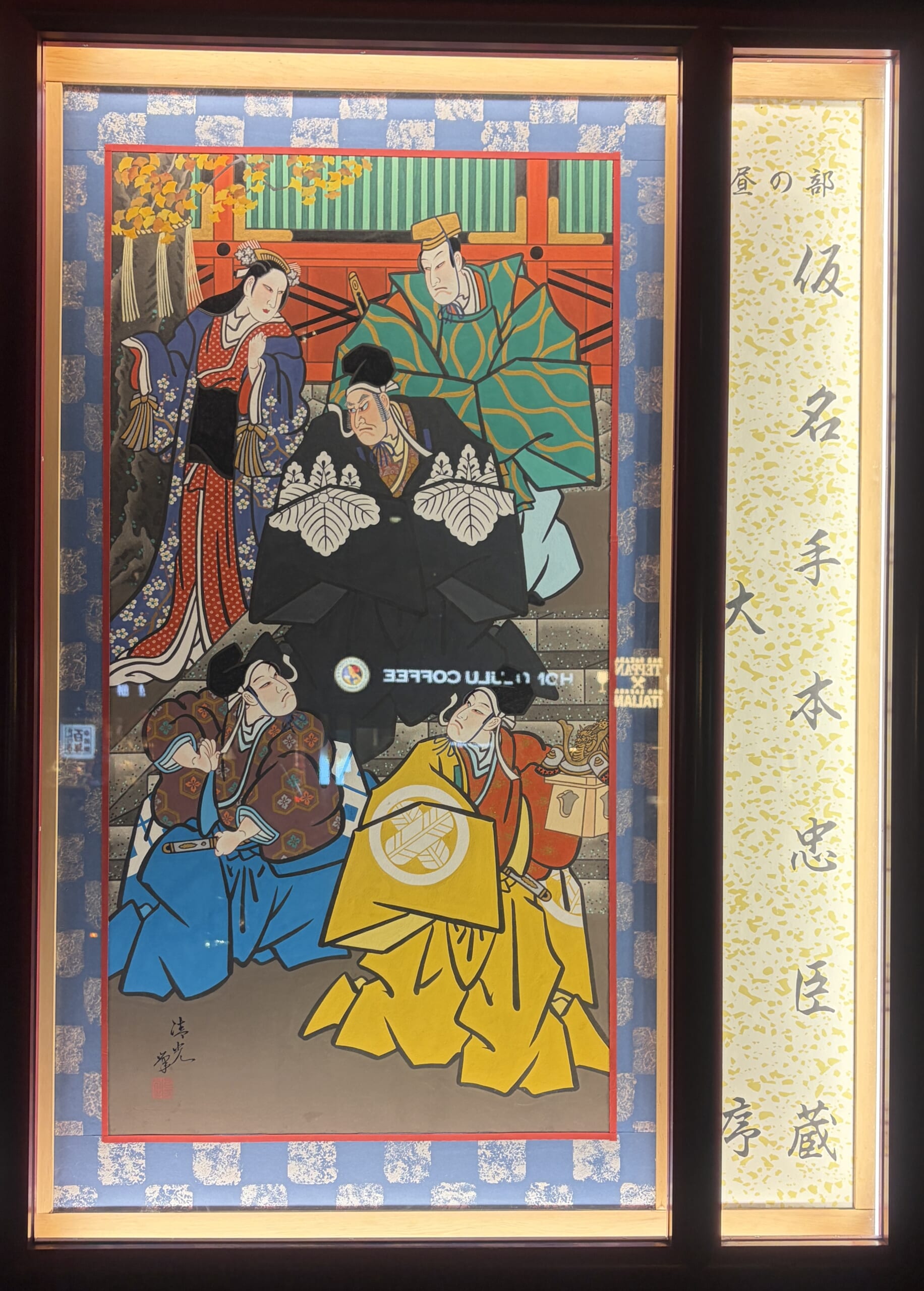
Shichinosuke Nakamura as En’ya Hangan was simply exquisite! Just seeing the painted signboards outside had me thinking, “Classical kabuki really gets me going!” The moment it was over, that had turned into, “I want to see it again.” Once again, today was simply the best.
Read about the Evening Show → November Program at the Kabukiza Theatre: Evening Show, Program B (November 2026)
More from this production → Bonus: November Program at the Kabukiza Theatre, Matinee (November 2026)
What Is Kanadehon Chūshingura?
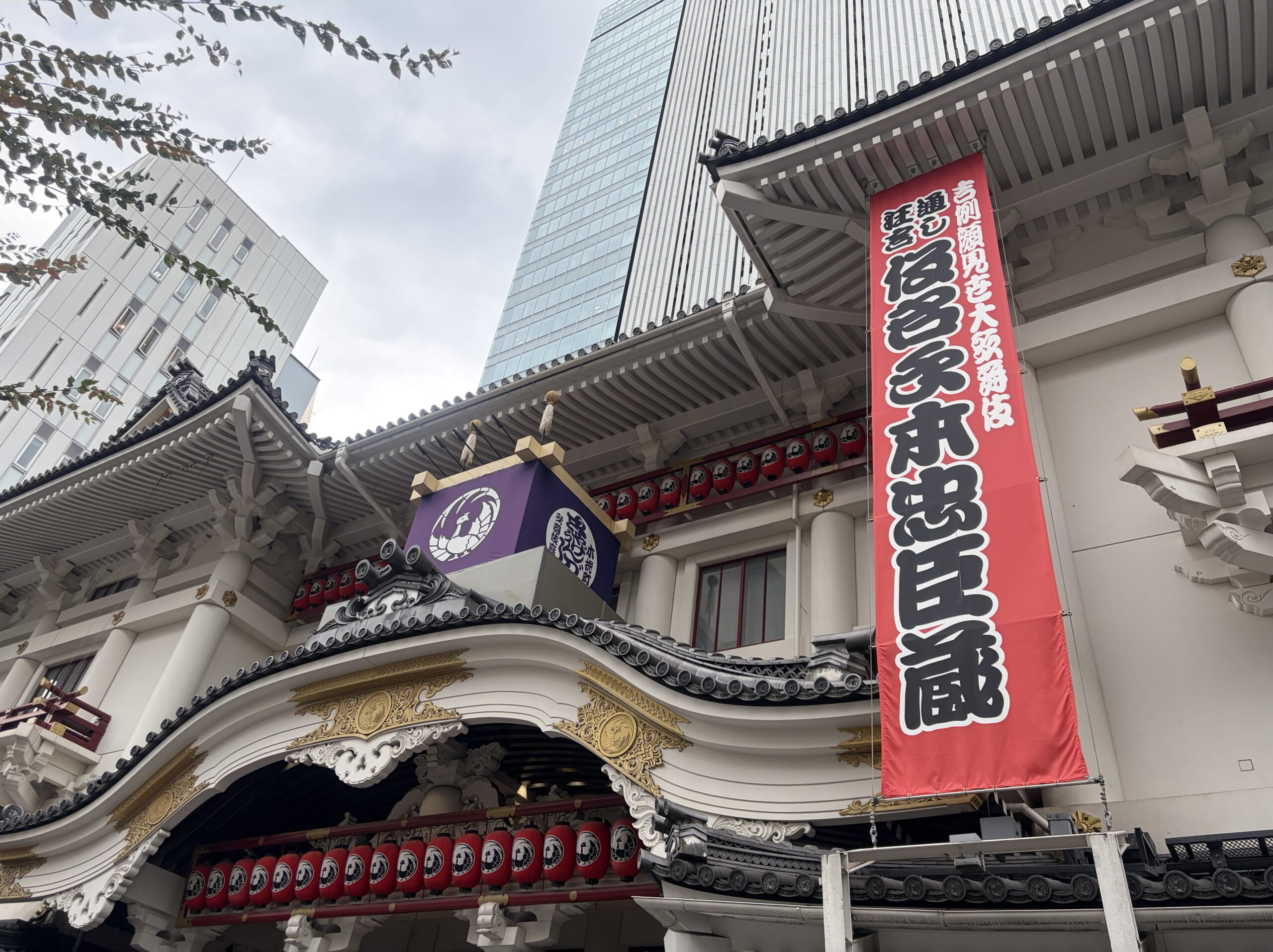
Kanadehon Chūshingura (The Treasury of Loyal Retainers) is one of kabuki’s three great masterpieces, alongside Sugawara Denju Tenarai Kagami as well as Yoshitsune Senbon Zakura. It takes the real-life vendetta of the Akō rōnin, which happened in the Edo period, then moves it to the era of the Taiheiki chronicle. Kō no Moronao stands in for Kira Kōzukenosuke, while En’ya Hangan stands in for Asano Takumi no Kami.
This month, the Kabukiza is staging the whole epic across the Matinee plus the Evening Show as a tōshi kyōgen (a full-length staging). What’s more, it comes in two versions with different casts, Program A, Program B. I saw Program B. The Matinee runs from the Daijo (the grand prologue), through Act 3, to Act 4, where Hangan commits seppuku, finishing with the dance piece Michiyuki Tabiji no Hanamuko (The Lovers’ Journey).
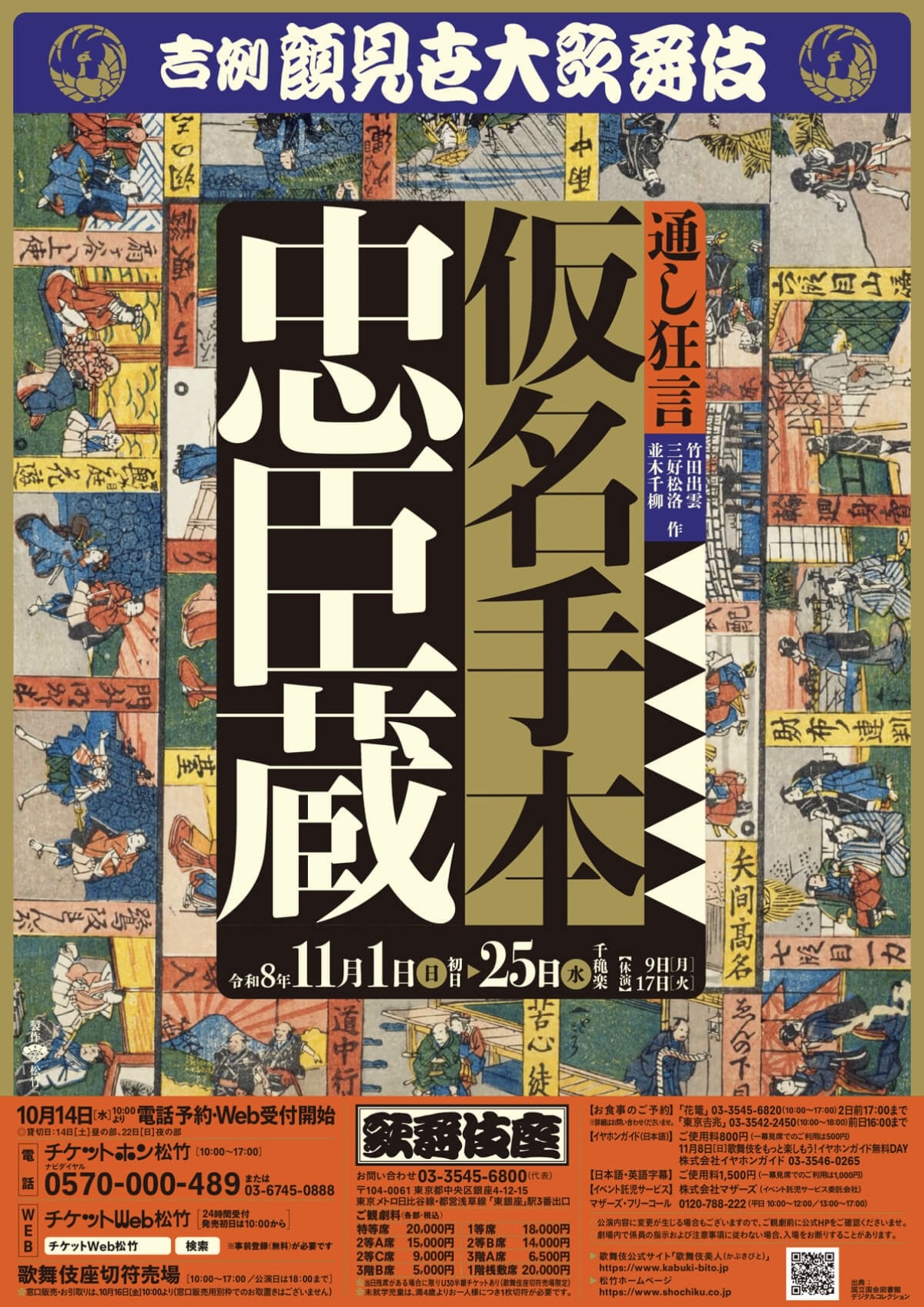
I’ve seen the Ichiriki Teahouse scene (Act 7) several times, plus I saw the full-length version at the Kabukiza in March last year too. What I was really looking forward to: Shichinosuke Nakamura as En’ya Hangan, plus the Michiyuki danced by Tokizō Nakamura with Somegorō Ichikawa.
Chūshingura Before the Curtain Even Opens
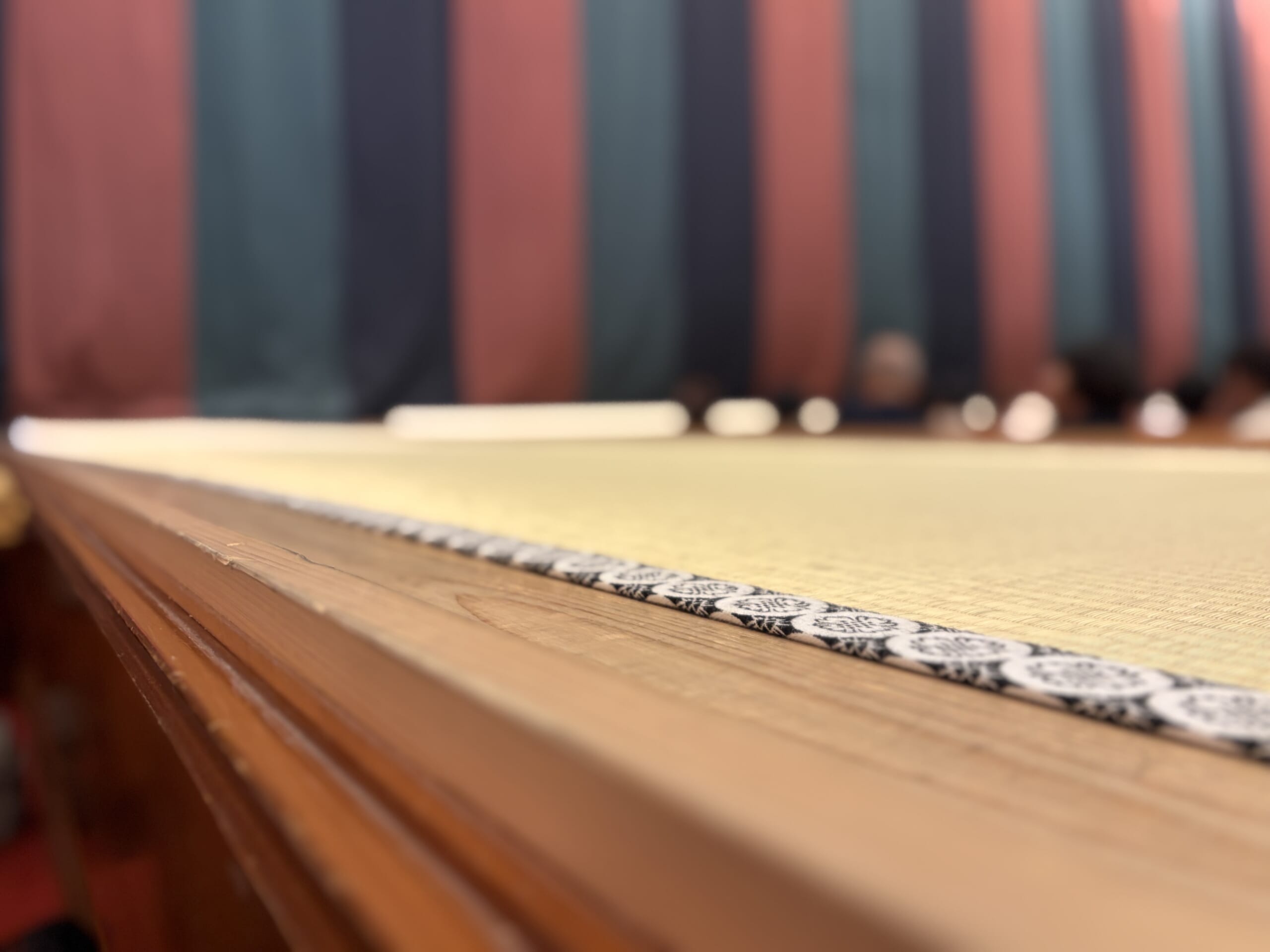
This time my seat was one of the “dobu” seats right beside the hanamichi (the walkway running through the audience), towards the front. Right in front of me was the tatami at the edge of the stage, giving off a lovely tatami scent 🫶
About ten minutes before curtain-up, a kōjō ningyō (an announcer puppet) appears in front of the curtain to read out the day’s cast, one by one. It’s a tradition unique to Chūshingura, which I absolutely love.
I pretty much knew the cast already, so I was nodding along, clapping away, when suddenly, during the cast list for the night-raid scene, out came the name Tsurumatsu Nakamura! The official website doesn’t list every single actor, so I had no idea at all that he was appearing… I only found out from the puppet.
Back before you could look everything up online, I imagine audiences often learnt the cast this way, from the announcer puppet. Thinking about it like that, I felt as if I’d become a theatregoer from the Edo period. I had seen him at the Heisei Nakamura-za, but I’d been wondering nervously when I’d hear his name at the Kabukiza, so I was absolutely thrilled!
The Four Acts of the Matinee
Daijo: A Curtain That Opens Ever So Slowly
The Daijo begins slowly, really slowly. In time with the ki (wooden clappers), the striped jōshiki-maku curtain draws back little by little. Tradition has it that the clappers are struck 47 times, the same number as the loyal retainers.
Then comes the tōzai-goe, the call of “Tōzai, tōzaai.” It travels from one side of the stage, to the centre, then across to the other side, repeated seven, five, then three times. While counting along, I get nervous that I’ll lose count. But the very last call before the end is shorter, delivered differently, so you can tell, “Ah, this is the last one.” Cleverly done.
Kō no Moronao, who pesters Lady Kaoyo (Manju Nakamura) with his advances, is played by Yajūrō Bandō. I’m fairly sure he had a role like that in a film too, so the two crossed over in my head. I couldn’t help laughing (haha).
Stepping in to calm things down, as the fuming Momonoi Wakasanosuke squares up to Moronao, is En’ya Hangan: Shichinosuke. He usually plays onnagata (female roles), so when he takes a tachiyaku (male role), he’s twice as cool. Graceful, with a softness that feels almost like wagoto (a gentle, refined style of playing male roles). I absolutely love it.
Which brings to mind Program A’s En’ya Hangan, played by Ukon Onoe. I’m itching to see that one too…
Act 3: Everyone, Please Keep Each Other in the Loop!
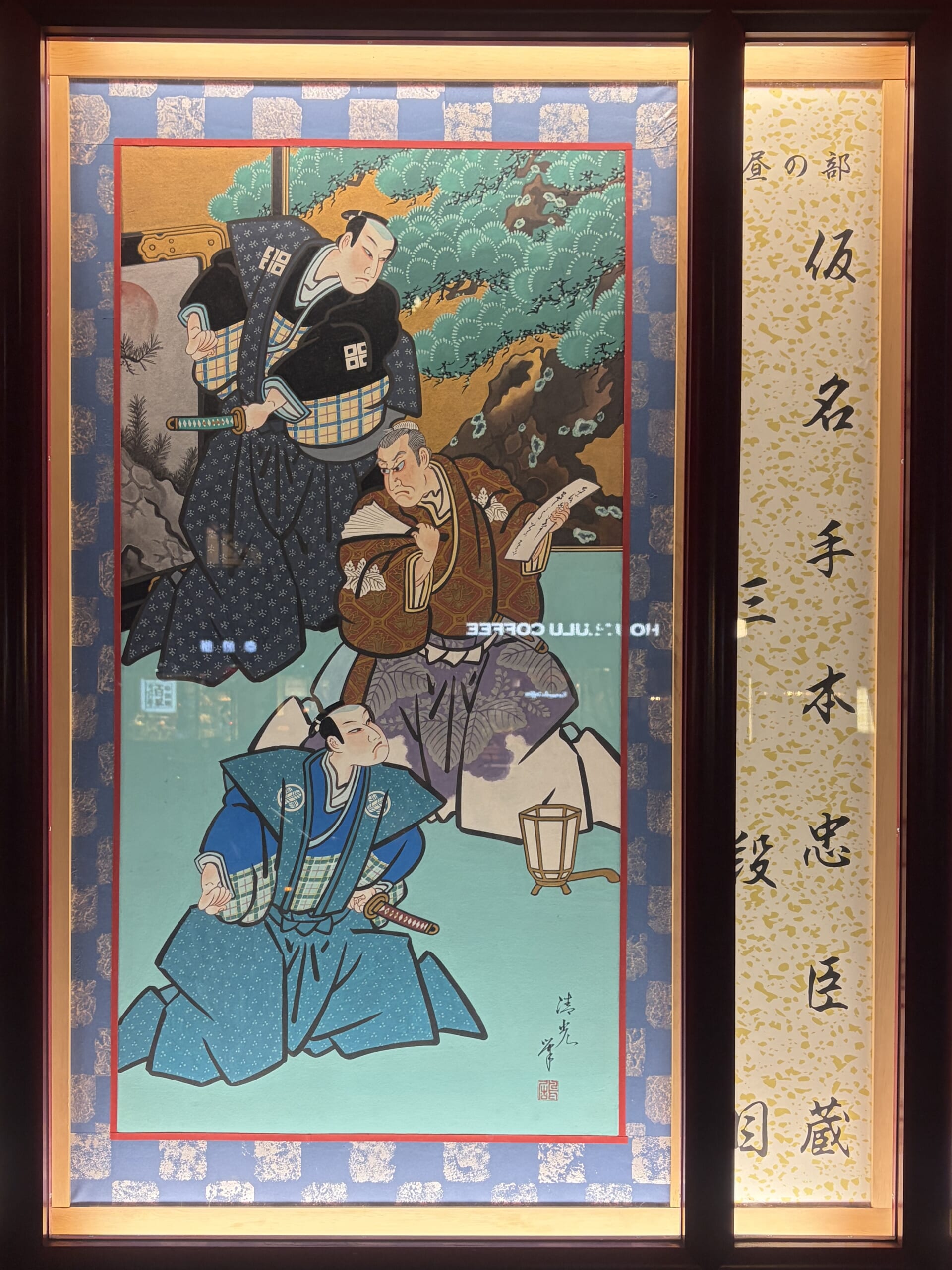
Wakasanosuke’s chief retainer, Kakogawa Honzō (Kitsutarō Ichimura), secretly bribes Moronao to spare his lord from disaster. So in the Pine Room, as Wakasanosuke waits ready to strike, Moronao suddenly grovels with apologies. Wakasanosuke is left completely deflated.
Wakasanosuke is played by Kashō Nakamura. Hot-blooded, full of fire, he was brilliant. Mind you, Ukon’s Wakasanosuke last year was hot-blooded too, absolutely thrilling!
So Moronao, who never wanted to bow his head in the first place, takes out all his frustration on Lord Hangan. Needling, nagging, on, on, on. What a horrible man! Misunderstandings lead to tragedy, don’t they… I found myself thinking, “Everyone, practise hōrensō!” (the Japanese office mantra: report, inform, consult) (haha). Then again, if everyone had communicated properly, there’d be no story at all 🤣
After being needled on, on, on, Hangan finally draws his sword on Moronao ⚔️ He’d been quietly seething the whole time… You must not lose your temper. You absolutely must not draw your sword. But I have to admit, I thought he looked so cool.
Act 4: The Hushed, Heavy Tōsanba
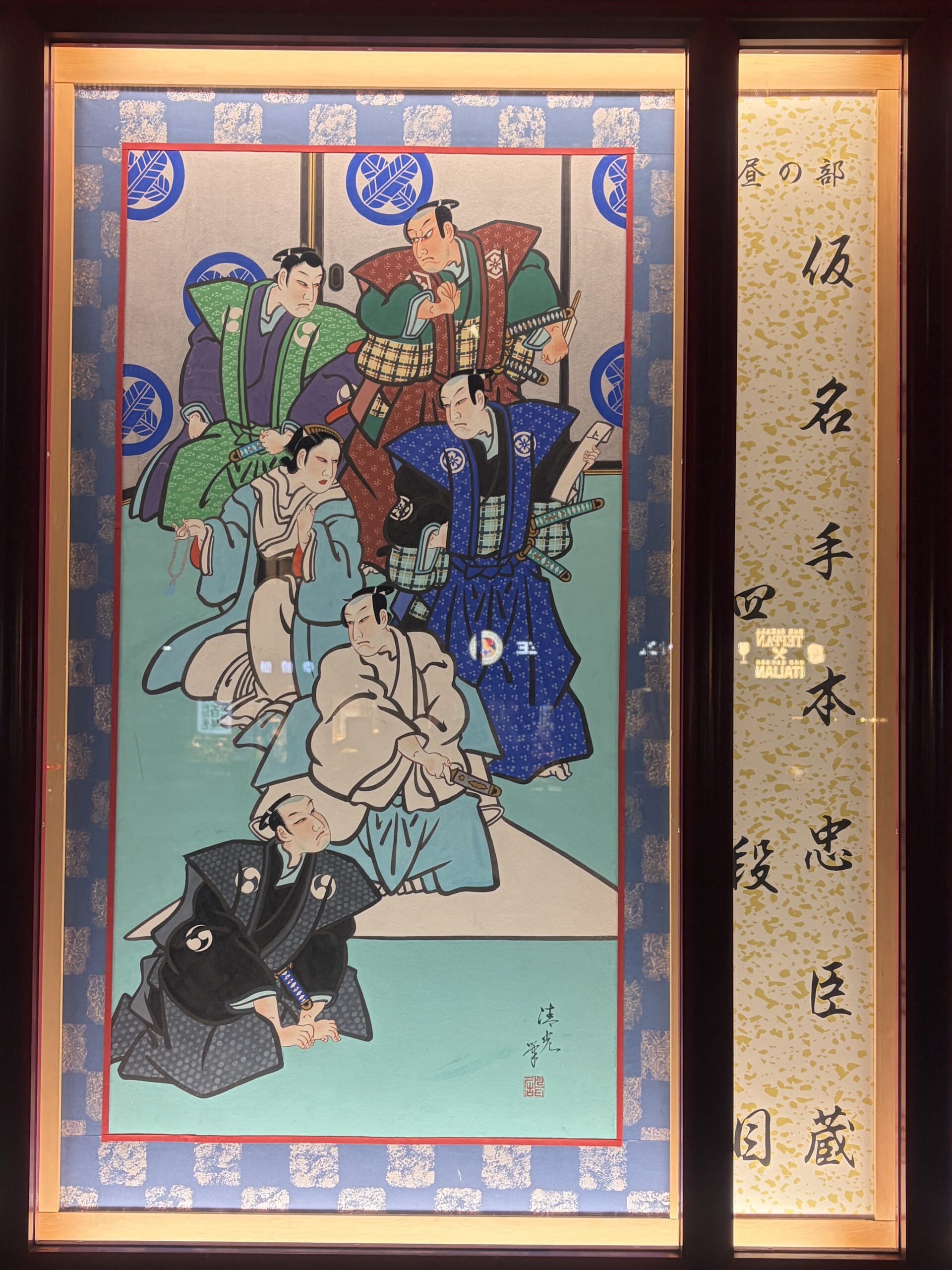
Act 4 is known as the tōsanba (“the scene where no one is let through”). For staging reasons, entry to the auditorium is partly restricted while it is performed.
Two jōshi (official envoys) arrive, Ishidō Umanojō (Shikan Nakamura) with Yakushiji Jirozaemon (Omezō Ichikawa), to deliver the order: Hangan must commit seppuku. Of course that verdict is painful, but even more painful is the fact that Hangan had sensed it was coming. He is already dressed in white. (By the way, the real Asano Takumi no Kami apparently had to commit seppuku on the very day of the incident. The same day!)
Hangan longs for his chief retainer, Ōboshi Yuranosuke, to arrive, so he can tell him of his bitter regret. He asks Yuranosuke’s son Rikiya (Tatsunosuke Onoe) for news, but Yuranosuke still isn’t here. Then, just as Hangan plunges in the blade, Yuranosuke (Kōshirō Matsumoto) finally rushes in. Always just a little too late!!! That one…
Afterwards, the sight of Hangan lying there for so long was so heartbreaking I could hardly watch. Rather than being taken offstage straight away, he deliberately stays on stage, lifeless. That makes it all the more unbearable…
The audience was silent. Well, more than that, it was painful, the air heavy. I hear that for the incense-offering scene, it’s customary to burn the incense favoured by the actor playing Hangan. Sadly, burnt on the far side of the stage, its scent doesn’t reach as far as the seats beside the hanamichi.
Rumour has it, maybe, maybe not, that the actor playing Hangan goes home afterwards without meeting anyone. Like the tōsanba itself, there seem to be all sorts of customs, not only within the play but also for the actors who perform it. It really makes me feel how deeply cherished this play has been.
When Yuranosuke leaves the castle behind, it’s just so frustrating, isn’t it? Honestly, Kō no Moronao is overwhelmingly in the wrong, right? Hmm? Ah, unless… was Lady Kaoyo simply too beautiful? Back to square one? (haha) No, Kō no Moronao is still the villain!
Michiyuki Tabiji no Hanamuko: What a Relief!
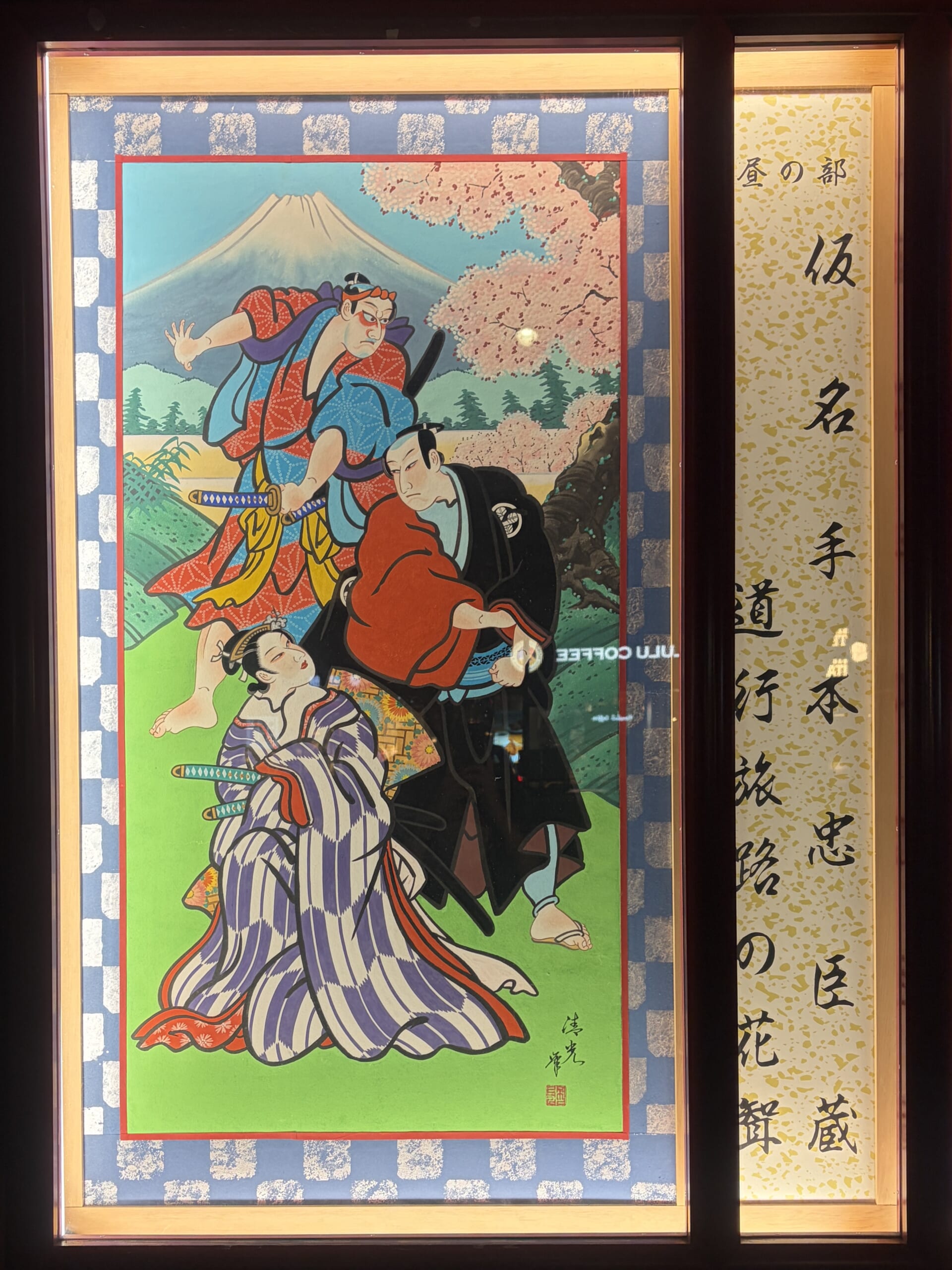
A michiyuki is a dance depicting a journey. Here, Hangan’s retainer Hayano Kanpei flees with Okaru, a lady-in-waiting to Lady Kaoyo. The pair are ashamed that they were off on a secret rendezvous at the very moment their lord was in trouble.
After the heavy Act 4, an interval, then the curtain opens on such brightness. What a relief! Because think about it: while Lord Hangan was in deep trouble, these two were busy flirting! There’s a touch of youthful folly to its cheerfulness, which is such a relief (haha).
Plus, it’s Tokizō with Somegorō. Beautiful beyond words.
When the two stood side by side on the hanamichi, Somegorō’s hand was so beautiful. It hovered beside Tokizō’s Okaru, placed so gently, almost touching yet not quite. The way he held that hand was so lovely, you could feel how protected she was! Since I was sitting right beside the hanamichi, I got to see that closeness up close.
As for Somegorō, he’s always handsome, but he was even more so than usual. “Cool” isn’t quite it; “otokomae” (dashingly manly) fits best. His face was tiny, too. Hey, did something happen? (haha)
Above all, Tokizō: I really do love him! …Ah, I mean Okaru, Kanpei, of course (haha). The pair were so beautiful that halfway through, they turned into Tokizō with Somegorō in my eyes. My apologies.
Okaru’s unwelcome admirer, Sagisaka Bannai (Tanenosuke Nakamura), comes chasing after them, but the two were so perfect there was no room at all for him.
In Closing
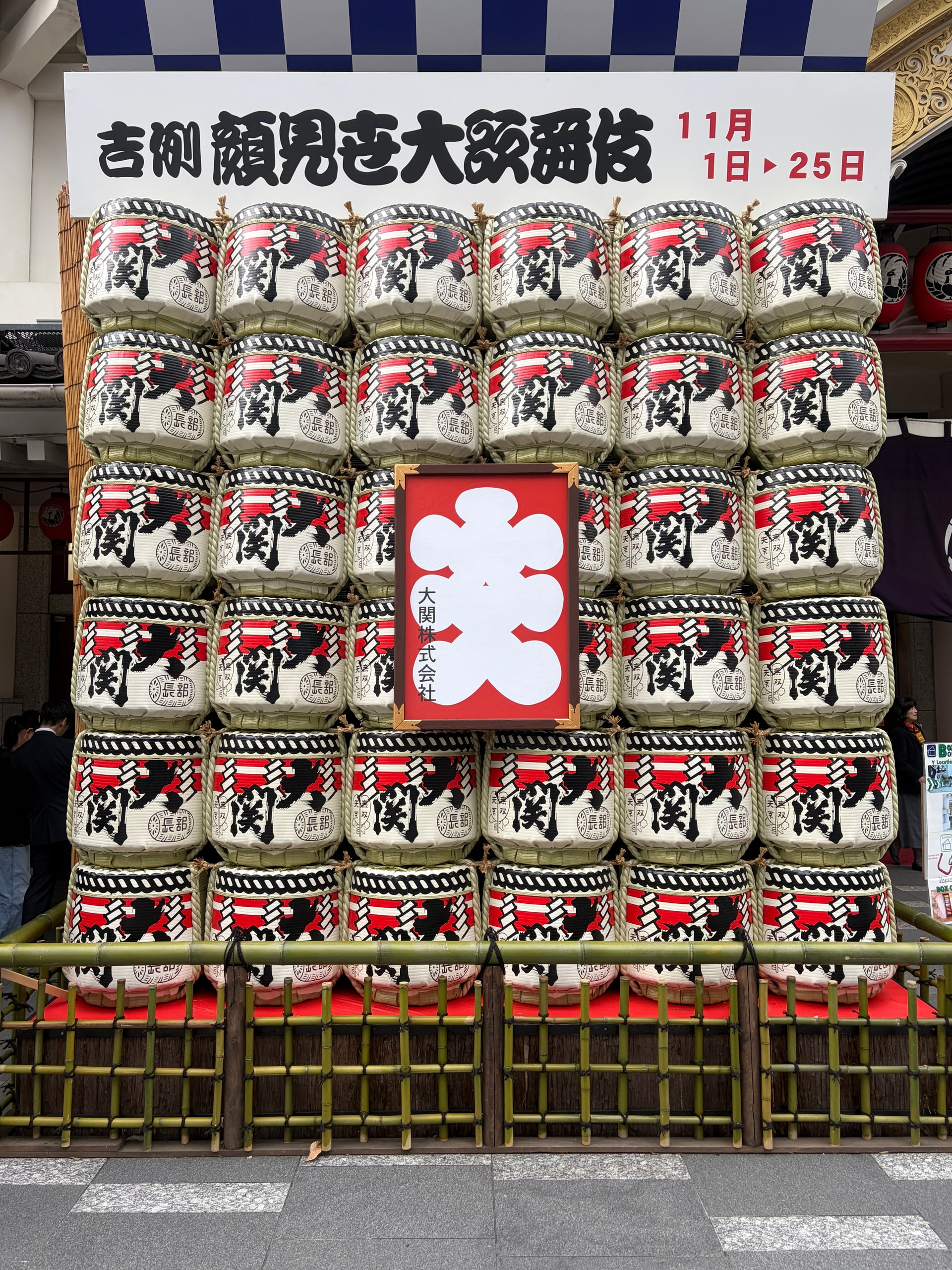
From the slowly opening curtain of the Daijo, to the silent, heavy Act 4, to the redeeming Michiyuki. When the matinee ended, what remained was, “I want to see it again.”
In Program A, Hangan is played by Ukon. It would likely be a completely different Hangan from Shichinosuke’s, so I’d love to see it too. Kikugorō Onoe’s Okaru can only be seen in Program A as well, which I’m curious about. Being able to compare different casts is one of the joys of having two programmes, I think.