It was like watching a small light appear in pitch darkness, a darkness so deep you couldn’t see the bottom, then grow and grow until it burst. Quiet but fierce, and very, very deep. The first thing out of my mouth when it ended was, “Well, I’ve just seen something.” 🥺 Yes, today was the best, as always.
- My First Visit to Tokyo Metropolitan Theatre, and a Note About “Bodies”
- So What Is Marcos Joruri “Kinkaku-ji”?
- “Beauty & Ruin” Before Curtain-Up
- A Scorched Curtain, and the Puppet Who Was More Human Than Anyone
- Maholo, Who Exists Only “Now”
- The Onnagata Kazutaro Looked the Most “Male” of All
- Light and Sound, and Thoughts of Boltanski
- The Answer to “Beauty & Ruin”
- Closing Thoughts
My First Visit to Tokyo Metropolitan Theatre, and a Note About “Bodies”
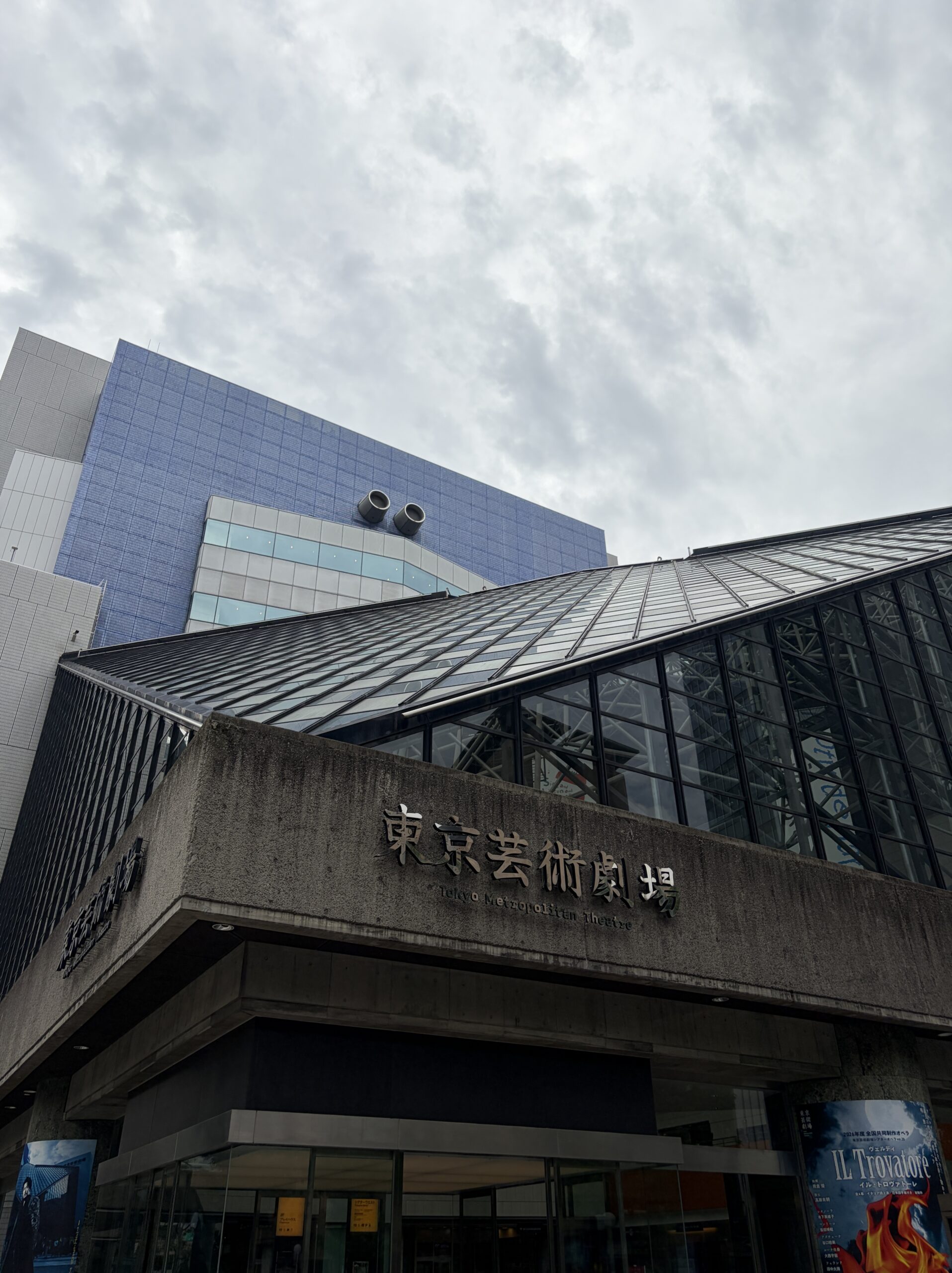
This was my first time at Tokyo Metropolitan Theatre in Ikebukuro. With Toshiki Okada newly appointed as artistic director, I’m very curious to see what direction this theatre takes from here.
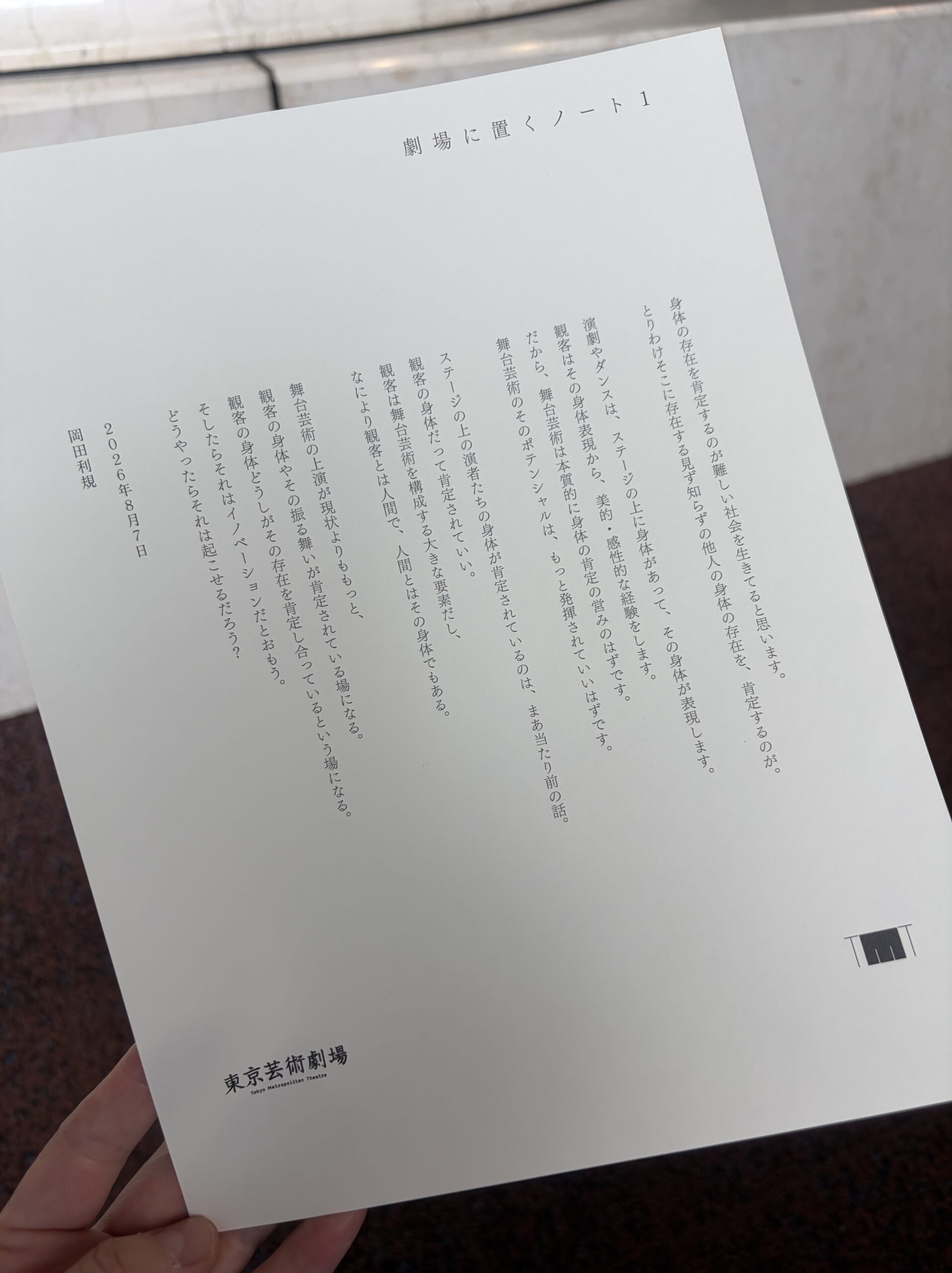
By the flyers in the lobby was a short piece by Okada called “Notes Left in the Theatre 1”. It’s about how the performing arts need two kinds of bodies to exist: the performers’ bodies on stage and the audience’s bodies in the seats. Performers watch how the audience reacts, and the audience responds to the performers with their whole bodies. A stage is never a one-way street, is it? And right after reading this, I watched a production in which puppet bodies and human bodies cross paths. Good timing.
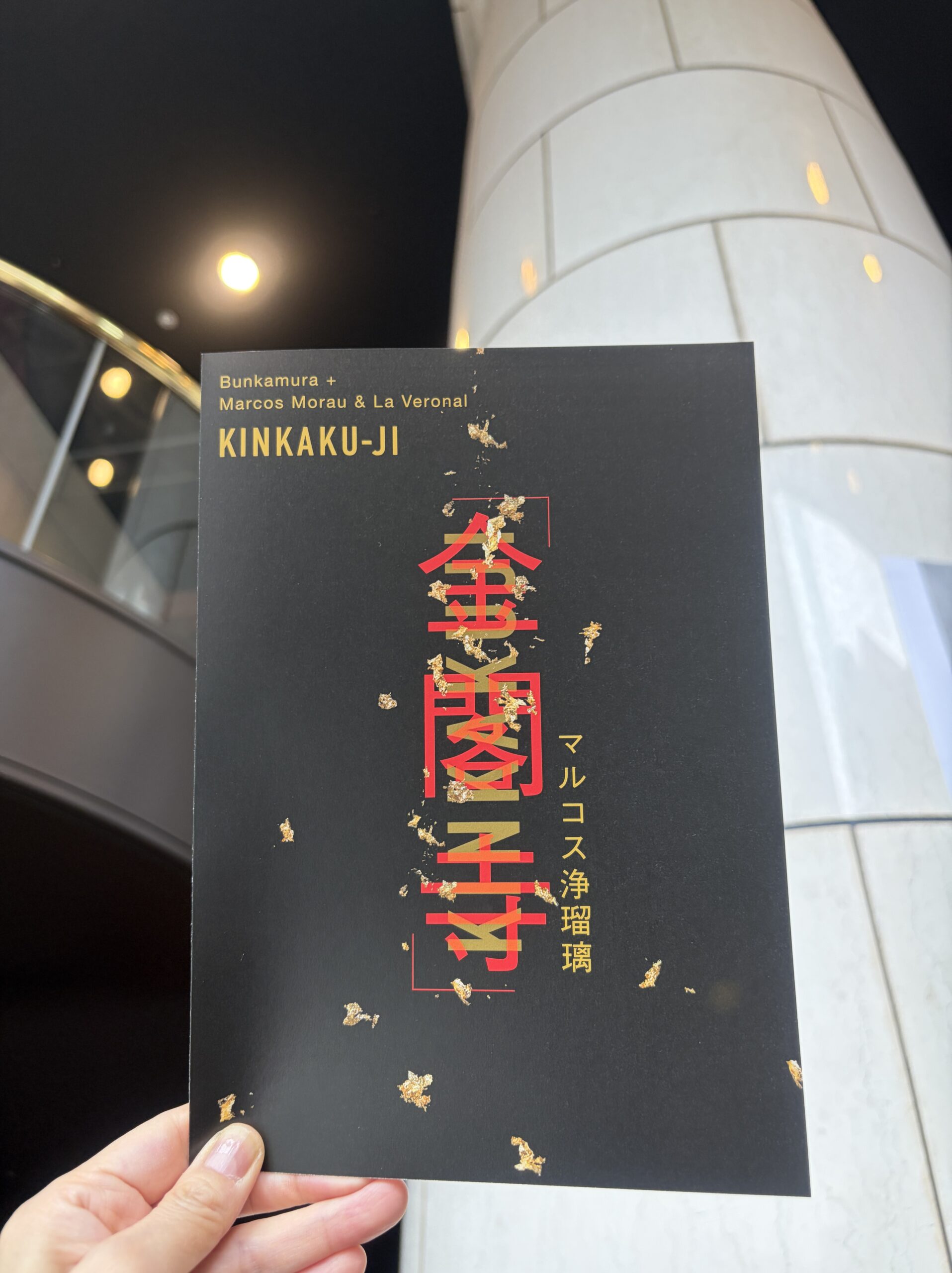
So What Is Marcos Joruri “Kinkaku-ji”?
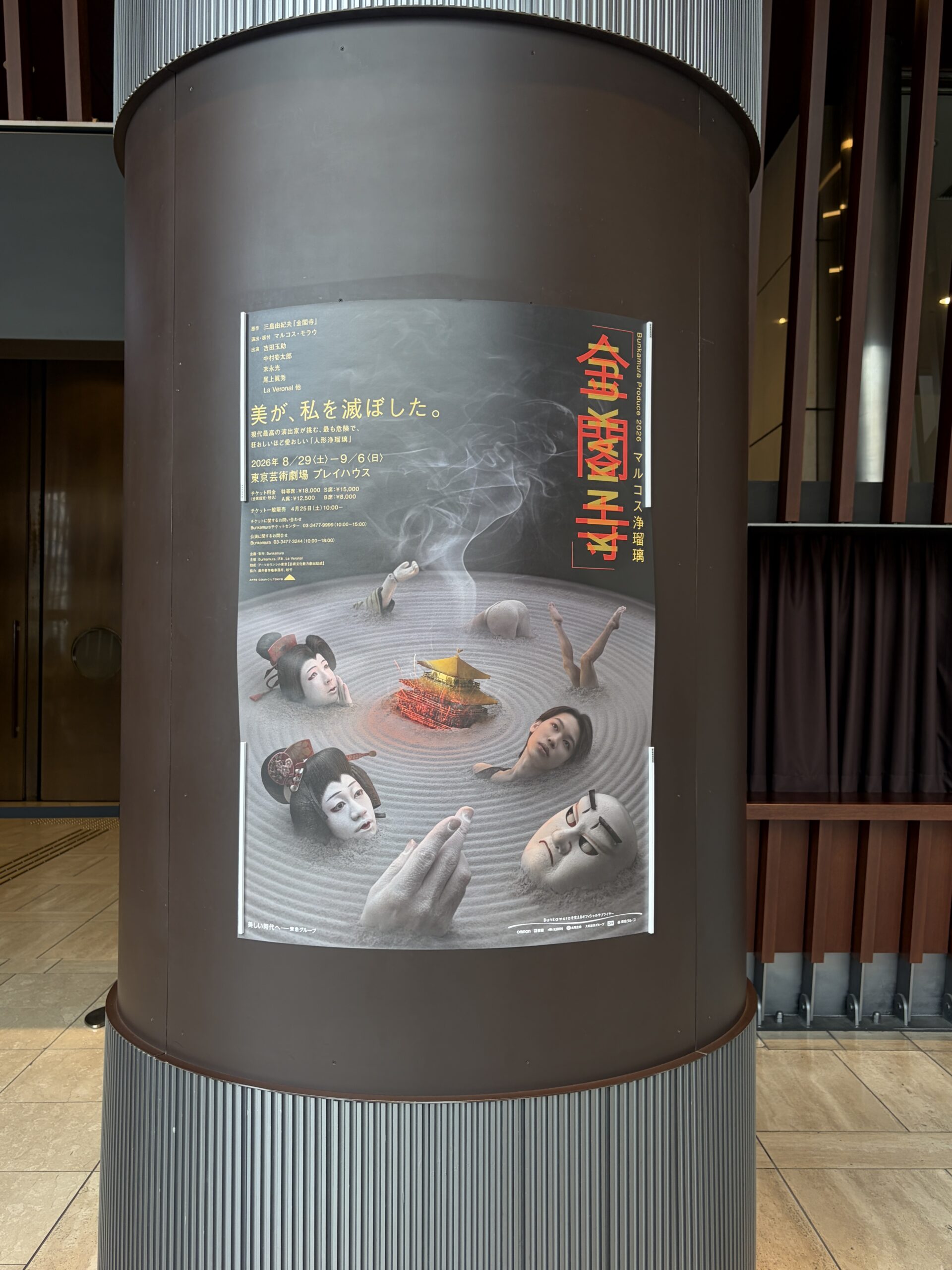
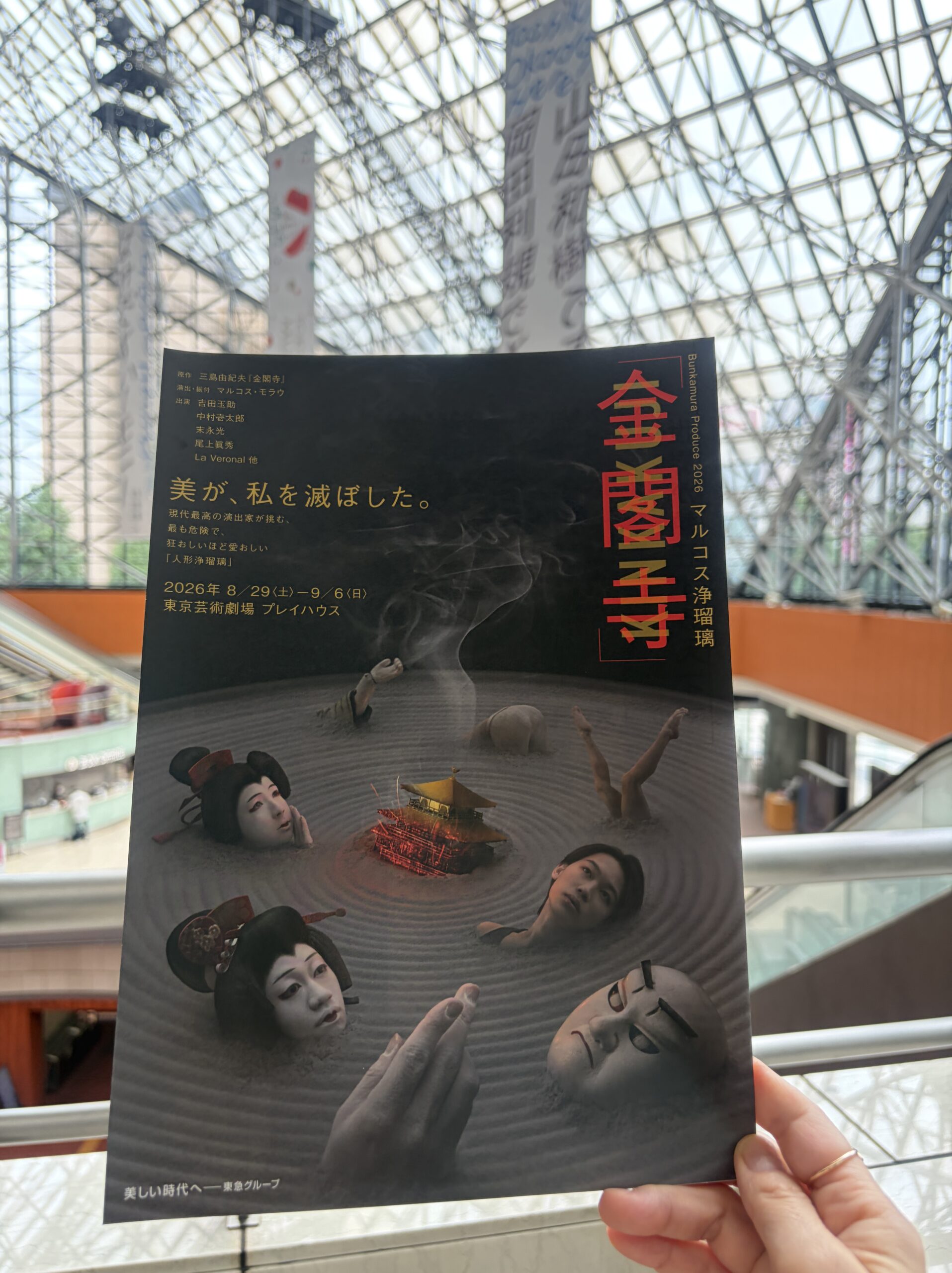
The source is Yukio Mishima’s novel The Temple of the Golden Pavilion (Kinkaku-ji). Direction and choreography are by Marcos Morau, who leads the Spanish dance company La Veronal. On stage: bunraku puppets handled by Tamasuke Yoshida and his fellow puppeteers, kabuki actors Kazutaro Nakamura and Maholo Onoe, idol Koh Suenaga, seven dancers gathered from across Europe, and the Catalan singer María Arnal. Bunraku, kabuki, dance and song: different kinds of bodily expression, all on one stage, in a world premiere.
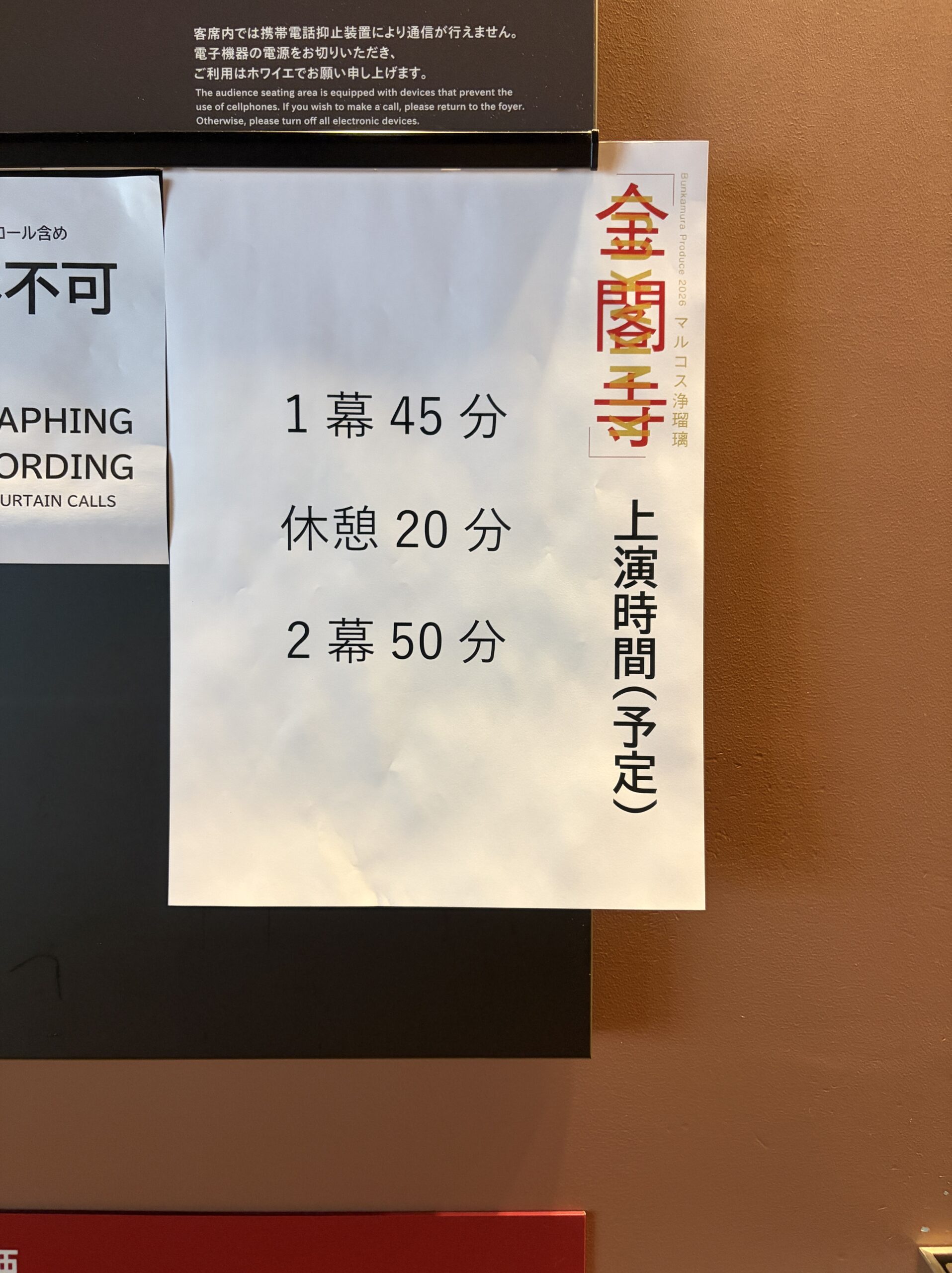
Running time: Act 1, 45 minutes; a 20-minute interval; Act 2, 50 minutes. Once it started, it was over in a blink.
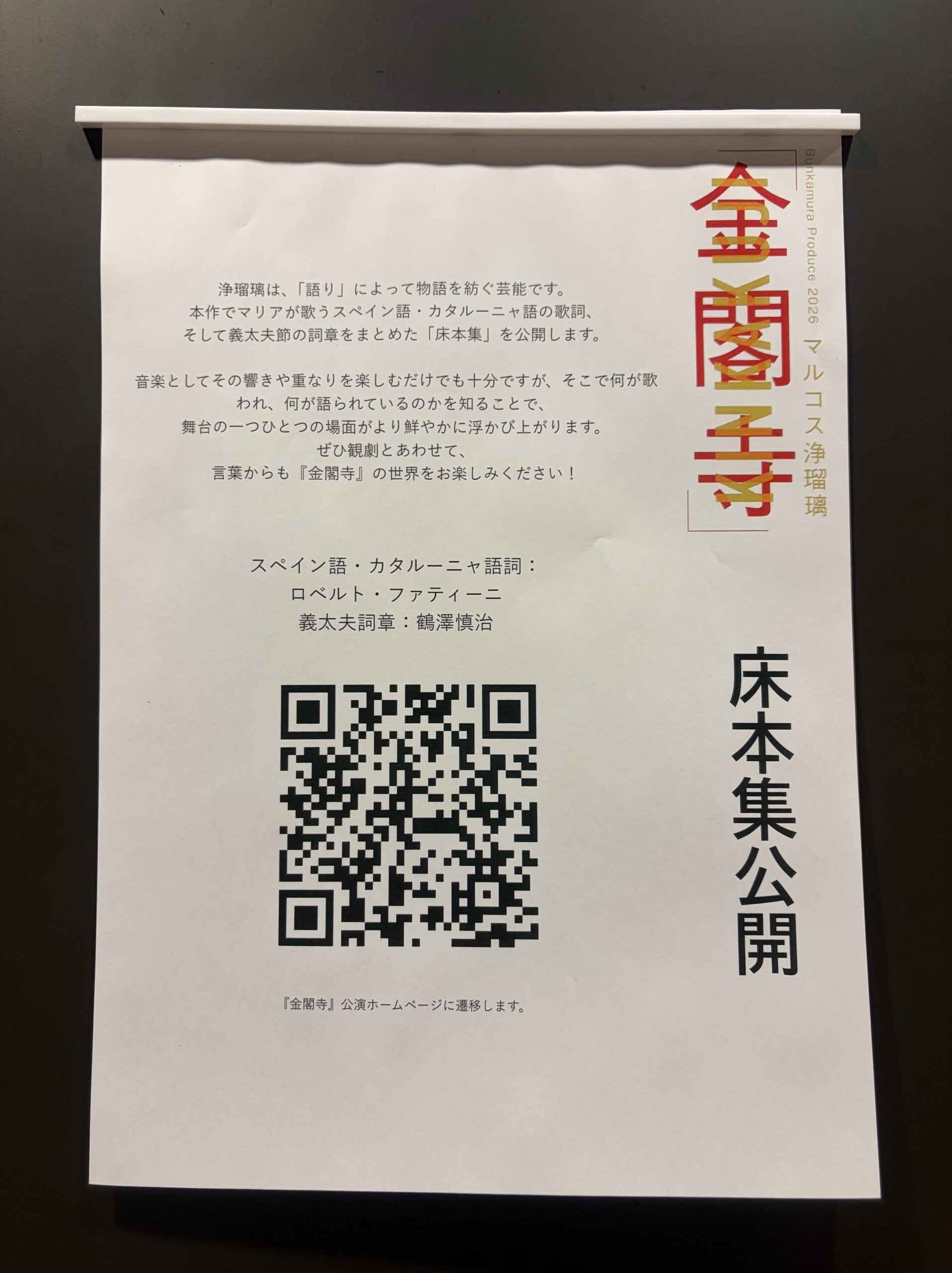
Incidentally, although this is billed as joruri (the sung narration that accompanies the puppets), there was no printed yukahon, the libretto you normally receive at bunraku. Instead you scan a QR code in the lobby and read it on the production website. Since mobile-phone jammers operate in the auditorium, it’s less something to follow along with than something to read before or after the show. I read it when I got home. That comes back later.
“Beauty & Ruin” Before Curtain-Up
I went in as soon as the doors opened, so I had a wander round before heading to my seat. That was when I found the production’s special cocktail, “Beauty & Ruin” 🍷 It’s normally a sparkling sake cocktail with yuzu honey and lemon, but I had them make it non-alcoholic. Clean, refreshing sweetness, very easy to drink. If I’m honest, it was a zero-judgement, no-look order (“What? A special drink? Yes please!”), but the glass with its curving stem was so pretty that it alone was worth it ⭐️

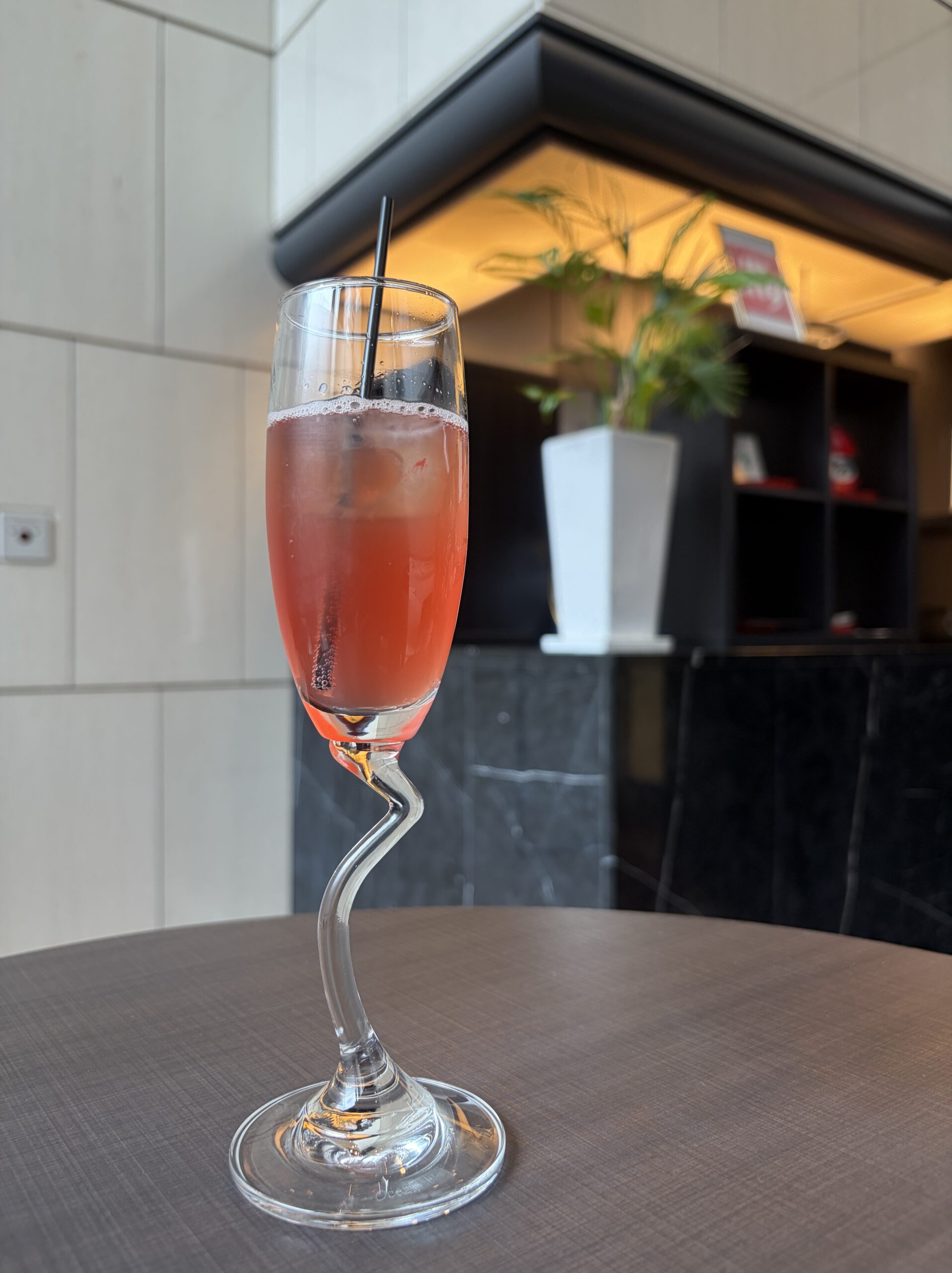
Sipping it, I found myself thinking that things heading for ruin are fleeting and beautiful. But looking at the flyer, I wondered: is this really going to be a show that ends on “fleeting”? Kazutaro’s in it, after all. Surely it’s going to be bursting with energy? That hunch only made me look forward to it more.
My seat, by the way, was in a balcony on the second level. Sitting down, the railing in front cut straight across my view, and I waited for the curtain thinking, hmm, that might be in the way…
A Scorched Curtain, and the Puppet Who Was More Human Than Anyone
At the start, Kazutaro appeared bare-faced, and then, right there on stage, began single-mindedly applying his white make-up. That was it; I was hooked.
The joshikimaku (the traditional striped kabuki curtain) was scorched and full of holes, and one by one the performers peered out through them. Among the faces was the puppet’s. Then María Arnal and the puppet embraced. At that point I knew: today belongs to the puppet.
Of everyone on stage, the one who was best (for me, at least) was indeed the puppet. Every time it appeared it seized my heart, almost painfully. A bunraku puppet is something the puppeteers breathe life into. And this time all three of them, the head puppeteer, the left-hand puppeteer and the foot puppeteer, were visible, in the unhooded style called dezukai. Everything about the people moving the puppet was in plain sight. And yet the puppet stood there with more personality than ever, almost godlike. Of everyone on that stage, the puppet was the most human.
All three puppeteers were doing movements you rarely see in ordinary bunraku, I think. Tamanobu Yoshida on the feet was in constant motion across the stage. That looks hard, I thought, and couldn’t stop watching him 🥺 And at the curtain call, the puppet blew a kiss to the audience. So stylish; a feast for the eyes ❤️
The biggest applause of the night also went, I suspect, to the puppet. Everyone had their hearts stolen by a bunraku puppet, I’m fairly sure of it.
Maholo, Who Exists Only “Now”
Maholo is someone on the threshold of adulthood. He has youth on his side, and the fragility, precariousness and brittleness that come only from being unfinished. Rather than acting “unfinished”, his very presence stood on that stage as a symbol of the beauty that lives in fragility. Not every young performer could bring that out; it had to be him, the role fitted him that precisely. I couldn’t look away.
And even for Maholo, who fits the role so perfectly, it is a role that only the Maholo of this moment could play. And we can only see it now. I think this is true of any stage: a role played for the first time and one played many times over are performed differently, and watched differently. Performers and audiences both change through experience. Theatre happens only once, and that is exactly what makes it so fascinating ❤️
The Onnagata Kazutaro Looked the Most “Male” of All
In Act 2 the dancers shed their white coat-like costumes for something closer to dresses, and their bodies and movements began to look a little like onnagata (kabuki’s male actors of female roles). Kazutaro, meanwhile, radiated the kind of raw energy that shouts “I’m alive!” Perhaps the only “man” on that stage was Kazutaro, who normally plays women. Strange, isn’t it, his particular magnetism.
Puppets looked human, living humans drew closer to puppets, and the male-female boundary wavered. Okada’s note about “bodies” had come back round.
Light and Sound, and Thoughts of Boltanski
In Act 2, a single line of lights running across the stage flickered on and off in time with a knocking sound. I’d been thinking from the start, “I rather like this atmosphere”, and halfway through it clicked: Christian Boltanski. “The Last Class” in a disused school in Echigo-Tsumari, and “Les Archives du Cœur” on Teshima, works that use light and sound in darkness to conjure the presence of people who aren’t there. Feeling that from the stage, I thought, ah, I want to go back to the Seto Inland Sea 🚢 Boltanski is an artist I find myself needing to revisit regularly.
Come to think of it, the dancers’ faces weren’t lit, were they? Subtle adjustments like that are what build the whole stage. Frightening, Morau 😱
Gidayu (bunraku’s narrative chanting), my favourite of bunraku’s three arts, felt here like one ingredient of the joruri rather than the main course. Gidayu layered over Western melodies is rare, and precious for that. Still, if I’m honest, I’d have loved to hear some full-throated, hard-core gidayu on that stage too.
And María Arnal’s singing was wonderful. Curious about the source of those sorrowful melodies, I looked her up: she’s a singer who has worked with both Spanish traditional music and contemporary sounds. That explains it, and explains why her voice filled the darkness of that stage so completely.
The Answer to “Beauty & Ruin”
There were many kinds of beautiful people on that stage. The puppet, godlike and more human than anyone. Kazutaro, standing there with the heat of a living body: “I’m alive!” And between them, Maholo, living in a time that had not yet become either.
The urge to ruin, to break something, because it is beautiful. And the sense that something is beautiful because it will be ruined. Both of these contradictory things were on that stage at once. But what is truly beautiful cannot, after all, be touched. And left untouched, it is the one who reaches out who breaks. That, I think, is the kind of production this was.
While I watched, something of The Sea of Fertility kept drifting across my mind. When I read the libretto at home, I learned that the dharani chanted by the gidayu near the end was drawn from The Temple of Dawn, the third volume of Yukio Mishima’s The Sea of Fertility. It wasn’t my imagination.
You don’t need to know the novel; the stage design and the bodies alone are overwhelming. But reading the libretto or the novel afterwards makes the bottom of that darkness a little deeper.
Closing Thoughts
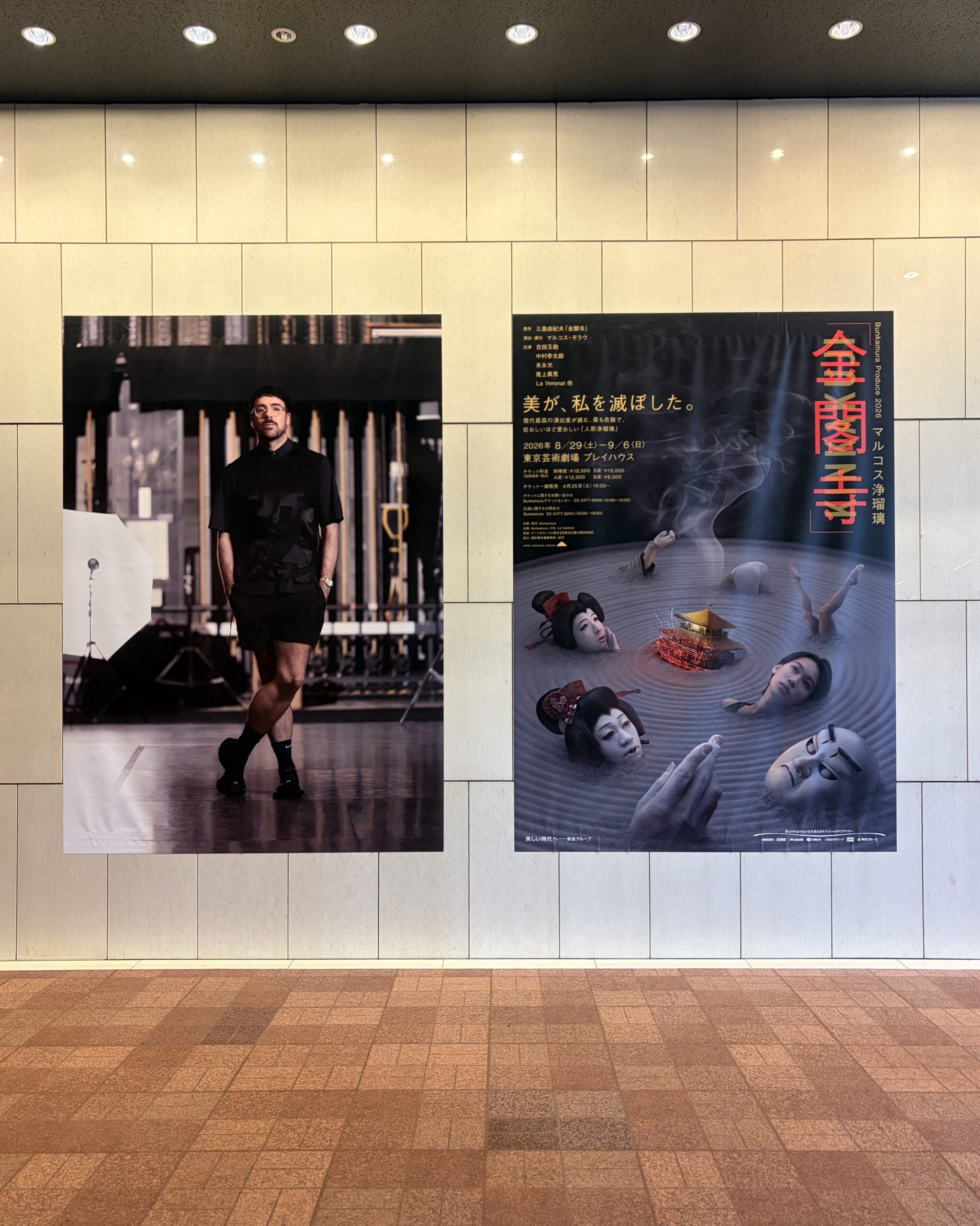
Anyway, that direction was exactly my kind of thing. I want to see it again, and I will absolutely go to whatever Marcos Morau makes next.
And I’m glad I saw Maholo now, something I’ve been quietly savouring since coming back to everyday life.