Six months after its release, I finally got to see it 😭 I was determined to watch it from a premium seat — my lower back might not have survived otherwise — so I stubbornly hunted down a cinema and booked one. A year-end screening, powered by pure persistence. And yes, today was wonderful, as always.
So, what is “Kokuho”?
“Kokuho” (meaning “national treasure”) is director Lee Sang-il’s film adaptation of the novel of the same name by Shuichi Yoshida — their third collaboration, after the films Villain and Rage. Ryo Yoshizawa stars as an onnagata (a kabuki actor who specialises in female roles), and the film follows his character’s life in the world of kabuki.
Since opening in June 2025, it has enjoyed a remarkably long run, even becoming the highest-grossing live-action Japanese film of all time. There was also that six-minute standing ovation at the Cannes Film Festival — at least, that was the line everyone kept repeating. It is, without question, the film everyone in Japan has been talking about.
(A little aside: the first time I ever saw Yoshizawa was in “Shinkaishaku Nihonshi”, a comedy TV series by director Yuichi Fukuda that playfully rewrites Japanese history. That show? Brilliant. I’d happily watch it all over again…)
The premium seat of pure persistence
I kept meaning to go, but work was so busy that I couldn’t find the time until the very end of the year. Before I knew it, it was late, late December — a last-minute dash to the cinema.
The one thing I refused to compromise on was the seat. I searched for a screening with premium seats available and booked one at TOHO Cinemas. With a runtime of nearly three hours, this turned out to be absolutely the right call ✌️ Three hours in a comfortable, spacious seat flew by. Persistence: victorious (laughs).
About the story
The story begins with a boy born into a yakuza family who finds his way into the world of kabuki. To be honest, I could see in which the plot was heading fairly early on (laughs) — and yet I stayed captivated for the full three hours. That, I think, is the sheer power of what’s on screen.
Much of the praise in Japan seems to centre on how the actors trained in kabuki for a year and a half before filming, and their stage scenes do carry real heat. Still, a small part of me wondered — is the effort itself the thing being celebrated? Truth be told, I still haven’t quite worked out which part of the film sparked this enormous boom.
For me, it was the music and the visuals
This film, for me, came down to the music and the visuals. That was everything.
Music washing over you through the cinema’s sound system, and images filling the entire screen. Rather than following the story, I spent three hours simply immersed in sound and picture. This is one to see in a cinema, not on a streaming service. There’s a scene — on a rooftop, I think — with Yoshizawa dancing as his stage make-up dissolves into something almost ghostly, and it was so beautiful and so fragile that the tears came before I understood why. The music and the visuals simply got me.
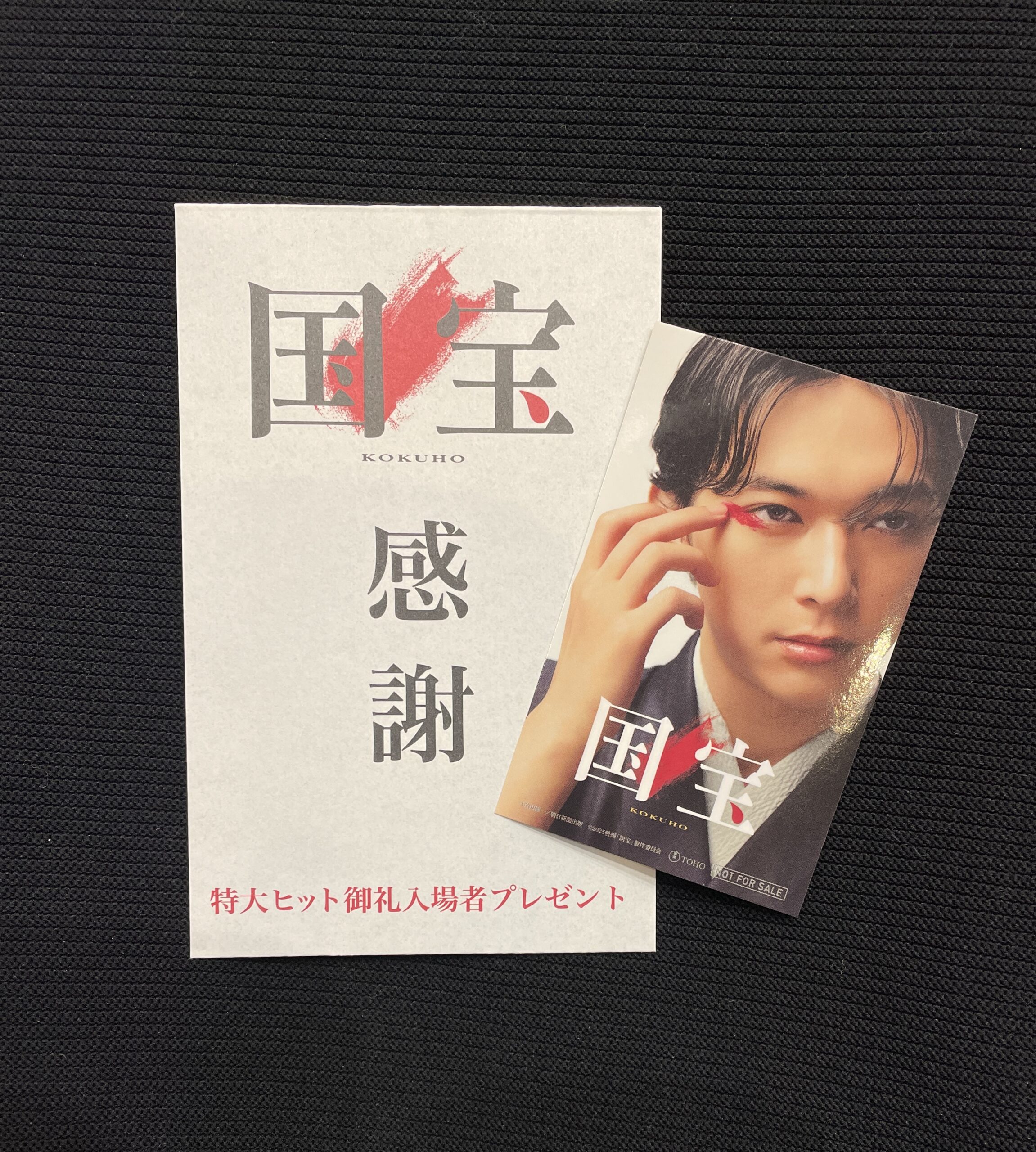
On the way in, I was handed a special gift for cinemagoers marking the film’s extraordinary hit run, printed with the word “kansha” — gratitude. A lovely way to close out the year.
Final thoughts
Part of me wants to see it again — but then I remember it’s three hours long, and my resolve wavers (laughs). And yet the urge to bathe in that music and those visuals one more time keeps quietly growing.
If you do go, my advice: a comfortable seat and a well-rested body. I can personally recommend the premium seat of pure persistence.